 Skip to content

| “Quick AI-Powered Insights on the Topic— Freshly Updated!” ChatGPT Perplexity Google AI Mode Claude |
Every summer, construction sites across the Middle East become some of the most dangerous workplaces on the planet — and the numbers prove it. A worker collapses on a Dubai high-rise. Another is rushed off a Riyadh highway project, unresponsive.
These are not rare accidents, they are the predictable consequence of inadequate heat stress management in construction at a time when temperatures routinely breach 48°C.
Although successful results from implementation of strict regulations such as midday work ban by Ministry of Human Resources and Emiratisation (MoHRE) in the UAE is seen, heat stress in Middle East construction continues to pose serious risks. The challenge lies not in the absence of safety frameworks, but in the lack of real-time visibility into how heat impacts workers on-site.
This is where AI-driven technologies are stepping in—transforming traditional approaches into intelligent, responsive systems that actively prevent heat-related incidents before they occur.
Understanding Heat Stress in Middle East Construction Environments
The intensity of heat stress monitoring in Middle East is driven by a combination of environmental and operational factors.
Ambient temperatures often exceed 45°C during peak months, but the actual heat experienced by workers is amplified by humidity, solar radiation, and heat-retaining construction materials such as steel and concrete. This creates microclimates within the site, where certain zones become significantly more hazardous than others.
Additionally, workers engaged in physically demanding tasks such as lifting, welding, or working at height experience faster dehydration and fatigue buildup. Long working hours further compound the risk.
In the UAE, for instance, regulatory authorities enforce midday work bans during summer months. However, even outside restricted hours, heat exposure remains high enough to impact worker health and performance.
This makes heat stress monitoring in Middle East not just a compliance activity, but a continuous operational requirement.
Why Traditional Heat Stress Management in Middle East Construction Falls Short
Conventional approaches to managing heat stress in Middle East Construction are largely compliance-driven. They rely on predefined rules such as provision for scheduled breaks, hydration protocols, and supervisor-led monitoring. While these measures are necessary, they often fall short in dynamic construction environments.
The reality is that heat exposure varies significantly across:
-
Different zones of the site
-
Types of activities being performed
-
Individual worker conditions
As per World Health Organisation, globally 2.4 billion workers are exposed to heat stress, leading to 22.85 million occupational injuries per year. As Middle East is one of the highly affected region, manual supervision cannot be used to track these variables in real time.
For example, on a large infrastructure project in Dubai, supervisors may enforce scheduled breaks, but may not detect that workers in a steel reinforcement zone are experiencing significantly higher heat exposure due to radiant heat from materials. By the time symptoms appear, productivity has already dropped, and risks have escalated.
This gap between policy and real-time execution is where traditional systems struggle.
From Compliance to Intelligence: AI in Heat Stress Management in Construction
AI in workplace safety introduces a fundamental shift in how heat stress is managed on construction sites. Instead of relying solely on fixed rules and manual observation, AI systems continuously collect, analyze, and interpret data from multiple sources.
-
Real-time detection of heat-related risks
-
Predictive identification of fatigue and dehydration
-
Automated interventions based on actual conditions
In essence, AI transforms heat stress management in construction from a static checklist-based approach into a dynamic, data-driven system.
For EHS leaders, this means moving from asking “Are we compliant?” to “Are our workers actually safe right now?”
AI-Integrated Heat Stress Monitoring System: How It Works in Middle East Construction Sites
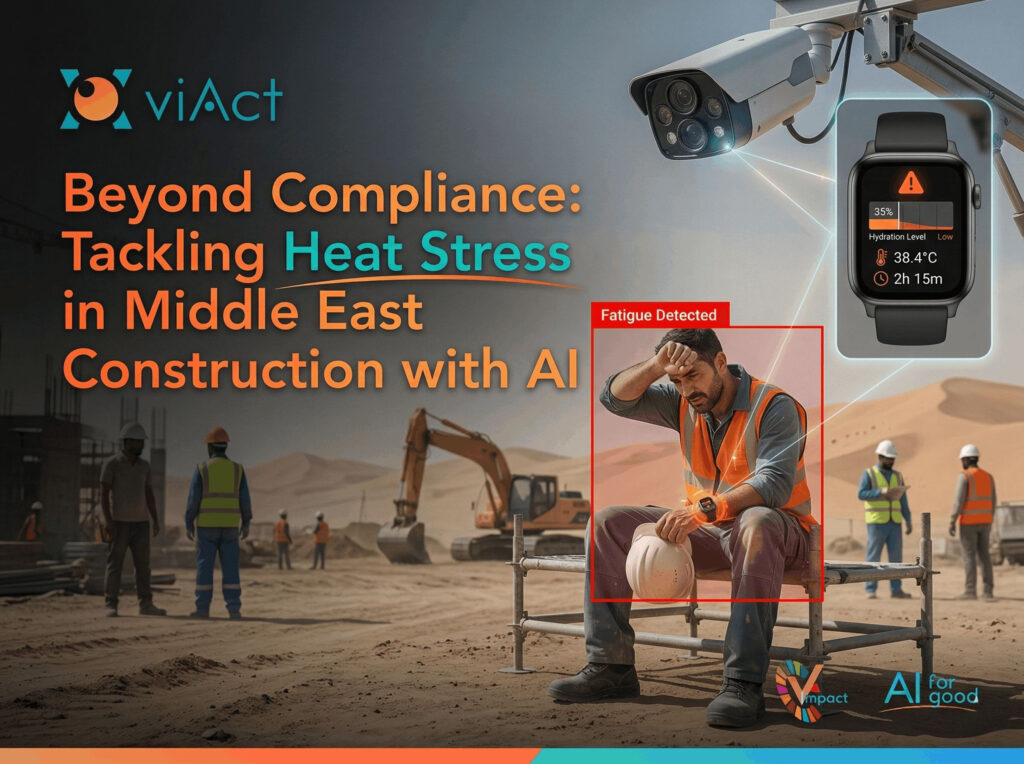
A modern heat stress monitoring system combines multiple technologies including IoT wearables like Smart Watch, AI video analytics, and environmental sensors, to create a comprehensive safety network across the site.
Here’s how each make their unique contribution:

Wearable devices such as smart watches play a critical role in capturing physiological data directly from workers.
-
Heart rate
-
Body temperature
-
Movement patterns
-
Fatigue indicators
This data provides real-time insight into how each worker is responding to heat conditions. Suppose, on a high-rise construction site in Abu Dhabi, workers performing facade installation are exposed to direct sunlight for extended periods. A smart watch detects a steady increase in heart rate combined with reduced movement efficiency—indicating early-stage fatigue.
An alert is triggered, prompting the supervisor to rotate the worker before the condition escalates into heat exhaustion and making heat stress monitoring in UAE construction projects fully automated.
While wearables provide individual-level data, video analytics adds a layer of behavioral intelligence for frontline workers by monitoring their movements and activities across the site.
AI models analyze video feeds to detect:
-
Slower or irregular movement patterns
-
Frequent pauses or micro-breaks
-
Unsafe postures linked to fatigue
-
Reduced responsiveness in high-risk zones
In a road construction project in Saudi Arabia, video analytics can identify a pattern where workers operating near asphalt paving equipment show repeated pauses and slower reaction times during afternoon hours.
The system flags this as a fatigue trend, enabling supervisors to adjust shift schedules and reduce exposure during peak heat periods.
AI systems also integrate environmental data such as temperature, humidity, and radiant heat to create dynamic heat maps of the construction site.
These heat maps highlight:
For instance, when on a large infrastructure project, the system identifies that an excavation zone surrounded by concrete barriers retains heat longer than other areas. Even during non-peak hours, this zone remains high-risk. Based on this insight, site managers implement additional cooling measures and limit continuous exposure time for workers.
The true value of AI lies in its ability to accumulate data from across the sites and evaluate and predict risk in a centrally visible platform.
Modern EHS dashboards combine physiological, behavioral, and environmental data to enable:
-
Forecast heat stress risk levels
-
Trigger hydration reminders
-
Recommend break schedules
-
Suggest workforce rotation
In a construction site, AI detects a combination of rising temperature, high worker exertion, and increasing fatigue indicators across a team. Instead of waiting for symptoms, the system proactively recommends a temporary halt and staggered breaks, preventing potential heatstroke incidents.
Measurable Impact: What AI-Driven Heat Stress Management Delivers
The implementation of AI-driven heat stress monitoring in Middle East construction projects introduces a measurable shift from qualitative safety oversight to quantified risk management and performance optimization.
At a system level, AI continuously aggregates physiological data (wearables), behavioral signals (video analytics), and environmental inputs (temperature, humidity, radiant heat) to generate real-time heat stress risk profiles across workers and zones.
This enables six key outcomes:
| Exposure Index (Duration × Intensity × Worker Condition) | Combines environmental heat, exposure time, and physiological data (heart rate, body temperature) | Reduction in cumulative heat exposure and lower probability of heat-related incidents | |
| Fatigue Index (behavioral + physiological signals) | Movement efficiency, pause frequency, heart rate variability, posture changes | Stabilized productivity curves and reduced fatigue-induced performance drops | |
| Continuous Compliance Score | Adherence to rest cycles, hydration intervals, and regulatory work-hour limits | Improved compliance consistency with automated, audit-ready records | |
| Heat Intensity Score (zone-wise) | Temperature, humidity, radiant heat, and activity density across site zones | Identification of high-risk zones and optimized workforce allocation | |
| Activity Deviation Metrics | Irregular movement, slowed response time, unsafe behavior under heat stress | Early detection of fatigue-related risks and proactive intervention | |
| Response Latency & Closure Rate | Time taken to act on alerts and implement corrective measures | Faster interventions and improved safety control efficiency | |
| Time-based and shift-based risk pattern analysis | Data-driven planning for shifts, breaks, and task scheduling |
Overall, AI-driven heat stress management transforms safety performance into a continuously measured system, where risk is quantified, interventions are optimized, and outcomes are directly linked to operational data rather than assumptions.
Real-World Success Story
A leading construction company in Saudi Arabia, operating large-scale infrastructure projects under extreme desert conditions, was facing persistent challenges in maintaining both safety and productivity compliance during prolonged outdoor shifts.
Despite established protocols, manual supervision struggled to identify early signs of heat stress among frontline workers—often reacting only after symptoms had escalated.
To address this gap, the company deployed viAct’s AI-powered video analytics module, integrated with IoT-enabled smart wearables for real-time physiological and behavioral monitoring.
Within just one year, the transformation was measurable:
-
63% reduction in on-site medical emergencies
-
4,800 lost work hours prevented
-
95% compliance rate achieved across heat safety protocols
By combining continuous monitoring with intelligent alerts, the system enabled proactive interventions—shifting heat stress management from reactive response to predictive, data-driven control.
Implementation Strategy for Middle East Construction Leaders
For organizations looking to adopt AI in heat stress management in construction, a phased and practical approach is essential.
-
Identify high-risk zones such as areas involving steelwork, roofing, excavation, or heavy machinery. These zones should be prioritized for initial deployment.
-
Finally, implementation should align with regional regulations, including UAE summer safety guidelines and broader GCC labor standards.
When executed correctly, AI becomes a natural extension of existing safety practices enhancing them without adding operational burden.
Conclusion: Key Takeaways
-
AI enables continuous monitoring at worker, zone, and site levels, improving visibility across operations
AI is redefining heat stress management in construction—transforming it into a predictive, real-time safety system that protects workers while enabling sustainable operations in the extreme conditions of the Middle East.
1. What is the typical cost of implementing a heat stress monitoring system?
Most providers, including viAct, offer customized pricing models based on project requirements with base price of 100USD/Camera/Month.
2. What kind of ROI can construction companies expect from heat stress monitoring?
-
Reduction in medical incidents
-
Fewer lost work hours
-
Improved workforce productivity
-
Stronger compliance scores
3. Is worker privacy a concern with AI-enhanced heat stress monitoring systems?
Modern systems are designed with data privacy and compliance in mind, focusing on safety metrics rather than personal surveillance, and adhering to data protection guidelines like GDPR. It includes features like face & body blur, anonymisation, and ghosting.
4. Is a platform like viAct available for heat stress monitoring in UAE construction projects?
Yes, viAct is actively deployed across Middle East regions including UAE, Qatar, Saudi Arabia, Kuwait, Oman etc supporting construction, oil & gas, and other industrial sectors.
5. Can viAct align with Middle East heat stress regulations and guidelines?
Yes, viAct solutions are designed to align with regional frameworks such as UAE Midday Break Rules, Saudi Arabia’s heat stress guidelines, and broader HSE compliance standards by automating monitoring, documentation, and reporting.
viAct is a leading Impact AI company focused on improving safety and efficiency in high-risk industries. Since 2016, we’ve implemented innovative “Scenario-based Vision Intelligence” solutions across hundreds of organizations. Recognized by Forbes and the World Economic Forum, we aim for a sustainable future through responsible technology.







