 Skip to content

People are expecting the built environment to last longer and perform better while also demanding the same strength, durability, and resilience, not to mention cost-effectiveness. One of the unsung heroes among the construction stakeholders are specifiers. They play a vital role in selecting the materials and methods that balance an endless litany of competing requirements.
Specifiers have rediscovered that blended cements such as Type IL are a ready-made off-the-shelf high-performance solution that meets the dual challenges of both structural requirements and environmental aspirations. These cements are readily available throughout the U.S.
The cement industry has always been a cornerstone of the U.S. economy and a partner to the various stakeholders along the construction value chain, innovating to meet market needs. As demands for more environmentally responsible materials have grown, the industry has had a part in meeting that need. In 2021, the American Cement Association (ACA) developed its Roadmap to Carbon Neutrality, outlining various levers to reduce emissions in the built environment. Blended cements are among the imperatives.
Blended cements represent just one part of the cement industry’s ongoing commitment to add value throughout the construction value chain. They represent an innovative set of product solutions that were highlighted in ACA’s Roadmap to Carbon Neutrality. The association’s engagement with each link of the value chain identified other solutions that specifiers can implement.
Blended cements and their benefits
Blended cements use precise additions of limestone and other materials to lessen the energy impacts from more traditional cements. Those additions include limestone and calcined clay, as well as industrial by-products such as steel slag or harvested fly ash. All additions must be carefully controlled, meeting strict physical and chemical requirements and demonstrating their performance in concrete mixtures.
In addition to sustainability benefits, blended cements offer:
- Greater flexibility—Blended cements provide the flexibility to tailor concrete mixes to specific performance criteria, enabling specifiers to optimize designs based on a project’s unique needs. This customization also extends to aesthetics. For instance, trial batches can be used to refine the color and finish of the concrete, ensuring they align with the project’s visual and functional requirements.
- Meeting emerging regulations—There is growing demand for lower-carbon building materials. States and cities are passing ‘green procurement’ regulations, and many companies have decarbonization goals. Blended cements will help fulfill these needs.
- Proven capabilities—Blended cements have undergone extensive testing and research in the U.S. and other countries to ensure durability and resiliency. Researchers have studied fresh properties related to placing and finishing, as well as hardened properties that relate to durability. Blended cements can provide the same proven performance as traditional cements.

Planning and working with blended cements
A transition from traditional cements to blended cements requires planning and attention to detail. It is far more than just swapping out one material from another or changing over a concrete mixture in the space of one day. And that is true for any new product considered for a concrete mixture. That means everyone involved in the construction project communicates early and often and on an ongoing basis. The entire project team should know not just the required strength, durability, and sustainability performance requirements, but just as importantly, the reasons behind each of those requirements. The team must also be prepared to meet each of those targets. This only works when everyone embraces a team approach, and that is true for any switch in material.
A baker would not switch from whole wheat flour to oat flour without first getting a comfort level with how oat flour impacts the baking time and oven temperatures required, or how the oat flour works or does not work with the other ingredients. And it is the same when a project team switches from traditional cement to blended cement in a concrete mixture. Everyone on the project team needs a comfort level, and that means everyone from the cement producer to the general contractor to the concrete provider to the concrete contractor, all the way down the value chain to the workers pumping, placing, and finishing the concrete. That early engagement is an assurance of guaranteed success.
When specifying blended cements, it is important to consider the following and the implications to the full team:
- Work with the cement supplier to use performance-based specifications instead of falling back on prescriptive cement types that may not give them the flexibility they need.
- Use trial batches and mock-ups to match performance with expectations, including project schedule and project budget expectations.
- Communicate with suppliers from the very start to understand regional material differences and be aware of local material availability, challenges in transportation, and how local climate or materials may impact mix performance.
- Ensure certified field-testing technicians are monitoring slump and air content since higher fineness can affect these properties and may impact admixture dosages.
- Consider the effects of temperature on set time and strength development. Remind contractors to watch out for lower bleed rates and avoid finishing too early, which can trap water and cause surface issues.
- Using test sections or mock-ups to better understand timing is always encouraged.
Type IL cement has a proven track record of reliability, durability, and flexibility in a range of projects from buildings and pavements to bridges and other infrastructure. Thanks to extensive research and thorough testing, all 50 State Departments of Transportation (DOT) accept the use of blended cements in new infrastructure, and many are using Type IL cement.
Versatility throughout a structure
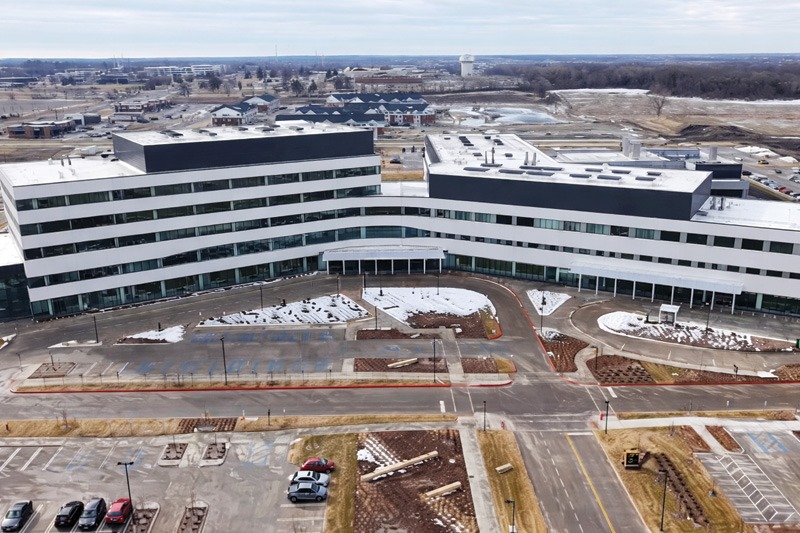
Faced with the need for more bed space to serve the community of North Liberty, Iowa, the University of Iowa Hospitals opted for a concrete building for occupant safety and the overall long-term benefits of concrete durability. As an inert substance, concrete does not off-gas harmful chemicals, and its extremely high stiffness can reduce vibrations in buildings, which can be beneficial where sensitive medical equipment operates.
For this project, the team used 22,937 m³ (30,000 yd3) of concrete products made with Type IL. Concrete was used in cast-in-place, precast and post-tensioned products ranging from foundations to floor slabs, columns and walls, and even the parking lot. The team collaborated closely and, as a result, built the six-story, 43,555 m² (469,000-sf) hospital on a 24-month schedule. The result was a facility that not only met the highest standards for strength and durability but also delivered a meaningful reduction in carbon emissions. This project stands as a testament to what is possible when sustainability is embedded in the design process from day one.
Meeting strength and aesthetic requirements
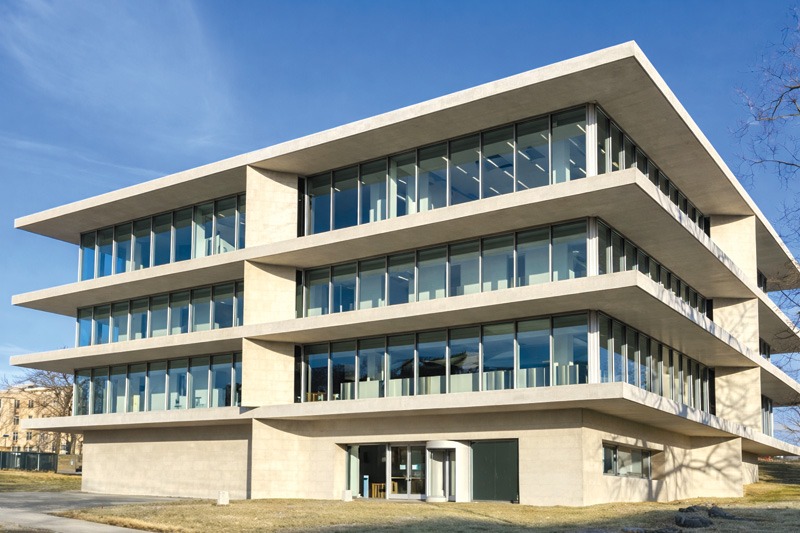
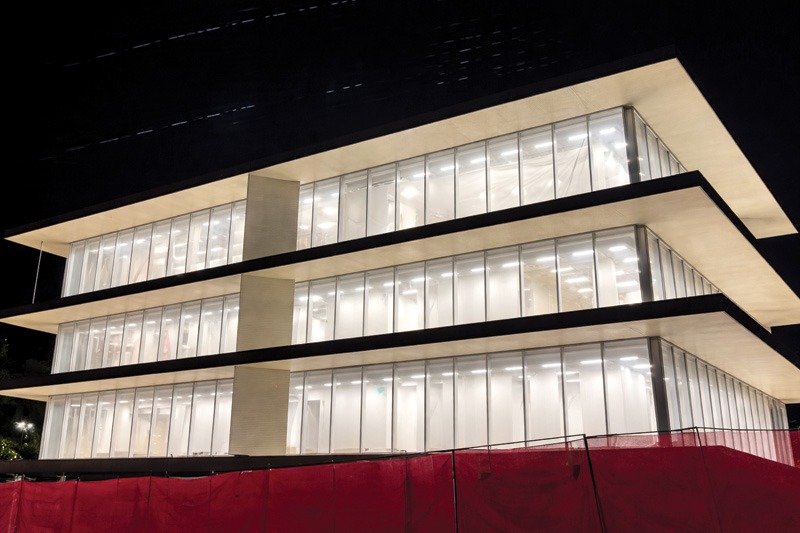
The Indiana University Ferguson International Center project required white concrete to coordinate with the campus’s historic tan and gray limestone buildings, many of which date back to the original 1820s campus construction. Initially, the plan was to use white cement with imported materials for the four-level post-tension deck, which required architectural concrete on the outer perimeters and vertical elements.
However, the project team decided to switch to Type IL because it could achieve the needed color, durability, and strength while being more budget-friendly. The university was also looking for locally produced, more sustainable materials.
To match the color of the surrounding buildings, the team completed 29 trial batches, making subtle adjustments each time. The extensive trials paid off, achieving a color match that met the university’s stringent requirements.
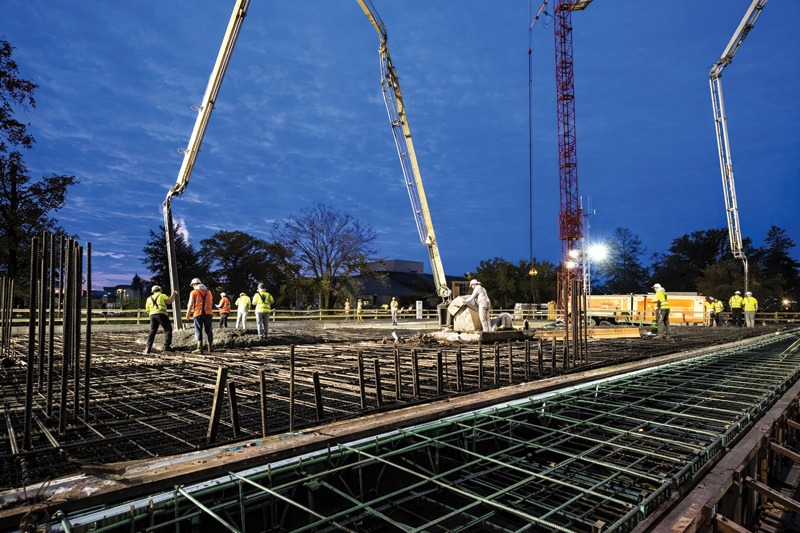
Another unique aspect of this project was the post-tension deck, which used two different mixes simultaneously. The project required different PSI levels for various components, including a 41,369 kPa (6,000 psi) post-tension deck concrete and 27,579 kPa (4,000 psi) for architectural walls. To achieve the 41,369 kPa (6,000 psi), the team chose a 34,474 kPa (5,000 psi) design using slag and strength-enhancing admixtures. Two different pumps were used to pour two different mix designs in the post-tensioned concrete deck. The greater mass of the center section was the 41,369 kPa (6,000 psi) non-air-entrained ash mix, using an F ash. With the cantilever section, there was a 1.83–2.44 m (6–8 ft) section around the outside rim, which used a 34,474 kPa (5,000 psi) slag mix, air-entrained.
The limestone percentage across this project was approximately 11 percent. The careful blend ensured that the project met structural and aesthetic requirements, while providing substantial sustainability benefits. The team used several smaller mockups and stayed attentive to detail throughout the process, enabling them to move forward with confidence it would meet required standards and aesthetic requirements.
Paving the way to more resilient infrastructure
Thanks to extensive research and thorough testing, all 50 State DOT accept the use of blended cements in new infrastructure, and many are using Type IL cement. In Tennessee, where the local DOT looks to reduce the environmental impact of new projects, Type IL was selected for bridge deck repairs along a critical automotive corridor in the Southeastern U.S.
Working closely with their cement suppliers, ready mix concrete producers began testing mixes for compressive strength, setting time, air content, slump, and bleed potential. They used a mixture containing 9,932 kg/m³ (620 lb/ft3) of Type IL with a 25 percent fly ash replacement. The fly ash provided better consistency for the mix. After running some 450 trial batches, producers were confident in the compressive strength results of 27,579 kPa (4,000 psi) at 28 days, noting little to no difference between the Type IL mixes and their typical Type I/II mixes. Ready mix employees commented that it was easy to make the change.
With this information in hand, the ready-mix producer approached TDOT about using Type IL concrete for its bridge decks. TDOT agreed to use the Type IL/fly ash mixes. As a result of the 1:1 replacement level for traditional Portland cement and the additional 25 percent fly ash content, TDOT was able to use Type IL to reduce the carbon footprint for several bridge decks while producing concrete with the
required properties.
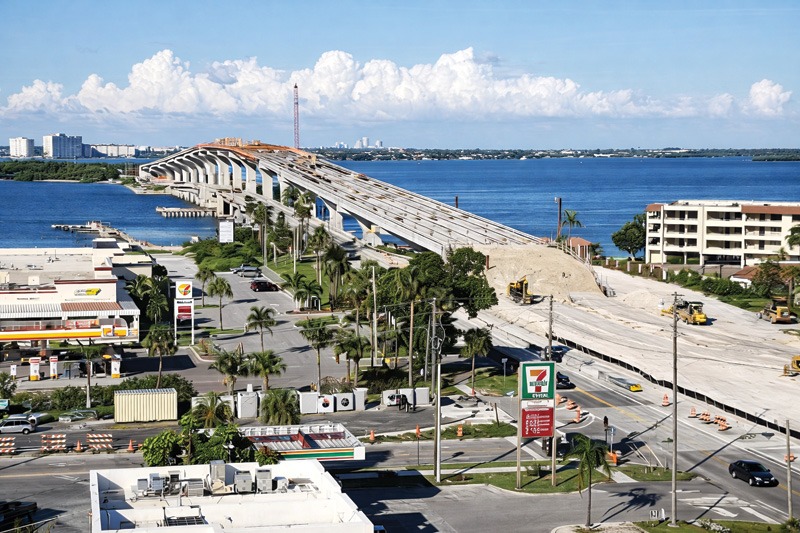
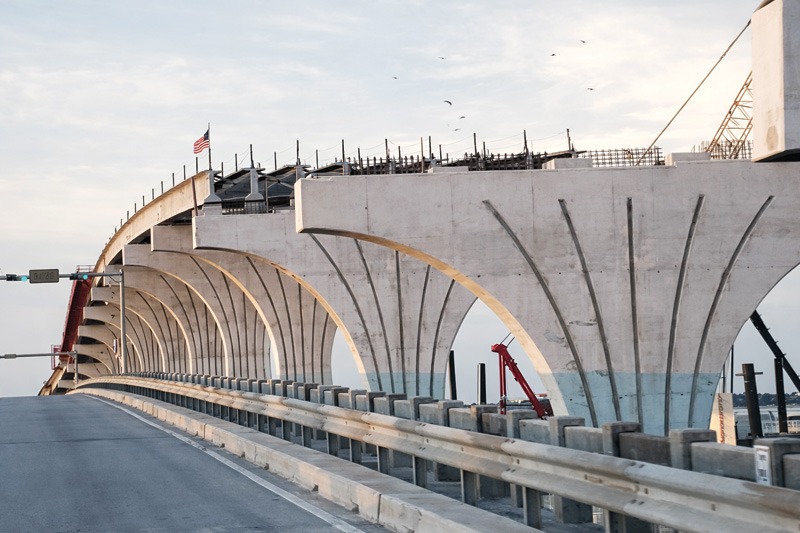
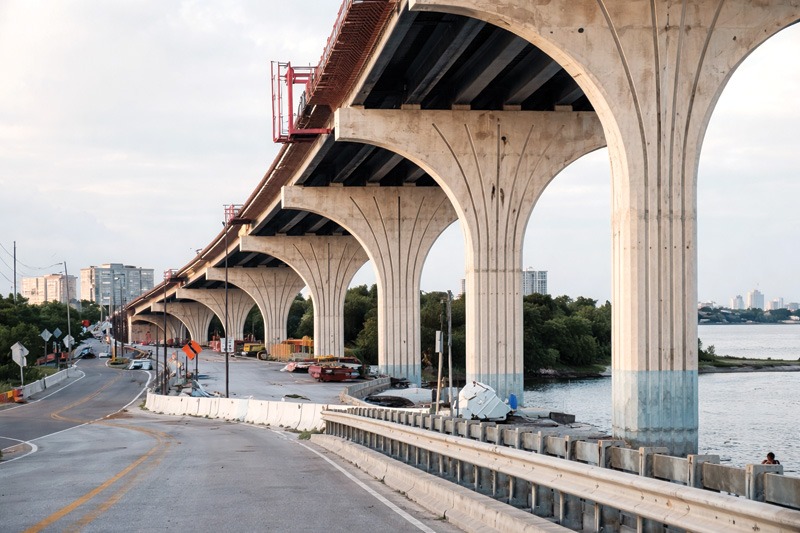
Maintaining bridges is critical everywhere, but in Florida, a state heavily dependent on tourism, bridges are especially important for access to the 1,066 km (663 miles) of beaches and small islands along Florida’s 2,173 km (1,350 miles) coastline. In Pinellas County Florida, south of St. Petersburg, the island of Tierra Verde and its renowned beaches are accessed via SR 679, Bayway Bridge-Structure E. In 2018, the Florida Department of Transportation (FDOT) began a $56.8-million design-build project to replace the 60-year-old bascule bridge with a high-level, fixed bridge to reduce congestion and minimize delays related to boat traffic; repave the existing SR 679 roadway between SR 682 and the new bridge; and replace a seawall south of the bridge along SR 679 in Pinellas County.
These structures are all exposed to a marine environment. Although such exposures are aggressive to reinforced concrete because chlorides corrode steel, encasing metal reinforcement in concrete protects it from salt and corrosion. Sensing an opportunity to promote sustainable and performance aspects of concrete, the ready-mix concrete supplier provided submittals for Type IL mixes to the contractor, American Bridge Company. FDOT already encourages the use of Type IL in all their projects. As a result, Type IL was used for much of the 13,520 m³ (17,704 yd3) of concrete, excluding precast elements.
Building a better future
Traditional Portland cement has been in use for nearly two centuries. Blended cements present an exciting and critical shift in the construction industry, driven by the urgent need to reduce carbon emissions while still meeting durability and resiliency requirements. While blended cements accounted for only three percent of U.S. cement consumption in 2020, they surpassed 50 percent by 2024, reflecting growing confidence among producers, contractors, and architects in their performance.
Through the ACA, construction stakeholders have access to technical resources, workshops, and direct support to help project teams navigate the transition to blended cements, validate performance, and optimize every product for both sustainability and strength.
Author

Rick Bohan, senior vice president of cement for the American Cement Association (ACA), has been at the forefront of research and technology throughout his career as a licensed professional engineer. As ACA’s lead on the development and now the implementation of its Roadmap to Carbon Neutrality, Bohan is passionate about engaging the industry as the solution to society’s grand challenge of global warming.
Key Takeaways
Blended cements such as Type IL offer durable, resilient, and sustainable concrete solutions. They meet strength and aesthetic requirements, reduce carbon footprint, and are proven across buildings, bridges, and infrastructure nationwide.







