Skip to content

Few building materials possess the profound ability to inspire a sense of reverence and evoke feelings the way that wood can. Timber has been written into the narrative of human experience, cultural heritage, and architectural innovation. As such, it naturally creates a bridge to both past and future.
Since the dawn of humanity and the earliest days of religious worship, there has been a deep connection to trees. Many cultures believe that trees are spirits themselves. As early as the 4th century BC, druids in Europe were known to worship in oak groves, which they considered sacred.
In ancestry and among some people today, trees are a powerful manifestation of the earth itself, but also serve a very real and practical purpose as a source of wood, an ancient building material still widely used. In recent years, wood has risen to the forefront of building material innovation as architects and developers have begun to harness its potential as a carbon-neutral, 21st-century structural material. But while timber is beginning to serve as the backbone of today’s high-rises and other commercial facilities, it is still avidly used in one of its earliest applications—spiritual spaces.
Wood for worship
Timber is a storyteller. It has life and carries centuries of architectural tradition. In spiritual spaces and buildings designed for worship, timber frames can do more than provide shelter. Wood creates an atmosphere of reverence and warmth, connecting contemporary congregations with the spiritual past.
“Wood in a religious setting is a reminder of nature, and the visible contributions of human harvesting and work,” says Richard Dattner FAIA, principal at Dattner Architects, and a designer of worship spaces that uses timber.
Perhaps the most iconic example of the physical and spiritual power of timber can be found in the hammer beam trusses of London’s Westminster Abbey. Commissioned in 1393 by King Richard II and measuring 21 x 73 m (68 x 240 ft), it is the largest medieval timber roof in Northern Europe.
This masterpiece of design continues to captivate worshippers and visitors alike. To an observer, the centuries-old, seemingly impossible cantilevered design creates a sense of strength, durability, and wonder. The awe produced by this blend of spirit, nature, strength, and permanence is what designers of worship spaces today seek to emulate. Many recent projects demonstrate how architects are reimagining timber’s role in spiritual architecture.
Timeless and modern
While wood is an ancient building material, that does not mean it is not innovative. Today’s engineered wood products provide greater degrees of performance and flexibility to designers while still embodying the elements that make timber such a timeless material. For example, glue-laminated timber, or glulam, is a structural product constituted by layers of dimensional lumber bonded with durable, moisture-resistant structural adhesives. These materials are available to today’s designers and builders of worship spaces.
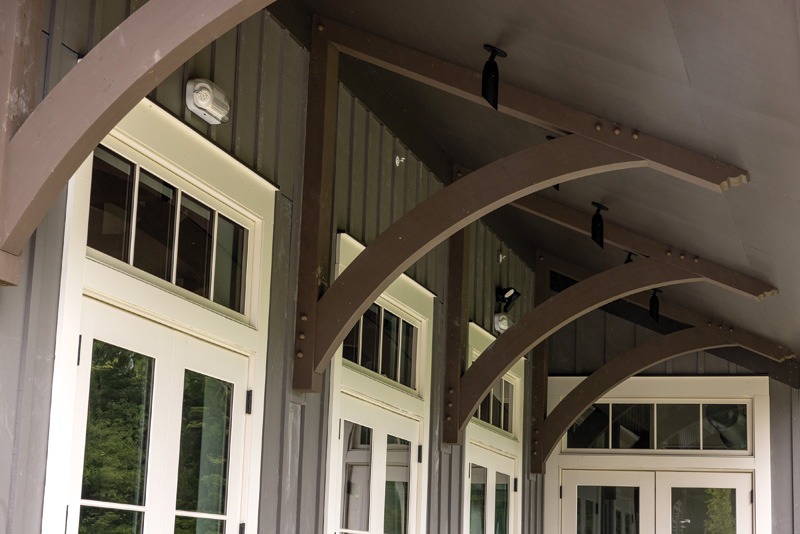
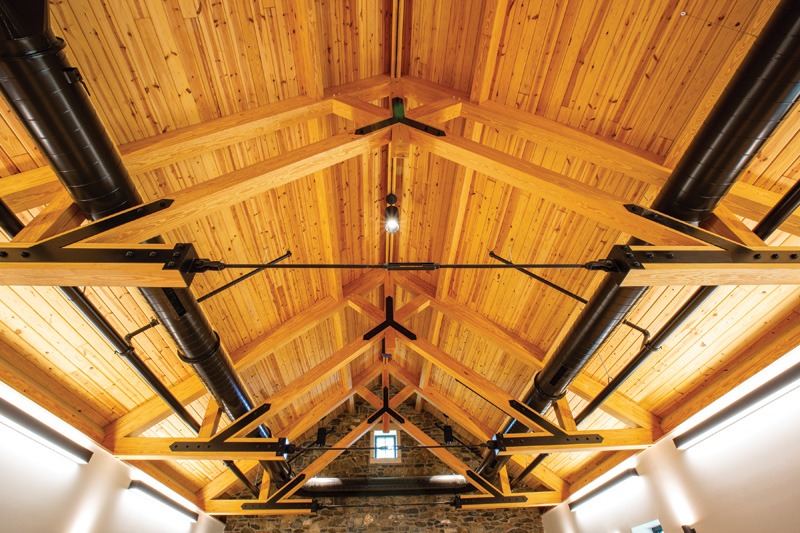
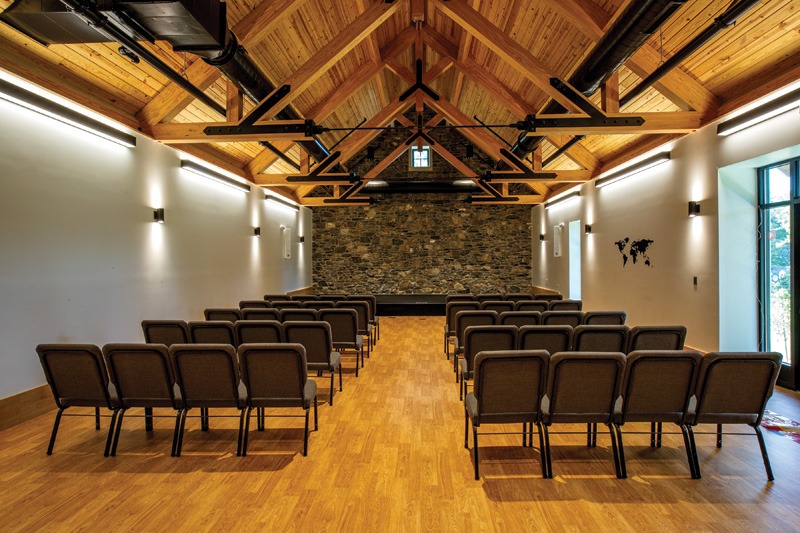
Trinity Community Church in Hockessin, Del., showcases a modern approach to timber design using glulam trusses in southern yellow pine with a natural clear finish. It features expressed steel connections and tension-rod joinery in a matte black powder-coat finish.
With a span of 12 x 20 m (40 x 65 ft), the lobby incorporates 161 pieces of timber totaling 22.45 m³ (9,515 board ft). Outside, 35 timber brackets supporting exterior overhangs express the timber beneath the eaves. The scale of the project highlights the intentional celebration of timber in design.
Spiritual sustainability
Beyond aesthetic and structural considerations, sustainability has come to the fore when considering timber’s role in spiritual spaces. In an era of growing environmental consciousness, wood embodies a connection to the planet and a commitment to responsible stewardship.
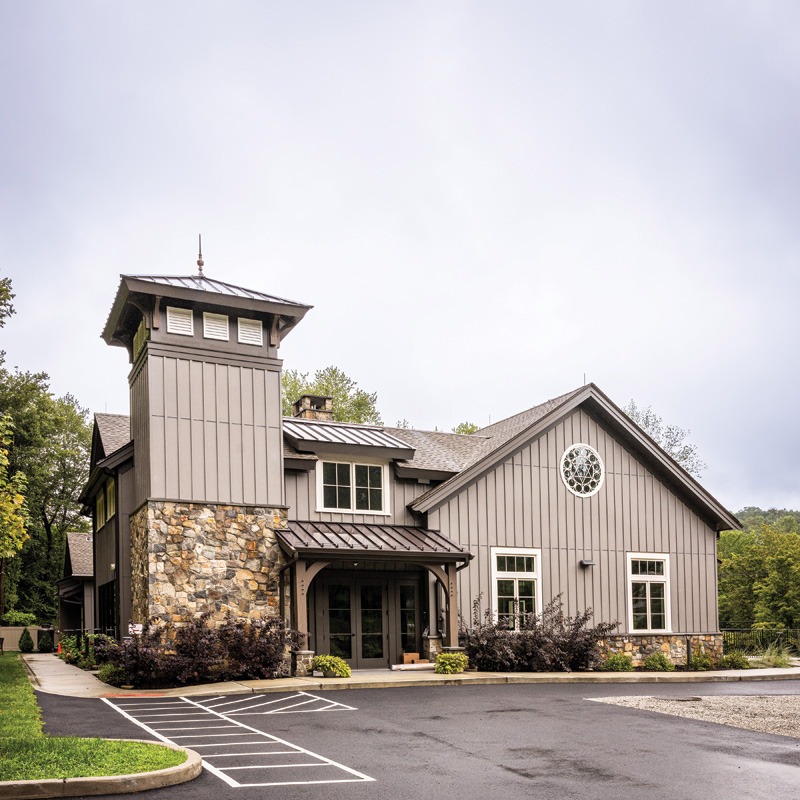
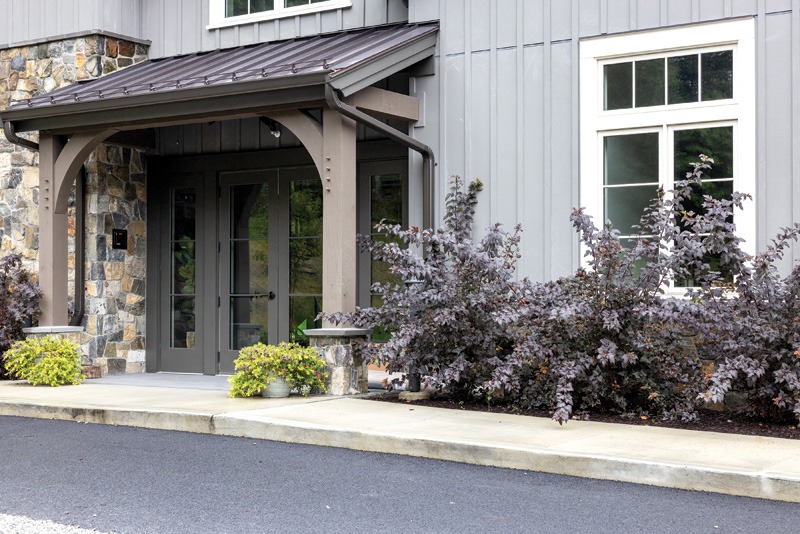
The Chabad of Bedford illustrates this concept. By strategically combining Douglas fir glulam and solid timber, the design team was able to minimize material use while maximizing structural efficiency. The project incorporated structural insulated panels with an impressive R–40 insulation value to provide superior energy efficiency and performance to the building.
Timber framing has a lower embodied carbon footprint than steel or concrete.1 This advantage stems from timber’s natural carbon sequestration process: trees absorb carbon dioxide as they grow, storing it within their fibers even after harvesting. Timber production also requires less energy-intensive processing than steel or concrete manufacturing. The renewability of timber, coupled with responsible forestry practices and efficient construction techniques, further contributes to its reduced environmental impact.
Mark Hughes, professor of Wood Material Technology at Aalto University in Finland, notes in the book, Rethinking Wood: Future Dimensions of Timber Assembly,2 that building construction accounts for between 30 and 50 percent of material usage, while construction and demolition waste accounted for 32 percent of total waste in the EU 27 in 2012.
“Timber is arguably our most important green construction material,” said Hughes, “it is abundant, renewable, possesses good technical characteristics, and can be converted into a host of different ‘engineered’ wood products with relatively minor inputs of energy and other materials.”4
Further, timber framing is a champion of waste reduction and recycling, embodying the principles of a circular economy. First, there is very little waste generated in highly efficient production processes. Artisans working in controlled plant conditions can cut all pieces to necessary lengths with great precision, making the most effective and complete use of the materials. Secondly, offcuts and byproducts are carefully repurposed or recycled, reducing the burden on landfills. This sustainable approach aligns with responsible forest management practices, in which harvested trees are use efficiently, leaving very little waste.
Additionally, less work on the jobsite means less air pollution, dust, and noise in areas near other buildings and communities. This is good for the general environment, as well as for neighbors who are not eager to be near dirty, noisy, and long-lasting construction projects.
Form and function
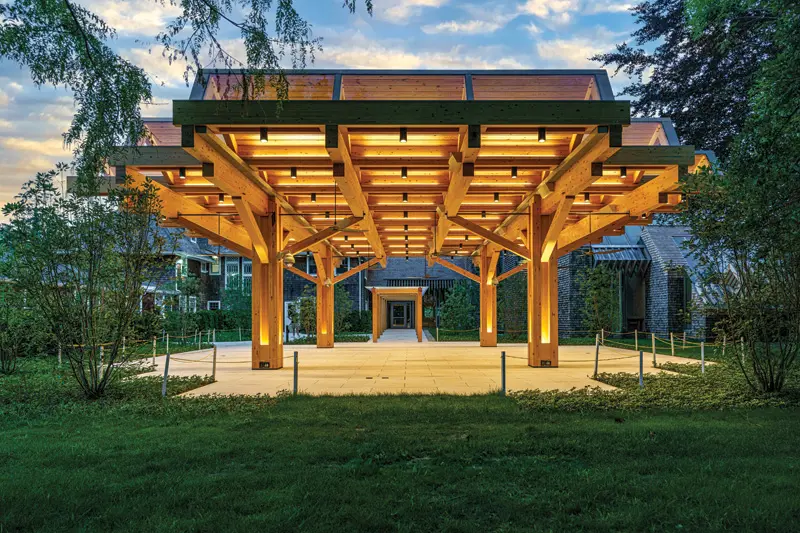
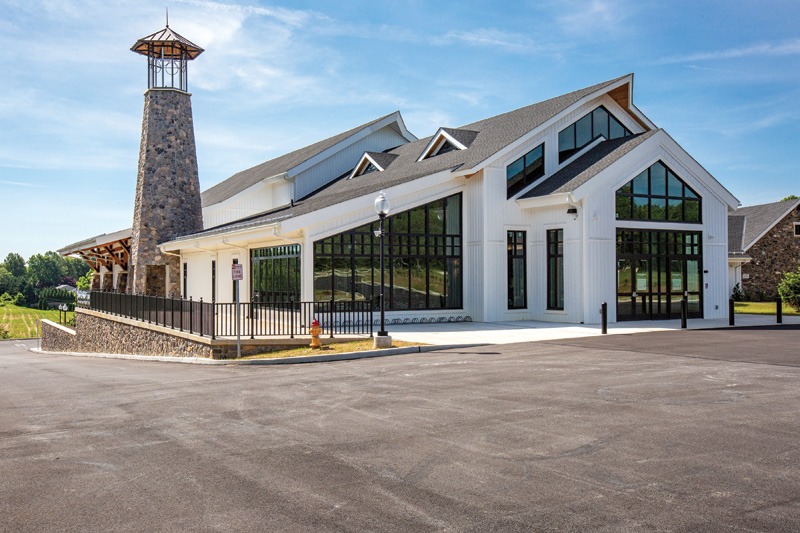
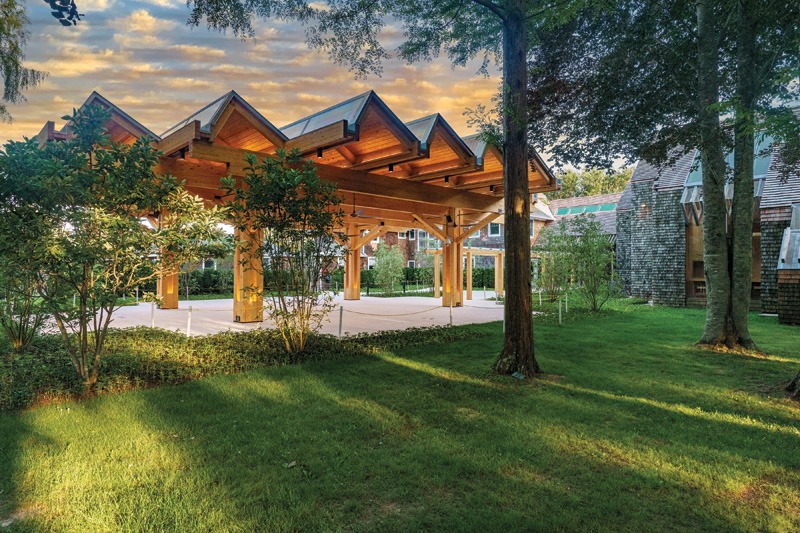
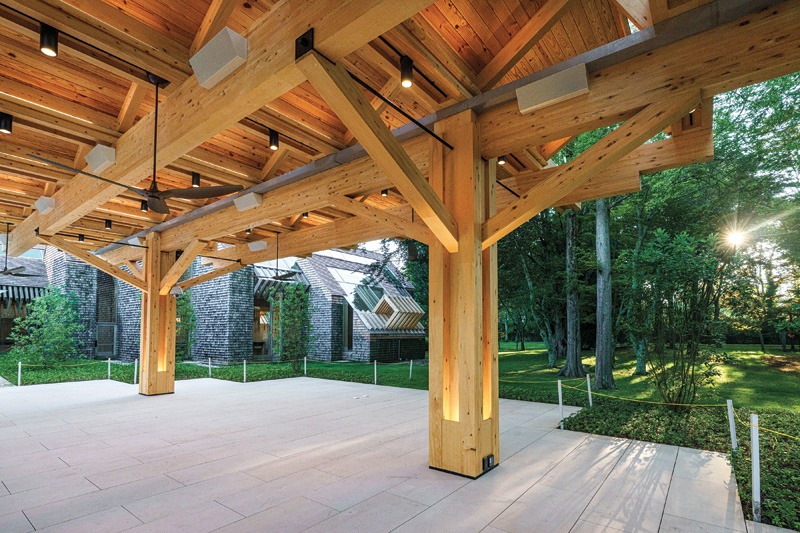
Part of the enduring appeal of wood is its flexibility and utility. As technology and techniques improve, that element continues to grow. At the Jewish Center of the Hamptons in New York, a new pavilion represents an example of a modern approach to designing with mass timber. In this project, the material transcends its traditional structural role and steps into an integral part of the building’s water management system. Alaskan yellow cedar glulam was selected for its durability in a coastal environment, with carefully designed channels that collect and redirect water through the structural elements.
The pavilion’s design mimics natural forms, creating a profound connection between the built environment and the landscape. Skylights, sawtooth roof profiles, and meticulously planned water drainage systems transform timber from a mere construction material into a holistic architectural element. Dattner Architects took care to optimize the materials they utilized on the project.
“This dramatic, timber-framed pavilion is set in a landscaped grove adjoining a historic, mid-century place of worship,” Dattner explains. “The Alaskan Yellow Cedar matches the interior of the sanctuary, as do the angled, north-facing skylights. The 3,500 sf [325 m²] pavilion roof is supported on four ‘cluster’ columns—each consisting of four joined vertical members. The roofing is zinc-coated copper, and the unique ‘H’ shaped beams also serve as gutters collecting rainwater to pipes down the four columns.”
For those who worship inside the sanctuary, the innovative design and material applications have provided spiritual and practical benefits, including sound management.
“The cantor has spoken about the amazing acoustics of the Sanctuary,” explains David Waserstein, director of operations for the facility. “While I’m sure a lot of that comes from the geometry of the space, some of it comes from the resonance of the wood itself. It’s not entirely dissimilar from the use of woods in opera houses and concert halls.”
Uninterrupted service
From the building occupant and use perspective, houses of worship are unique in that they operate year-round, often holding services on the holidays when other building types are closed. Some religions hold daily prayer, and all the business of the gathered body happens throughout the week. To this end, anything the project team can do to accelerate the renovation process helps minimize interruptions to the building’s operations and order.
By its nature, off-site timber construction can significantly enhance a project’s overall efficiency. Offsite components can be manufactured while foundations are being poured and are ready to receive them. Monitored manufacturing settings equipped with precise fabrication tools, automated processes, and standardized workflows deliver quality control and consistency levels that surpass anything possible on a construction site. Additionally, off-site construction means a more consistent work crew and a more controlled workflow that is less prone to disruption.
When components are built in a climate-controlled factory, it virtually eliminates the risk of weather-related delays. When it comes to scheduling, off-site production facilities are also more reliable, making timelines and costs more predictable. And in factory construction, workers can become specialized experts in their craft, leading to higher-quality products.
In the new construction of a spiritual space, there is also the emotional payoff for the building occupants when a construction project comes to a resolution.
“Other than a family waiting for the key to their new house, no other type of construction project has people more excited for the grand opening than a church body,” says Rev. Chris Eden, pastor at Otterbein United Methodist Church, Lancaster, Pa. “They have invested time and resources into fundraising, held countless planning meetings, have talked about it at every service, and they can’t wait to invite friends and family to see the new space.”
Taking much of the work off the job site makes for a tidier environment, generating less waste and debris on the site. There are also advantages on the job site itself. With less construction happening onsite, even tight or remote sites become easier to work with.
“In urban areas, space is at a premium,” says Mike Banta, general manager with Mid-Atlantic Timberframes. “Storing construction materials and equipment on-site during the building process is not ideal, and maybe not even possible. Builders can save space by having heavy timber components built in a factory and scheduled for precise, on-time delivery to the site.”
Inspiring awe
Architects consistently emphasize timber’s ability to inspire. In spiritual spaces, the elements are not hidden but celebrated. Exposed trusses, visible connections, and thoughtful detailing invite congregants to appreciate the structure’s inherent beauty as they gaze upward. Whether in historic cathedrals or modern spiritual centers, these designs continue to captivate and delight the eye.
Wooden structures inspire awe and reverence. Nobody is putting timber in a church and then covering it up. The timber connects to the past and anchors the space. There is a durability and reassurance in using timber as a building material in a spiritual space.
Looking to the future of spiritual architecture, timber continues to offer a unique promise. It bridges historical tradition with contemporary design, provides sustainable solutions, and creates spaces that inspire spiritual reflection. Modern timber-frame design requires collaboration, and successful projects demand precise coordination among architects, builders, and timber suppliers. Every detail matters.
Timber is often chosen for worship spaces, not just for its structural capabilities, but for its ability to tell a story. Each beam, each truss carries with it a narrative of responsible harvesting, skilled craftsmanship, and architectural innovation. Wood in spiritual spaces is a philosophical statement as much as it is a design choice. The material speaks to humanity’s connection with nature, its respect for craftsmanship, and the desire to create spaces that transcend the everyday. Mass timber combines traditional craftsmanship with contemporary sustainable design, creating spaces that are both spiritually evocative and environmentally responsible.
Notes
2 See Rethinking Wood: Future Dimensions of Timber Assembly.
Author

Mike Banta is general manager at Mid-Atlantic Timberframes. From a young age, he was fascinated by the exposed structural elements
of timber framing and admired the longevity and character of the timbers. For more than 20 years, he has been designing timber frame structures and has advanced expertise in glue-laminated timber (GLT), cross-laminated timber (CLT), timber and steel hybrid systems, and other structural components, including structural steel and reclaimed and recycled timber. He is also well-versed in sustainable design, 3D modeling and detailing, CNC programming, prototyping, and quality control.
Key Takeaways
Timber continues to shape spiritual architecture by uniting tradition, modern engineering, and sustainability. From historic cathedrals to contemporary mass-timber sanctuaries, wood offers structural performance, low embodied carbon, and powerful emotional resonance. Off-site fabrication improves construction efficiency, while exposed timber frames enhance acoustics, durability, and the sense of reverence central to worship spaces.