
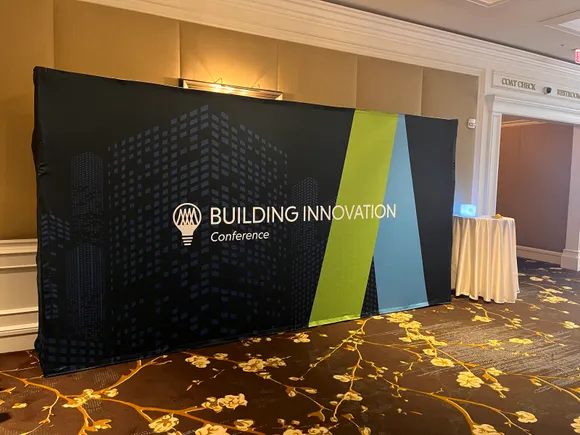

McLEAN, Va. — Digital tools are making more of an impact for construction officials, particularly on permitting systems and inspections, speakers said during the 2026 Building Innovation conference, an annual construction industry gathering, held May 19-20.
Discussions during the event, hosted by the National Institute of Building Sciences, centered around data and connected systems, along with their rising importance. One of the clearest examples came from Washington, D.C.’s Department of Buildings, where officials described several recent efforts to shorten permitting timelines and reduce review bottlenecks.
For example, the department has consolidated portions of its building permit and certificate-of-occupancy process into a single workflow, said Nicole Rogers, chief building official for D.C.’s DOB.
“This streamlined the process by consolidating the two, so that the review and inspection could take place in less than 15 business days,” said Rogers. “Traditionally, the process maintained more than 60 days.”
Rogers added the city also created instant permits for small repairs and solar installations. That allowed homeowners to obtain approvals in less than two minutes, she said.
Those types of speedy permitting systems could significantly improve construction and review timelines, said Joan O’Neil, chief knowledge officer at the International Code Council.
“Modernized building departments with technology and solutions can increase permit issuance by 80%,” said O’Neil. “We know that technology can streamline permitting, and we also know that this is the biggest bottleneck that we hear in terms of slowing construction.”
Artificial intelligence in construction
The conference also focused on how visual artificial intelligence and digital inspection technologies allowed officials to remotely review jobsites and identify potential issues before stepping on the site.
For example, Stephen DeVito, director of technology at Procon, a McLean, Virginia-based construction management and technology firm, described a project with the General Services Administration where inspectors virtually walked a building before arriving onsite using continuously captured visual records and spatial modeling tools.
“[The inspector] said he knew the building so well that when he got there, he ended up being able to do two floors per day” versus taking two days per floor previously, said DeVito. “That’s just the beginning of what this technology can do.”
These kinds of tools give officials and inspection teams more context and visibility into ongoing work, said DeVito.
“The ability to map what the actual evidence is at a given point in time, that is going to help with inspections the most,” said DeVito. “We have over 100 inspectors in our firm, and they have adopted this technology rapidly.”
AI surfaced repeatedly throughout the conference, though several examples focused more on simulations and potential rather than fully deployed field systems.
A team at contech giant Procore, for example, trained an AI system using thousands of pages from NIBS’ Whole Building Design Guide, said Blake Shiver, general manager for Procore’s public sector. The team then prompted the tool to generate a detailed disaster response and reconstruction strategy for a hypothetical hurricane scenario involving displaced residents and damaged petroleum infrastructure.
“We’re able to take something that might have taken months to sequentialize with old technology and get it down to minutes,” said Shiver. “That’s going to save lives.”
Shiver also said AI could help preserve institutional knowledge as experienced workers retire from the industry.
“It effectively took decades and generations of wisdom and allowed me to apply it in context in minutes,” said Shiver. “We never had that capability before.”
Nevertheless, the AI systems still require guardrails, such as human oversight and continuous feedback loops, said Colin Whitlatch, chief technology officer at Kahua, an Alpharetta, Georgia-based construction management software provider. He added there are not any automatic decisions being made at the firm.
“We operate off of something ‘called human in the loop,’” said Whitlatch. “Because one thing is AI, with limited exception, never says, ‘no.’”
AI implementation can also bring on additional administrative burdens, said David Jackson, a consultant and founder of the Code Advisory Group, who works with tribal nations on code adoption and inspections. With AI tools, Jackson described situations where inspectors had to complete both handwritten inspection forms and digital documents simultaneously.
“I still have to leave a carbon copy. I still have to leave written documentation on the jobsite,” said Jackson. “So, it’s almost a duplication of my workload to manually fill out 100 plus inspection tickets, leave them physically on the jobsite, come back into the computer, load my notes verbatim.”






