
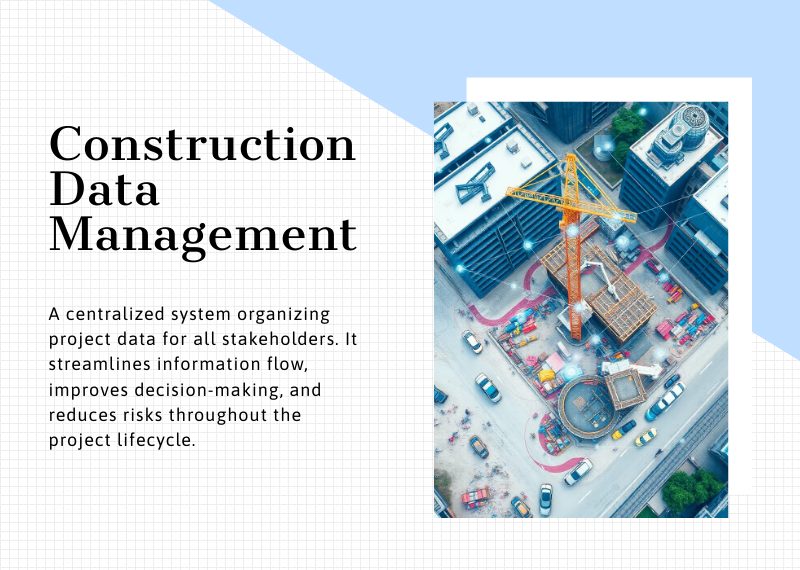

WHAT DEFINES A DATA MANAGEMENT SYSTEM IN CONSTRUCTION PROJECTS
A data management system in construction is a centralized framework that captures, organizes, governs, and distributes project information across all stakeholders. It replaces fragmented data flows with structured, accessible, and controlled information environments that support decision-making throughout the project lifecycle.
Construction projects generate high volumes of heterogeneous data—drawings, RFIs, schedules, cost reports, field logs, compliance documents, and sensor inputs. Without a unified system, this data becomes siloed, inconsistent, and operationally risky.
At its core, a construction data management system performs three critical functions:
- Standardizes how data is created and stored
- Controls access and versioning across teams
- Enables real-time visibility into project conditions
The system is not defined by software alone. It includes governance rules, workflows, naming conventions, and integration logic that ensure data is usable at scale.
WHY CENTRALIZED DATA CONTROL DETERMINES PROJECT OUTCOMES
Centralized data control directly improves project predictability by eliminating conflicting information sources. When multiple teams operate from different datasets, discrepancies compound into delays, cost overruns, and compliance exposure.
In construction, even minor inconsistencies—such as outdated drawings or misaligned cost data—can trigger downstream impacts across procurement, scheduling, and field execution. Centralization resolves this by enforcing a single source of truth.
The operational benefits are immediate:
- Reduced rework due to version conflicts
- Faster approvals and decision cycles
- Improved coordination between field and office teams
- Greater accountability through traceable data changes
- Enhanced reporting accuracy for stakeholders
Centralization also strengthens auditability. Every data point can be traced back to its origin, modification history, and responsible party, which is critical in dispute resolution and regulatory review.
HOW CONSTRUCTION DATA MANAGEMENT SYSTEMS DIFFER FROM GENERIC ENTERPRISE PLATFORMS
Construction data systems are purpose-built for project-based, multi–party environments, unlike traditional enterprise systems designed for stable organizational workflows. This distinction is critical because construction operates as a temporary ecosystem of contractors, subcontractors, consultants, and owners.
Generic systems struggle to accommodate:
- Constantly changing team structures
- High dependency on document-based workflows
- Field-driven data inputs under variable conditions
- Complex approval hierarchies tied to project phases
Construction-specific systems address these constraints by embedding industry workflows directly into the platform. RFIs, submittals, change orders, and daily reports are not add-ons—they are foundational components.
A comparison illustrates the difference:
| Capability | Construction Data System | Generic Enterprise System |
| Project-based structure | Native | Limited |
| Document version control | Advanced | Basic |
| Field data capture | Integrated | External tools required |
| Multi |
Granular | Rigid |
| Workflow customization | High | Moderate |
The distinction is not just functional—it affects adoption. Systems that align with construction realities are used consistently, while generic tools often lead to workarounds and data fragmentation.
WHAT TYPES OF DATA MUST BE STRUCTURED IN CONSTRUCTION PROJECTS
Effective systems prioritize the structuring of high-impact data categories that influence cost, schedule, and compliance. Not all data requires the same level of control, but critical project information must be standardized and governed.
Key data types include:
- Design Documentation: Drawings, models, specifications, revisions
- Project Controls Data: Schedules, budgets, forecasts, cost tracking
- Field Data: Daily logs, inspections, safety reports, progress updates
- Procurement Records: Purchase orders, vendor data, delivery tracking
- Communication Records: RFIs, submittals, meeting minutes
- Compliance Documentation: Permits, certifications, regulatory records
Each category carries different risks if mismanaged. For example, outdated design documents can lead to physical rework, while inaccurate cost data affects financial forecasting and stakeholder confidence.
Structuring this data requires consistent naming conventions, metadata tagging, and predefined storage hierarchies that ensure retrieval is immediate and unambiguous.
HOW DATA GOVERNANCE FRAMEWORKS REDUCE PROJECT RISK
Data governance establishes the rules that determine how information is created, modified, accessed, and retained. Without governance, even the most advanced systems degrade into disorganized repositories.
A well-defined governance framework enforces:
- Role-based access control
- Approval workflows for critical updates
- Version control protocols
- Data validation standards
- Retention and archival policies
These controls prevent unauthorized changes, eliminate duplicate records, and ensure that only validated data influences project decisions.
GOVERNANCE FAILURE SCENARIOS
Governance breakdowns typically manifest in predictable ways:
- Multiple versions of the same document circulating simultaneously
- Unauthorized edits to cost or schedule data
- Missing audit trails for critical decisions
- Inconsistent data naming and classification
Each failure introduces operational uncertainty. Over time, this uncertainty compounds into measurable project risk, particularly in large-scale or multi–phase developments.
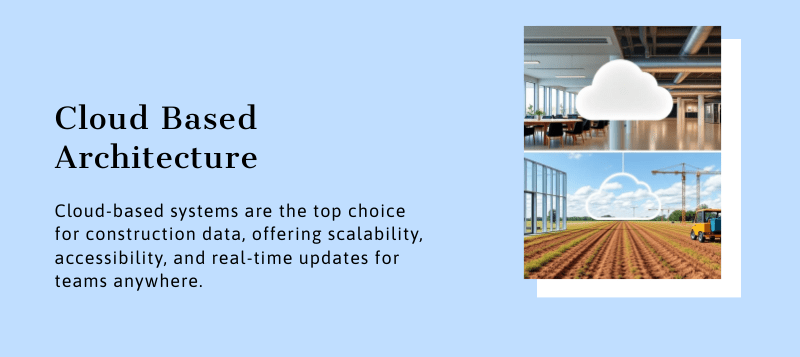
WHICH SYSTEM ARCHITECTURE BEST SUPPORTS CONSTRUCTION DATA FLOW
Cloud-based architectures are the most effective for construction data management due to their scalability, accessibility, and integration capabilities. They allow distributed teams to access and update data in real time, regardless of location.
Construction environments demand flexibility. Field teams require mobile access, while office teams need structured reporting and analytics. Cloud systems bridge this gap without requiring complex infrastructure.
Key architectural components include:
- Centralized cloud storage with redundancy
- API-driven integrations with scheduling and financial tools
- Mobile interfaces for field data capture
- Real-time synchronization across devices
- Secure access protocols with encryption
On-premise systems, while still used in certain cases, introduce limitations in accessibility and scalability. Hybrid models can be effective but require careful coordination to avoid data duplication.
HOW FIELD DATA CAPTURE TRANSFORMS PROJECT VISIBILITY
Field data capture systems convert on–site observations into structured, actionable data in real time. This eliminates delays associated with manual reporting and ensures that project leadership operates on current information.
Modern systems enable:
- Mobile entry of daily logs and inspections
- Photo and video documentation linked to specific tasks
- GPS-tagged updates for location accuracy
- Instant synchronization with central databases
The impact is operational clarity. Project managers can identify issues as they occur rather than after delays have already materialized.
OPERATIONAL CONSEQUENCES OF DELAYED FIELD DATA
When field data is delayed or incomplete, the following issues emerge:
- Misalignment between planned and actual progress
- Late identification of safety risks
- Inaccurate reporting to stakeholders
- Inefficient resource allocation
Real-time data capture reduces these gaps and allows corrective actions to be implemented immediately.
WHAT INTEGRATION CAPABILITIES ARE REQUIRED FOR FULL SYSTEM VALUE
Integration determines whether a data management system operates as a control hub or a disconnected repository. Systems that fail to integrate with core construction tools create additional administrative burden rather than reducing it.
Critical integrations include:
- Scheduling platforms for timeline alignment
- Accounting systems for cost tracking
- BIM tools for design coordination
- Procurement systems for supply chain visibility
- Communication platforms for stakeholder coordination
Integration enables data continuity. Information flows seamlessly across systems without manual re-entry, reducing errors and improving efficiency.
INTEGRATION FAILURE RISKS
When integration is absent or poorly implemented:
- Data must be manually transferred between systems
- Inconsistencies arise between datasets
- Reporting becomes unreliable
- Operational efficiency declines
Integration is not optional at scale. It is a prerequisite for maintaining data integrity across complex projects.
HOW DATA STANDARDIZATION IMPROVES CROSS-TEAM ALIGNMENT
Data standardization ensures that all stakeholders interpret and use information consistently. Without standardization, identical data points can be labeled, formatted, or categorized differently, leading to confusion and inefficiency.
Standardization applies to:
- Naming conventions for files and documents
- Data formats and units of measurement
- Classification systems for project elements
- Reporting templates and structures
This consistency enables seamless collaboration between teams that may not share the same internal processes or terminology.
PRACTICAL STANDARDIZATION ELEMENTS
Effective standardization typically includes:
- Predefined folder structures
- Metadata tagging requirements
- Controlled vocabulary for key data fields
- Template-based documentation workflows
Standardization reduces onboarding friction for new team members and ensures continuity across project phases.
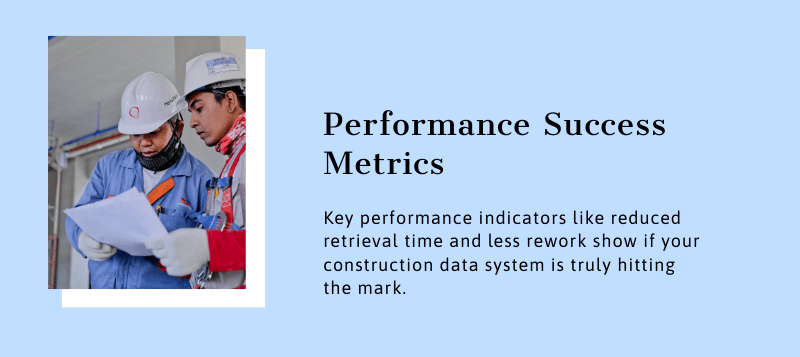
WHICH PERFORMANCE METRICS INDICATE A SUCCESSFUL SYSTEM
A successful construction data management system demonstrates measurable improvements in operational efficiency and decision accuracy. These improvements can be tracked through specific performance indicators.
Key metrics include:
- Reduction in document retrieval time
- Decrease in rework caused by outdated information
- Faster RFI and submittal turnaround times
- Improved accuracy in cost forecasting
- Increased compliance with reporting requirements
These metrics reflect the system’s ability to deliver actionable information when needed.
INTERPRETING PERFORMANCE DATA
Metrics must be evaluated in context. A reduction in retrieval time, for example, is only meaningful if it translates into faster decision-making and improved project outcomes.
Isolated improvements are insufficient. The system must demonstrate cumulative impact across multiple operational areas.
WHAT IMPLEMENTATION CHALLENGES MOST OFTEN DERAIL ADOPTION
Implementation failures are typically driven by organizational resistance, poor planning, or inadequate system configuration. Technology alone does not ensure success.
Common challenges include:
- Lack of user training and onboarding
- Misalignment between system design and actual workflows
- Incomplete data migration from legacy systems
- Resistance from field teams accustomed to manual processes
- Overly complex interfaces that hinder usability
These issues reduce adoption rates and undermine system effectiveness.
MITIGATION STRATEGIES
Successful implementation requires:
- Early stakeholder involvement in system design
- Phased rollout with pilot testing
- Continuous training and support
- Alignment between system workflows and real-world operations
Adoption is driven by usability and relevance. Systems that align with daily workflows are integrated naturally into project operations.
HOW SECURITY AND COMPLIANCE REQUIREMENTS SHAPE SYSTEM DESIGN
Security and compliance are foundational requirements in construction data management due to the sensitivity of project information and contractual obligations. Systems must protect data integrity while ensuring accessibility for authorized users.
Core security measures include:
- Role-based access controls
- Data encryption in transit and at rest
- Multi-factor authentication
- Audit logs for all data interactions
Compliance requirements vary by project type and jurisdiction but often include strict documentation and reporting standards.
RISK EXPOSURE WITHOUT ADEQUATE SECURITY
Insufficient security introduces significant risks:
- Unauthorized access to sensitive project data
- Data breaches affecting contractual relationships
- Loss of critical documentation required for compliance
- Legal exposure in dispute scenarios
Security must be integrated into system architecture rather than added as an afterthought.
WHEN SCALABILITY BECOMES A CRITICAL SYSTEM REQUIREMENT
Scalability becomes essential as project size, complexity, and data volume increase. Systems that cannot scale effectively create bottlenecks that limit operational efficiency.
Scalable systems support:
- Increasing data volumes without performance degradation
- Expansion across multiple projects and regions
- Integration with additional tools and technologies
- Growth in user base without access conflicts
Scalability is particularly important for organizations managing multiple concurrent projects or long-term infrastructure programs.
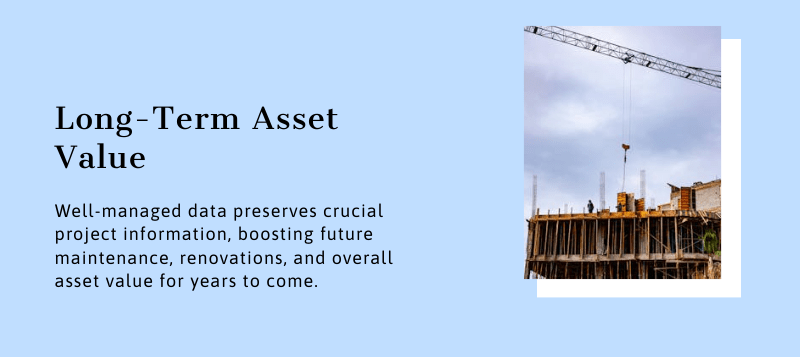
HOW DATA MANAGEMENT SYSTEMS INFLUENCE LONG-TERM PROJECT VALUE
Data management systems extend beyond project execution and contribute to long-term asset value by preserving structured, accessible information for future use. This includes maintenance, renovations, and operational planning.
Well-managed data enables:
- Efficient facility management post-construction
- Faster response to maintenance issues
- Accurate historical records for future projects
- Improved lifecycle cost management
The value of structured data increases over time. Projects that invest in robust data management systems create a foundation for ongoing operational efficiency.
FREQUENTLY ASKED QUESTIONS
WHAT IS A CONSTRUCTION DATA MANAGEMENT SYSTEM?
A construction data management system is a centralized platform and framework that organizes, controls, and distributes project information across all stakeholders.
WHY IS DATA MANAGEMENT IMPORTANT IN CONSTRUCTION PROJECTS?
Data management is critical because it ensures accuracy, reduces rework, improves coordination, and supports informed decision-making throughout the project lifecycle.
WHAT TYPES OF DATA ARE MANAGED IN CONSTRUCTION PROJECTS?
Construction projects manage design documents, cost data, schedules, field reports, procurement records, and compliance documentation.
HOW DO DATA MANAGEMENT SYSTEMS IMPROVE PROJECT EFFICIENCY?
They streamline workflows, reduce duplication, enable real-time visibility, and eliminate delays caused by inconsistent or inaccessible information.
WHAT ARE THE MAIN RISKS OF POOR DATA MANAGEMENT?
Risks include project delays, cost overruns, compliance failures, data inconsistencies, and reduced accountability.
HOW DOES FIELD DATA CAPTURE IMPACT PROJECT PERFORMANCE?
Real-time field data capture improves visibility, enables faster decision-making, and reduces the risk of undetected issues.
WHAT FEATURES SHOULD A CONSTRUCTION DATA MANAGEMENT SYSTEM INCLUDE?
Key features include centralized storage, version control, integration capabilities, mobile access, and robust security measures.







