
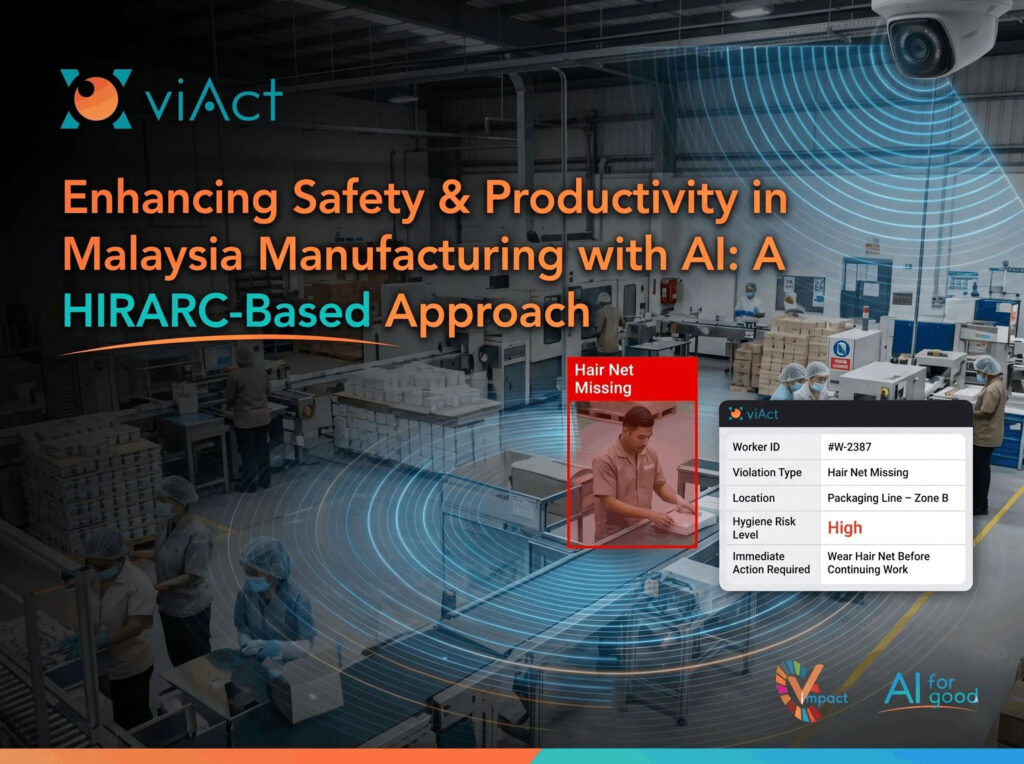

In 2026, Malaysia’s manufacturing sector isn’t short on safety frameworks. It’s short on real-time execution.
As per a news report by Bernama, the Department of Occupational Safety and Health (DOSH) logged 4,409 workplace incidents in the first five months of 2025. The manufacturing sector, with 2,320 incidents, contributed the most to the mark. Across industrial hubs like Johor, Perak and Penang, incident rates are not stabilising but are climbing.
That raises an uncomfortable question:
If HIRARC is already in place, why are incidents still rising?
This is the central tension in manufacturing safety in Malaysia today. HIRARC risk assessment is legally sound, structurally coherent, and mandated by the Occupational Safety and Health Act 1994 and the DOSH guidelines. What is broken is the gap between documentation and execution.
What HIRARC Risk Assessment in Malaysia Was Built to Do — and the Current Gap
HIRARC is a three-stage operational framework: Hazard Identification, Risk Assessment, and Risk Control.
When understood correctly, it is the backbone of a functioning safety management system. The problem is not the framework, but it is where the framework breaks under real-world manufacturing conditions.
Here’s how that gap plays out on the factory floors and how AI helps to bring it into focus:
1. Hazard Identification: What’s Documented vs What’s Changing
HIRARC assumes hazards are identified comprehensively across tasks and conditions.
-
Production environments change faster than register updates
-
Temporary tasks, maintenance workarounds, and process deviations go undocumented
-
New risks emerge between audit cycles, not during them
AI-powered video analytics and IoT sensors transform hazard identification into a continuous process—detecting gas leaks, unsafe behaviors, PPE non-compliance, and equipment anomalies in real time.
2. Risk Assessment: What’s Rated vs What’s Real
HIRARC assigns risk levels based on likelihood and severity.
-
Risk scores are static, reviewed annually or during audits
-
Production spikes, reduced staffing, or environmental changes don’t update the risk level
-
A “medium risk” on paper may already be “high risk” on the floor
AI enables real-time risk scoring, recalculating risk levels based on live inputs such as worker activity, machine performance, and environmental data.
3. Risk Control: What’s Listed vs What’s Verified
HIRARC defines control measures as those related to project management, engineering, or administration.
-
Controls are documented but not continuously verified
-
No visibility into whether safeguards are active during night shifts or peak pressure
-
Compliance becomes assumption, not confirmation
AI introduces a real-time verification layer, ensuring controls are active, deviations are detected instantly and corrective actions are triggered without delay.
AI-driven safety is not a parallel system sitting alongside HIRARC. Each technology component maps directly to a HIRARC pillar, extending its reach from the filing cabinet to the production floor.

Conventional HIRARC identifies hazards at a point in time. AI cameras equipped with computer vision run continuous hazard mapping — detecting missing PPE, unauthorised zone entries, chemical spills, and equipment anomalies in real time, on every shift, without fatigue. IoT environmental sensors feed air quality, temperature, noise, and vibration data into a live hazard model. Hazard identification is no longer an annual exercise. It is a continuous operation.
For example, at a food & beverage processing facility, an AI camera can detect a worker entering a cold storage zone without thermal PPE. The system cross-references the HIRARC control requirement for that zone and raises an alert before the worker is exposed to a documented cold-stress hazard.
2. Real-Time Risk Assessment — Dynamic Scoring with Multi-Variable Inputs
Static HIRARC scores assume static conditions. AI-powered risk assessment ingests live variables like production speed, workforce density, environmental readings, equipment status, time-on-shift, and recalculates risk scores dynamically. A hazard rated ‘low’ under normal conditions can auto-escalate to ‘high’ when three simultaneous risk factors converge.
Suppose at a Penang semiconductor plant, an AI system detects that a cleanroom workstation simultaneously has elevated particulate levels, a worker on their tenth consecutive hour, and a machine running 12% above rated RPM. Each factor alone scores low. Combined, the AI escalates the aggregate risk to critical — triggering an immediate supervisor review that no quarterly register could have anticipated.
3. Automated Risk Control — AI to PLC Integration
The most critical gap in conventional HIRARC is the delay between identifying a risk control requirement and executing it. AI-to-PLC (Programmable Logic Controller) integration eliminates that delay. When a HIRARC-defined control threshold is breached, the system does not send a notification for a human to action later; it acts by shutting down equipment, activating ventilation, triggering lockout/tagout sequences, and logging the intervention with full timestamp and event context.
4. Adaptive Risk Scheduling & Workforce Optimisation
Fatigue is one of the most underrepresented risk variables in Malaysian manufacturing HIRARC registers. AI-powered workforce scheduling incorporates fatigue modelling, cumulative exposure tracking, and task rotation logic to ensure that workers are not assigned to high-risk tasks at the point of maximum fatigue exposure.
The following three use cases each represent a different manufacturing sub-sector in Malaysia. Each one shows precisely what happens under a conventional HIRARC approach versus an AI-powered HIRARC system.
Use Case 1: Chemical Exposure in Rubber Glove Manufacturing
The Scenario. A compounder operator at a glove manufacturing facility in Klang Valley is exposed to ammonia concentrations that exceed the DOSH Permissible Exposure Limit (PEL) mid-shift, following a line speed increase and a minor ventilation fan fault.
|
Ammonia exposure listed in quarterly register |
AI CCTVs and IoT sensors continuously map ammonia concentration in real time |
|
|
Rated as ‘medium’ exposure risk at last review |
Risk tier auto-escalates to ‘critical’ the moment sensor readings breach DOSH PEL |
|
|
Control measure listed: ‘ensure adequate ventilation’ |
Automated alert to line supervisor within 90 seconds. Ventilation system activated remotely. Logged as a timestamped HIRARC control action — audit-ready. |
|
|
Operator exposure continues until supervisor notice |
Exposure event contained. Full action log available for DOSH reporting. |
Use Case 2: Machine Guard Bypass in Automotive Stamping Plant
The Scenario. A maintenance technician removes a machine guard during an unplanned repair between shifts at an automotive stamping facility in Shah Alam. The guard removal is an HIRARC-identified critical control point. The shift supervisor is occupied at another line.
|
Guard removal identified as high-risk in register |
Computer vision system detects guard removal in real time |
|
|
Assumed to be managed by supervisor observation |
Cross-references with active shift data — technician not on authorised maintenance schedule |
|
|
Supervisor observation — which did not occur |
Live HIRARC control failure flagged. Remote machine lockout triggered. Bypass must be formally authorised and logged before restart. |
|
|
Technician operates near unguarded press |
Machine offline until authorisation. Zero injury exposure. Full HIRARC trail maintained. |
Use Case 3: Cumulative Ergonomic Risk in E&E Assembly
The Scenario. Workers on a high-volume visual inspection line at a Penang E&E plant develop musculoskeletal disorders (MSDs) over six months. The ergonomic risk was rated ‘medium’ in the quarterly HIRARC review. No cumulative exposure tracking existed.
|
Ergonomic hazard listed for inspection stations |
||
|
Static ‘medium’ rating — no cumulative model |
Centralised platform aggregates exposure data across shifts; dynamic risk score escalates as cumulative threshold approaches |
|
|
Annual ergonomic review recommended |
Scheduler auto-triggers workstation rotation before injury window closes. Intervention happens before the MSD develops. |
|
|
MSDs develop over six months — workers removed from line |
Exposure managed proactively. Workforce continuity maintained. MSDs prevented. |
From Safety Compliance to Production Stability: The ROI from HIRARC Risk Assessment in Malaysia’s Manufacturing Industry
Every safety delay is a production delay. A machine lockout triggered reactively after an incident costs more than one triggered proactively by a sensor anomaly. An unplanned line shutdown caused by a worker injury costs more than a scheduled maintenance window.
AI-driven HIRARC does not just improve safety outcomes, but it structurally reduces production disruptions by converting reactive responses into predictive interventions.
Automated Conveyor Belt Intrusion Preventing Production Disruption
The Conventional Outcome – A worker enters a restricted conveyor zone. A manual sensor triggers an emergency stop. The line is down for 45 minutes while safety protocols are completed, the incident is logged, and equipment is inspected.
The AI-HIRARC Outcome– AI cameras detect the approaching intrusion 4 seconds before zone entry. The system activates a zonal slow down and audio alert. The worker stops. No full emergency stop is required. Logged as an HIRARC control action. Line continues at reduced speed for 60 seconds, then resumes normal operation.
Predictive Maintenance Eliminating Unplanned Downtime
The Conventional Outcome – A stamping press fails mid-shift due to hydraulic seal degradation. Emergency maintenance is called. The line is down for 3.5 hours. The failure was not in any current HIRARC action plan.
The AI-HIRARC Outcome – AI vibration and pressure sensors detect anomaly patterns in the hydraulic system 72 hours before failure probability peaks. The system flags this as an elevated operational risk within the HIRARC framework. Maintenance is scheduled during planned downtime. The seal is replaced. The line never stops.
This is where AI in Malaysia manufacturing safety creates measurable ROI that extends well beyond injury prevention.
|
Up to 95% faster intervention |
|||
|
Reactive — post-incident |
Predictive — pre-failure |
30–50% downtime reduction |
|
|
Risk Control Verification |
Automated with timestamped logs |
100% control action traceability |
|
|
Ergonomic Injury Prevention |
Identified after injury trend |
Pre-threshold intervention |
60–70% MSD reduction potential |
|
Manual documentation collation |
Auto-generated compliance report |
80% reduction in audit prep time |
|
|
Multilingual Risk Communication |
Briefings + printed notices |
Automated multilingual alerts |
Workforce-wide reach every shift |
The numbers in the table reflect what happens when a safety framework that was always structurally sound is finally given the operational infrastructure to function the way it was designed to. HIRARC identified the risks. AI executes the controls. The result is a manufacturing floor where safety compliance and production stability are not managed as separate objectives — they are driven by the same system, in real time, on every shift.
Conclusion: Key Takeaways
-
HIRARC is legally sound and operationally necessary, but it was designed for a manufacturing pace that no longer exists in Malaysia’s E&E, rubber, and F&B sectors.
-
Every minute between hazard occurrence and risk control action is an injury window. AI-HIRARC collapses that window from hours to seconds, not as a technology advantage, but as a compliance and liability necessity.
-
IoT sensors and computer vision do not replace HIRARC assessors; they give those assessments operational continuity. The risk that was identified once in the register is now monitored continuously on the floor.
-
Malaysia’s multilingual manufacturing workforce requires safety communication that transcends language barriers. AI-powered multilingual alert systems ensure that HIRARC control requirements reach every worker, on every shift, in the language they understand.
-
DOSH audit readiness is no longer a pre-audit scramble. AI-HIRARC systems generate timestamped, traceable control action logs as a byproduct of normal operations and audit documentation is always current.
-
Safety and productivity are not competing priorities. AI-HIRARC predictive maintenance and proactive risk intervention structurally reduce unplanned downtime, making real-time safety management a direct driver of production stability.
AI in Malaysia manufacturing safety is not just an upgrade to HIRARC; it represents a visionary shift in how industrial risk is managed at scale. Organizations that embrace this approach are not only improving compliance—they are building future-ready, intelligent safety ecosystems where prevention, productivity, and performance move together.
1. Is AI-based HIRARC compliant with Malaysia’s OSH Act 1994 and DOSH guidelines?
Yes. AI systems like viAct are designed to support compliance by ensuring:
They strengthen adherence to HIRARC risk assessment Malaysia guidelines, not replace them.
2. Can AI work with existing CCTV infrastructure in Malaysian factories?
Yes—most AI in Malaysia manufacturing safety solutions are designed to integrate with existing camera systems, reducing the need for additional hardware and lowering deployment costs.
3. What are the typical use cases of AI manufacturing safety applications in Malaysia?
Common applications include:
-
PPE compliance monitoring
-
Unsafe behavior detection
-
Heat stress and fatigue monitoring
-
Predictive maintenance
-
Hazard zone intrusion alerts
These are widely adopted across Malaysia’s manufacturing industry, especially in E&E, automotive, and F&B sectors.
4. How much does it cost to implement AI in Malaysia manufacturing safety?
Costs vary depending on plant size and scope, but most deployments are modular and scalable. Organizations can start with pilot projects using existing CCTV infrastructure, reducing upfront investment. ROI is typically realized through reduced incidents, downtime, and compliance costs.
5. Is viAct available and operational in Malaysia?
Yes. viAct has an active presence in Malaysia, supporting organizations across manufacturing, construction, and logistics sectors with AI-powered safety and HIRARC solutions tailored to local compliance requirements.
|
viAct is a leading Impact AI company focused on improving safety and efficiency in high-risk industries. Since 2016, we’ve implemented innovative “Scenario-based Vision Intelligence” solutions across hundreds of organizations. Recognized by Forbes and the World Economic Forum, we aim for a sustainable future through responsible technology. |






