
Manual inspections often allow grading errors to compound before crews detect variances. The result is extra equipment hours, wasted materials, added labor, and schedule disruptions—all of which reduce profit margins and strain client relationships.
Construction QA/QC technology connects design data with grade control to confirm elevations in real time. When supported by accurate calibration and proper setup, 3D machine control improves first-pass accuracy and reduces reliance on estimates and manual stake checks.
Why Rework Happened Frequently Before 3D Machine Control
Before the adoption of 3D machine control, crews relied on survey stakes, paper plans, and basic field tools. Operators interpreted grade intent from physical markers and printed drawings, often under tight schedule pressure.
Foremen frequently had to recall survey teams when stakes were damaged or unclear, slowing production. Without connected data, teams worked from static information that could lag behind current design revisions, increasing the risk of errors.
Common process gaps in daily operations included:
- Loss of grade tolerance between design intent and stake placement
- Limited access to updated digital surfaces or revision records in the field
- Variation in measurement results across crews and calibration settings
These constraints made it difficult to minimize rework. Crews often performed multiple passes in the same area after discovering deviations late in the process. Overcut sections required backfill and additional compaction, while inspectors rejected work outside tolerance—triggering costly corrective cycles that consumed both time and labor.
How 3D Machine Control Improves Accuracy and Increases ROI
With 3D machine control, project teams operate from a coordinated digital surface shared across survey, field, and management teams. Surveyors can publish validated models directly to heavy equipment and rovers.
Operators access live design data from the cab, while grade control systems maintain target elevations within defined tolerances. This digital alignment reduces interpretation errors and establishes measurable grade performance.
Operational improvements are reflected in key production metrics, including:
- Fewer passes required to achieve final surface tolerance
- Increased productive equipment hours per shift
- Reduced material movement due to corrective grading
- Improved grade consistency across shifts and operators
- Faster deployment of design revisions to active work zones
As a result, grading crews can achieve finished surfaces with consistent slopes. Excavation teams minimize trench overcut and reduce backfill requirements. In landfill and quarry operations, slopes and benches are shaped to the intended geometry during initial production—reducing the need for rework.
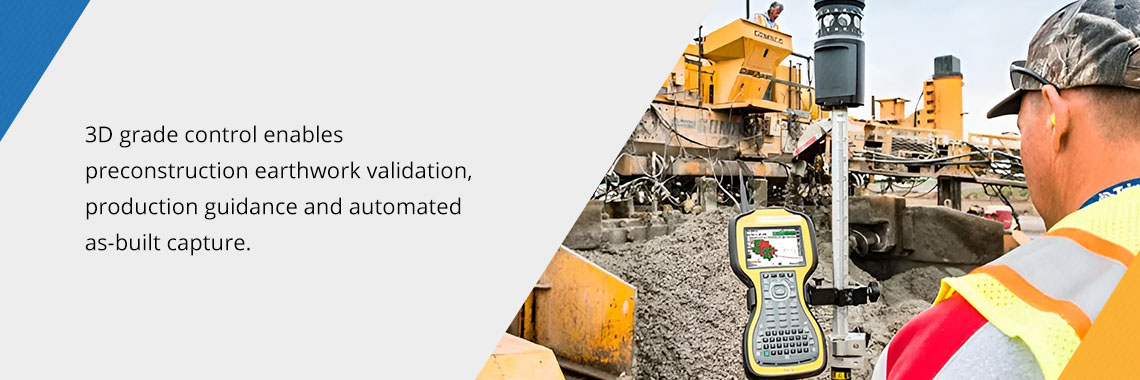
3D grade control enables preconstruction earthwork validation, production guidance, and automated as-built capture. By combining surface checks, on-equipment design verification, and digital records, teams gain continuous assurance from model approval through project delivery.
Surface Validation and Earthwork
Before digital validation, crews performed occasional level or laser checks only after large sections had been cut or filled. Discovering high or low areas late forced corrective grading, increased material movement, and extended heavy equipment hours. Verification typically occurred after bulk earthmoving, making adjustments time-consuming and costly.
Early drone flights, rover measurements, and integrated equipment data now allow earthwork teams to compare existing ground conditions to design surfaces before committing production time.
Crews can identify cut and fill requirements in advance and sequence work with greater precision. Early confirmation speeds site-prep approval, reduces regrading volumes, and ensures bulk excavation stays aligned with design intent—minimizing downstream adjustments.
On-Equipment Design Checks
Before in-cab design visibility, operators had to pause grading while a surveyor or foreman verified alignment and elevation. Heavy equipment often sat idle as crews measured surfaces and reviewed layout intent, disrupting workflow and delaying production.
With design data delivered directly to the cab, operators can track horizontal position and vertical elevation against the digital model in real time. Grade control displays cut and fill values on the fly, allowing corrections without halting progress.
Verification now happens alongside grading rather than after completion. Reducing idle time previously spent waiting for checks increases productive passes and lowers corrective effort.
Automated As-Built Capture
Traditional closeout processes relied on separate survey mobilizations to document completed work. Final measurements often required additional site visits and reconciliation with field records, creating gaps between constructed surfaces and documentation and adding administrative burden.
Integrated data logging allows heavy equipment to record position and elevation during daily production. Teams can compile progressive models reflecting actual conditions without extra measurement deployments. Continuous as-built verification reduces return trips, resolves quantity disputes, and ensures alignment accuracy. Reliable digital records also support future tie-ins, utility coordination, and maintenance planning by providing a dependable surface history.
Measuring ROI: From Fewer Errors to Tangible Savings
Process improvements yield measurable financial benefits when contractors apply labor rates, equipment costs, and schedule impact to reduced rework. Weekly production data can quantify savings from 3D machine control by factoring in crew size, equipment rates, and project duration.
Industry research indicates that rework can consume 5%–10% of total project costs, while digital quality workflows often cut inspection time by more than half, as documented in case studies.
Teams can experience measurable gains similar to the example below during a typical week of grading.
| Activity | Before hours per week | After hours per week | Saved hours per week |
| Surface validation — spot checks and resurvey | 8 | 2 | 6 |
| Design checks — on-site grade and alignment checks | 6 | 2 | 4 |
| As-built capture — end-of-project surveys | 6 | 1 | 5 |
| Total | 20 | 5 | 15 |
Multiply total weekly hours saved by a blended hourly cost that includes operators, fuel, and equipment ownership or rental. Then multiply that weekly savings by the total project weeks to estimate direct labor and equipment cost reduction.

Building It Right the First Time With SITECH Southwest
Grade errors rarely occur in isolation. A small elevation miss can add equipment hours, disrupt sequencing and lead to extra coordination across crews and inspection. Grade control systems help prevent that cycle by embedding design validation into production.
SITECH Southwest provides 3D machine control systems and construction management software that connects grading equipment with current digital models. Rental and used purchase options allow contractors to align fleet capability with the project scope.
Contact us or schedule a demo, and we’ll help you identify the grade control system or equipment solution for your project’s needs.