 Skip to content
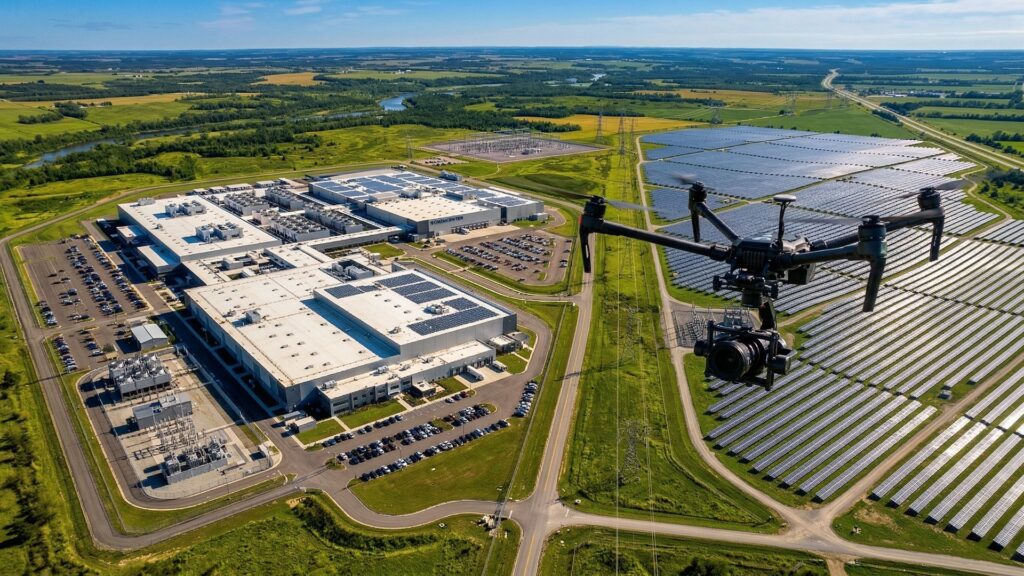
During my involvement in designing mobile phone production facilities, the speed of design and construction was critical. Any delay could directly translate into lost revenue. That same logic now applies to data centers, though the stakes are much higher. Instead of optimizing physical production lines, we are constructing infrastructure for digital production.
The global data center capacity is expected to nearly double by 2030, and with this level of demand, the traditional project-by-project delivery model begins to show its limitations.
Data centers are no longer isolated projects in the traditional sense. They are evolving into repeatable, scalable production systems, making them ideal environments for AEC process and business model innovation.
The building as a machine: a systems-first approach
A data center is essentially a high-performance machine. The building acts as a protective chassis for tightly integrated mechanical and electrical systems, much like a process plant is organized around production flows and equipment.
This shift is clearly reflected in cost structures. Servers and GPUs typically account for 60 to 70 percent, or even more, of total capital expenditure, while MEP systems can represent 70 percent or more of construction costs in demanding data centers. As a result, design begins with power distribution, cooling topology, and redundancy strategies, and only then moves to architectural and structural solutions that support these systems.
Engineering for extreme AI density
Only a few years ago, typical data center rack densities were in the range of 10-20 kW, with older facilities operating at even lower levels. By 2026, AI-driven workloads will have fundamentally changed the equation.
Current-generation systems are pushing rack densities to 130–140 kW, and future systems are expected to require 300 kW per rack or more. This development creates what many operators describe as a thermal wall, where conventional cooling approaches are no longer sufficient.
Consequently, the industry is rapidly shifting toward direct-to-chip and immersion-liquid cooling solutions. These technologies create new needs for precision, reliability, and risk management. At the same time, higher densities increase structural demands, as floor loads rise and spatial tolerances become more strict.
Beating the clock with industrialized construction
Time-to-market has become one of the defining constraints in data center development. Hyperscalers increasingly target delivery cycles of 12 to 18 months.
To meet these deadlines, firms are expanding the use of industrialized construction methods. Prefabricated electrical rooms, mechanical skids, and modular data halls are built off-site in controlled environments and then quickly assembled on location. While prefabrication is not new, the current shift involves a higher level of system integration and digital coordination to support it.
The jobsite increasingly becomes more of an assembly space rather than a traditional construction site. Complexity is moved upstream into design and manufacturing, where it can be managed more predictably and accurately.
Eviden’s modular data center demonstration
The digital thread and smart handovers
In an environment where downtime can cost thousands of dollars per minute, there’s little room for mistakes, which drives the adoption of continuous digital workflows. The traditional separation between project phases becomes a liability when performance and reliability matter most.
In the early design phase, engineers use AI-assisted simulations to evaluate thousands of scenarios for layout, cooling, and power distribution. This method shifts decision-making toward data-driven optimization instead of sequential iteration. During construction, BIM models are actively used in the field, combined with LiDAR scanning, drones, and augmented reality overlays to verify installation accuracy in real time.
At handover, the deliverable extends beyond just documentation. Owners increasingly receive a live, data-connected digital twin that integrates with IoT sensors and supports predictive maintenance. Since data center IT/server equipment is typically updated every three to five years, this ongoing digital thread becomes crucial for managing lifecycle performance rather than merely delivering a completed project.
Power scarcity as the ultimate constraint
Despite advances in design and delivery, the most significant constraint is often outside the project itself. Access to reliable power has become the main limiting factor in data center expansion, and in many cases, it dictates project feasibility more than design considerations.
In major US markets like Northern Virginia, grid interconnection delays can last five or even seven years. In Europe, the situation is often even more limited, with connection queues in key markets averaging 7 to 10 years, or even longer, according to the International Energy Agency.
This fundamentally changes project strategy. Instead of relying solely on grid connections, developers now explore on-site generation using natural-gas turbines, fuel cells, and hybrid microgrids, as well as co-location with existing power infrastructure, such as nuclear plants.
In this environment, site selection, energy strategy, and infrastructure integration become as critical as the building design itself, if not more so.
Sustainability to be addressed from the outset
At the same time with energy availability issues, sustainability requirements are becoming more stringent, particularly in Europe. Therefore, compliance must be embedded in the design process from the outset rather than addressed later.
The demand for rapid deployment and high power density can conflict with sustainability goals, particularly in terms of energy consumption and resource use. Managing this balance is becoming one of the central challenges in data center design.
AEC teams are increasingly integrating life cycle assessment directly into BIM workflows, allowing them to evaluate material choices, structural systems, and energy strategies early in the design phase. This improves decision-making at a point where design flexibility is still high, and changes are less costly.
The AEC partner of the future
Data centers are moving from one-off projects toward continuous, repeatable delivery models, and this transition is redefining the role of the AEC firm.
Firms need to develop deep specialization in mission-critical systems, build integrated teams that combine design, engineering, and digital capabilities, and treat data as a long-term asset rather than a project deliverable.
The most competitive players will not only design and build facilities but also contribute to an ongoing production system where design, construction, and operations are closely linked. This shift creates opportunities for new business models in which value increasingly depends on managing complexity, integrating systems, and maintaining performance over time.
If NVIDIA’s CEO Jensen Huang is correct, AEC firms have a significant opportunity in data center construction:
“We have only just begun this buildout. We are a few hundred billion dollars into it. Trillions of dollars of infrastructure still need to be built.”
To capitalize on these shifts, AEC tech providers must ensure their voice is heard by the decision-makers leading the charge.







