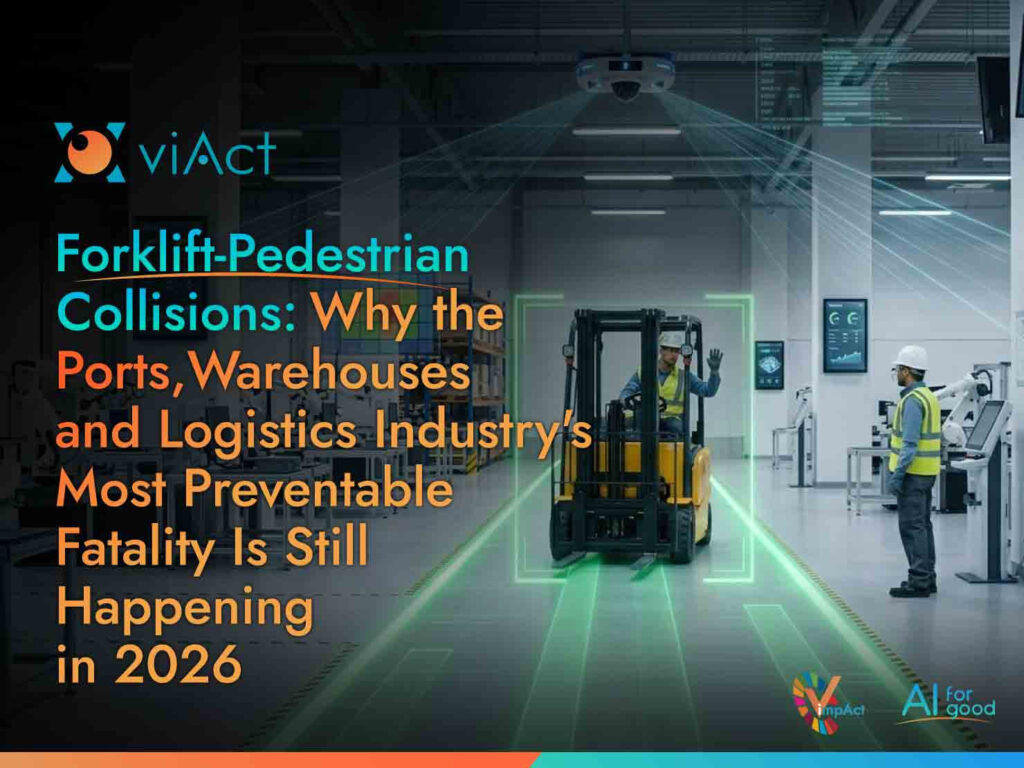

A forklift turns into a warehouse aisle carrying a heavy pallet. At the same moment, a worker steps into the same path from behind a storage rack. Both are simply doing their jobs. Yet within seconds, that routine moment can turn into one of the most dangerous situations in an industrial workplace.
Forklift–pedestrian collision prevention has long been considered achievable goal to avoid workplace fatalities in logistics, ports, and warehouses.
But if these incidents are so preventable, a difficult question still remains:
Why is forklift-pedestrian collision prevention in ports, warehouses, and logistics operations still struggling in 2026?
The answer is surprisingly simple. Most safety controls related to such situation focus on rules and warnings, while the real problem lies in unpredictable human movement and constantly changing work environments.
According to the U.S. Bureau of Labor Statistics, transportation incidents accounted for more than 38.2% of workplace fatalities in recent years, making them the leading cause of worker deaths across industries.
For EHS leaders, safety managers, and operations teams working in ports, warehouses, and logistic facilities, understanding why these collisions keep happening and how AI-based Forklift Pedestrian Collision Avoidance System are changing the equation — has never been more important.
How Forklift-Pedestrian Collision Risk Differs Across Ports, Warehouses and Logistics
Collisions among forklifts and pedestrians are not confined to a single type of facility—they are a shared risk across ports, warehouses, and logistics hubs, each with its own operational complexities.
-
In warehouses, the risk is driven by density and repetition. Forklifts move continuously through narrow aisles, often carrying loads that obstruct visibility, while workers pick, sort, and restock inventory within the same space. Frequent aisle crossings, blind corners, and high-paced order fulfillment create constant interaction between people and machines.
-
In ports, the challenge is scale and obstruction. Container yards are filled with stacked containers that limit visibility, while forklifts, reach stackers, and transport vehicles operate simultaneously across large zones. Ground workers navigating between these structures often enter equipment pathways without clear line of sight, increasing the likelihood of unexpected encounters.
-
In logistics hubs, the risk intensifies due to speed and time pressure. Operations are tightly scheduled, with forklifts moving rapidly between loading docks, trucks, and staging areas. Workers handling documentation, coordination, and cargo movement frequently share these spaces, leading to high-risk interactions—especially during peak loading and unloading periods.
The impact of a single collision extends far beyond immediate injury. It often results in:
What makes these incidents particularly concerning is that they are rarely caused by extreme conditions. Most occur during routine operations—making them both predictable and preventable.
Why Existing Safety Measures Fail at the Point of Forklift-Pedestrian Collision
Traditional safety measures such as floor markings, physical barriers, safety training, standard operating procedures (SOPs), and audible alarms remain essential in industrial environments, but they are not designed to prevent collisions at the exact moment risk develops. These controls primarily aim to guide behavior rather than manage real-time interactions between forklifts and pedestrians.

In practice, their effectiveness is limited—floor markings are often overlooked during high-pressure operations, alarms blend into background industrial noise, and training cannot account for unpredictable human movement in dynamic environments.
The Occupational Safety and Health Administration (OSHA) estimates that around 35,000 to 62,000 injuries take place every year due to moving forklifts leading to an average of 87 deaths. The core issue lies in a fundamental mismatch: most safety systems are static, while the risks they aim to control are constantly evolving.
Forklifts and pedestrians operate in shared, fast-moving environments where conditions change within seconds, yet traditional controls do not adapt or provide visibility into how risks are forming. As a result, collisions occur not because safety measures are absent, but because unsafe interactions are neither detected nor controlled at the moment they happen.
The Missing Layer: Real-Time Visibility of Human–Machine Interaction
To prevent forklift-pedestrian collisions in warehouses, ports and logistics, the focus must shift from general safety measures to real-time interaction visibility.
The critical question must be: “Can we see and respond to unsafe interactions as they happen?”
Monitoring zones is not enough. What matters is tracking:
Without this level of visibility, risks remain hidden until it is too late. In 2026, AI-based solutions monitoring collisions among forklifts and pedestrians are taking over across ports, warehouses and logistic facilities. Their intelligent network of AI tools creates a connected ecosystem, leading to an automated continuous monitoring around sites.
How AI-Based Forklift Pedestrian Collision Avoidance Systems Work
Unlike traditional safety controls that activate after an incident or rely on manual supervision, AI-based forklift collision prevention systems analyze operational activity continuously and detect patterns that indicate rising risk.
Instead of relying solely on rules, AI systems continuously monitor environments using computer vision and advanced analytics.
For example, when a forklift and a pedestrian move toward the same path, the system identifies both in real time, tracks their movement, and calculates distance and speed to predict a potential collision. At the same time, it can assess additional factors such as operator behavior, sudden speed changes, or unsafe manoeuvres. If the interaction crosses a defined risk threshold, the system triggers immediate alerts
Key capabilities include:
-
Real-Time Detection: AI identifies forklifts and pedestrians simultaneously, tracking their movement and proximity.
-
Collision Path Prediction: By analyzing direction and speed, AI can detect when two paths are likely to intersect.
-
Proximity-Based Alerts: When a high-risk interaction is detected, alerts are triggered instantly across mobile devices and hooters —before a collision occurs.
-
Near-Miss Capture: AI records unsafe interactions that did not result in incidents, providing valuable insights into recurring risks.
-
Data-Driven Insights: Over time, patterns emerge—highlighting high-risk zones, peak danger periods, and behavioral trends.
Real-World Use Cases: Preventing Forklift-Pedestrian Collisions Across Industrial Environments
While the risks are consistent, the way forklift–pedestrian collisions occur—and are prevented—varies across different operational settings.
Warehouse – Blind-Aisle Collision Prevention: In high-density warehouses, forklifts operate within constrained aisle networks where visibility is frequently obstructed by pallet racks and elevated loads. In a typical scenario, a forklift carrying an elevated load approaches an aisle crossing at approximately 6–8 km/h, while a pedestrian enters the same intersection from a perpendicular aisle.
An AI-based computer vision system processes live video feeds and performs multi-object detection and tracking, identifying both the forklift and the pedestrian as independent moving entities. Using trajectory mapping and velocity estimation, the system predicts a potential path intersection within a defined time window.
When the predicted proximity falls below a configured threshold (e.g., <3 meters with converging vectors), the system classifies the interaction as high-risk and triggers real-time alerts via edge-connected devices or control systems.
In parallel, the system can analyze operator behavior—detecting distraction patterns such as prolonged head deviation, delayed reaction time, or inconsistent speed control. From an operator safety perspective, this early warning reduces sudden braking and last-moment manoeuvres, while also addressing risks caused by reduced operator attention.
Over time, repeated detections at the same coordinates enable heatmap generation of high-risk intersections, supporting data-driven redesign of aisle crossings and pedestrian routing.
Ports – Managing Obstructed Movement Around Container Stacks: Port environments introduce complex visibility constraints due to container stacking, large operational zones, and simultaneous equipment movement. In one scenario, a forklift travels along a container lane while a ground worker moves between stacked rows, both operating within visually isolated corridors.
AI-enabled monitoring systems utilize wide-area camera coverage combined with spatial tracking algorithms to detect entities even when they are partially occluded. When risk thresholds are exceeded, alerts are generated for supervisory systems or on-ground alert mechanisms.
Additionally, aggregated data from repeated events enables:
-
Identification of high-frequency collision-prone zones
-
Analysis of movement density and crossing patterns
-
Optimization of traffic segregation strategies in container yards
Logistics Hubs- Preventing Reversing Collisions at Loading Docks: In logistics hubs, reversing forklifts near loading docks represent a high-risk scenario due to limited rear visibility and dense pedestrian activity. In a typical case, a forklift begins reversing at low speed (~4–6 km/h) after unloading, while a pedestrian enters the rear operating zone from a blind spot.
An AI-powered detection system for forklift safety combines rear-zone monitoring with proximity detection models to track both the forklift’s movement vector and the pedestrian’s entry into a predefined safety zone.
An immediate alert is triggered through integrated channels such as:
This enables the operator to halt movement before impact. Over time, the system logs these proximity breaches as near-miss events, enabling:
-
Temporal analysis of peak risk periods (e.g., shift changes, peak loading hours)
-
Identification of unsafe reversing zones
-
Implementation of controlled pedestrian exclusion zones and workflow adjustments
Real-World Success Story
When a Dubai-based energy manufacturing company relocated to a new, advanced production facility, the scale of operations quickly introduced new safety challenges. With more than 8,000 employees working across material handling and production zones, forklifts and pedestrians frequently shared the same operational spaces. As activity increased, the site began experiencing repeated forklift–pedestrian safety risks and operational violations.
The organization implemented viAct AI-powered forklift safety monitoring module across key areas of the facility.
Within months, the site recorded measurable improvements:
-
65% reduction in forklift–pedestrian collision risks
-
54% decline in overall safety violations
-
71% faster response time to safety incidents
Computer Vision (AI CCTV) vs Edge Device (AI Box) — Which Technology Fits Your Facility’s Collision Risk Profile?
One of the first questions EHS leaders ask when evaluating AI-based forklift pedestrian collision prevention is not whether the technology works but where to start. With multiple monitoring approaches available, understanding which technology fits your operational environment is the practical first step toward deployment.
AI-based forklift safety typically operates through two complementary approaches:
|
AI modules on forklift safety are deployed on existing/new CCTV infrastructure on site |
Edge AI safety device is installed directly on forklifts |
|
|
Monitors the entire operational environment including forklifts, pedestrians, and traffic flow |
Monitors the immediate surroundings of a specific forklift and gives a 360˚ visibility |
|
|
Detects human–vehicle interactions, unsafe proximity, and movement patterns across work zones |
Detects close-range hazards, blind spots, and obstacles around the forklift |
|
|
|
|
|
Monitoring large facilities where multiple vehicles and pedestrians interact |
Preventing collisions during vehicle manoeuvres and blind spot situations |
When used together, these technologies create a multi-layered forklift safety architecture that addresses collision risk at every level of the operation:
Conclusion: Key Takeaways
-
According to the U.S. Bureau of Labor Statistics, transportation incidents remain the leading cause of workplace fatalities, accounting for over one-third of worker deaths.
-
Forklift-pedestrian collisions continue to occur because shared workspaces combine limited visibility, dynamic pedestrian movement, and operational pressure.
-
Traditional controls such as painted walkways, alarms, and spotters reduce risk but often fail to address unpredictable human behavior in busy industrial environments.
-
Blind spots, and facility layout constraints from narrow aisles to obstructed sightlines significantly increase the likelihood of collisions.
-
AI-powered forklift pedestrian collision prevention systems improve safety by identifying unsafe interactions and near misses in real time.
-
Data from these systems allows organizations to redesign workflows, improve facility layouts, and address high-risk zones before incidents occur.
-
Ultimately, the most effective approach combines operational discipline, thoughtful facility design, and technology that improves visibility into everyday risks.
Forklift-pedestrian collisions remain one of the most preventable workplace fatalities, but preventing them requires moving beyond static safety controls toward continuous visibility and proactive risk management.
1. Is my existing CCTV infrastructure enough for deploying a forklift monitoring module?
Yes. Most modern forklift pedestrian collision avoidance systems like viAct can integrate with existing CCTV infrastructure. AI models analyze video feeds to detect forklifts, pedestrians, and unsafe proximity events in real time. This approach allows organizations to upgrade workplace safety technology without replacing their entire surveillance system.
2. How can organizations purchase an AI-based collision prevention solution for forklifts?
Most industrial safety platforms follow a modular deployment model. Organizations typically begin with a core safety monitoring platform and then add specific modules depending on operational risks such as forklift safety monitoring, pedestrian detection, hazardous zone monitoring, or vehicle interaction analytics.
This modular approach allows companies to prioritize critical safety risks first and expand coverage across facilities over time.
3. What is the typical pricing model for industrial collision prevention solutions?
AI-powered workplace safety platforms usually follow a subscription-based pricing model. Costs can vary depending on several factors including:
-
Number of cameras or monitoring points
-
Facility size and operational complexity
-
Number of AI safety modules deployed
-
Integration with EHS platforms or existing infrastructure
For example, base platform for viAct starts from USD 1,000 per month and varies depending on customisation requirements.
4. What industries benefit most from collision avoidance systems powered by AI?
Industries that rely heavily on material handling equipment benefit the most from these systems. This includes:
These sectors frequently involve shared spaces where forklifts and workers operate in close proximity.
5. In which countries are viAct forklift safety AI systems commonly deployed?
AI-powered workplace safety technologies are increasingly deployed across global industrial hubs including:
-
Southeast Asia including Hong Kong, Singapore, Vietnam
-
Middle East countries like Saudi Arabia, UAE, Qatar
-
Europe and North America
These regions often adopt AI-enabled safety monitoring to strengthen compliance with workplace safety standards and improve operational visibility.
– viAct is the leading Impact AI company enhancing safety in high-risk industries for a sustainable future.