Skip to content
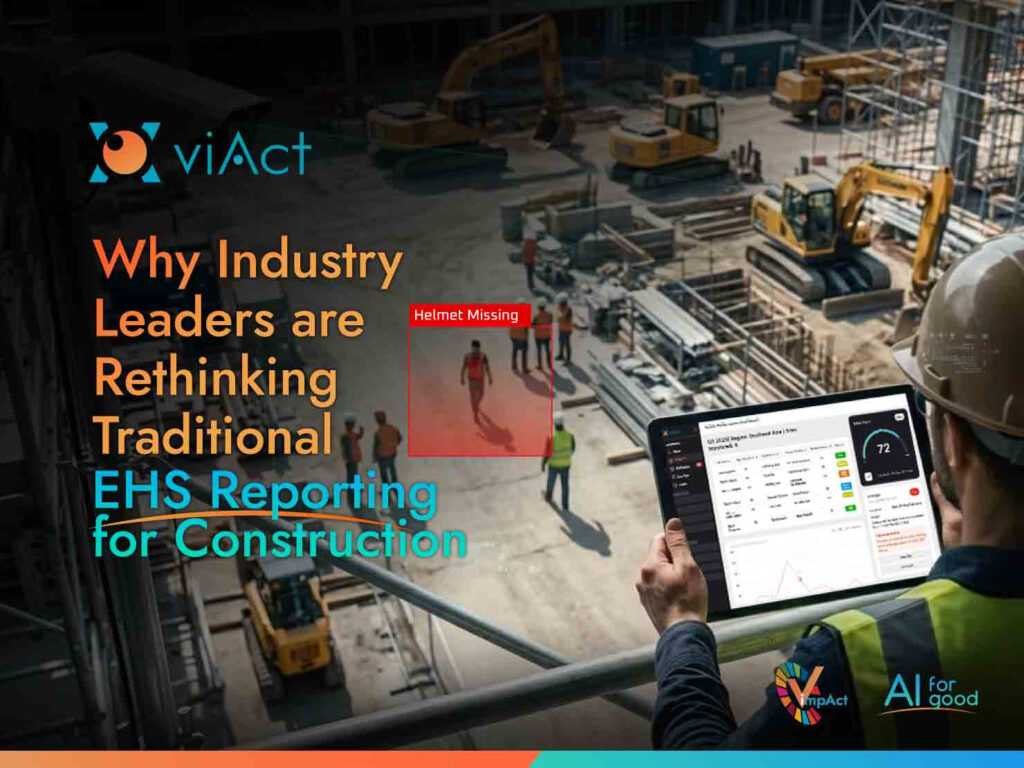

When one walks onto any construction site, dynamic movements can be tracked everywhere. From cranes lifting materials, welders at work, supervisors reviewing drawings to workers preparing equipment, the scene constantly changes. EHS reporting for construction has helped companies meet compliance requirements with paperwork and manual observations over the years.
But as projects became larger, timelines tighter, and risks more complex, those traditional systems started showing serious limitations.
Today, we see construction EHS reporting moving exponentially towards an AI-enabled, real-time, and data-driven safety management.
Let’s break down and understand exactly why.
Traditional Paperwork vs Visual Records for EHS Reporting for Construction
EHS reporting for construction for long have relied on heavy documentation process for their day to day operational activities. The traditional methods depended heavily on paperwork for maintaining such records. Every inspection, near-miss, hazard observation, and incident report was recorded manually. Files were either stored in cabinets or scattered across spreadsheets and emails.
Common limitations included:
-
Difficulty locating old incident records
-
Incomplete or inconsistent documentation
-
Loss or damage of physical files
-
No centralized system across multiple sites
-
Limited access for management or remote teams
For example, when a site manager wants to review all past incidents related to lifting operations before starting a high-risk crane activity, in a traditional system, this would require manually searching through registers and spreadsheets.
EHS reporting software in construction solves this problem by creating centralized searchable records. They do not just digitize records but also structure and index them intelligently. Every inspection, image, and violation is time-stamped, categorized, and tagged. AI systems can automatically classify incidents (e.g., lifting, scaffolding, electrical) and link them with corrective actions taken.
Instead of searching manually, safety officers can retrieve all relevant EHS records within seconds, which is consolidated and easily presented through a centralised EHS management platform. The shift towards automated construction EHS reporting is from passive storage to intelligent safety records that actively support decision-making.
For example, a leading construction company in Singapore struggled to align with the Ministry of Manpower’s (MOM) Workplace Safety & Health (WSH) 2028 strategy due to reliance on manual supervision and limited real-time visibility.
By deploying a multi-module AI safety solution from viAct, the company transformed its safety operations within a year, achieving:
-
7,000+ working hours saved
-
10x improvement in overall safety score
-
Improved on-time project delivery
Slow Manual Reporting vs Real-Time Alerts in Automated EHS reporting
As per OSHA’s top 10 safety violations in 2025, hazard communication stands second on the list with 2,546 instances. On traditional construction sites, the process of hazard communication often follows a slow chain:
-
Worker identifies a risk
-
Worker informs supervisor verbally
-
Supervisor documents it later
-
Management reviews it during scheduled meetings
This delay creates an exposure to risk. Say, a simple issue on a site such as blocked emergency exit, damaged scaffold plank, or exposed cable could remain unaddressed for hours or even days. The limitations of manual reporting include delayed hazard resolution, risk escalation due to slow response, lack of real-time visibility and poor coordination across departments.
Modern digital reporting tools enable instant communication. Near misses or potential hazards can be logged by anyone on site anytime, anywhere through their mobile devices. AI-powered video analytics continuously monitor the site environment and flag any identified breach without human intervention.
Advanced AI systems can categorize these risks based on severity. For example:
This prioritization ensures that critical hazards receive immediate attention. The difference is simple, instead of waiting for a meeting to address a hazard, corrective action can now begin within minutes.
Knowledge Locked in Files vs LLM-Based Smart Access

Construction EHS reporting process accumulate years of valuable safety knowledge. However, in traditional systems, this knowledge was buried inside files, PDFs, and spreadsheets.
New EHS officers faced multiple barriers:
-
Manually searching archived documents
-
Dependence on senior staff memory
-
Difficulty cross-referencing similar incidents
-
Time-consuming onboarding
If a newly appointed safety manager wanted to review previous heat stress incidents during summer months, it might require hours of document review.
LLM-powered assistants fundamentally transform knowledge accessibility. These systems allow safety professionals to interact with historical data conversationally. Instead of searching manually, they can ask:
-
“Show scaffold collapse incidents from the last two years.”
-
“What were the top three causes of electrical accidents?”
-
“Which zones recorded the highest near-miss reports?”
The AI retrieves structured results instantly and can even summarize findings. It can link related incidents, highlight recurring root causes, and suggest previous corrective measures. It amplifies human expertise by making institutional knowledge accessible, searchable, and actionable in seconds.
Manual Headcounts vs Digital Workforce Visibility
On large infrastructure, industrial, or high-rise construction projects, tracking workforce presence manually can be extremely challenging. Traditional systems relied on paper sign-in sheets, verbal confirmations, and physical headcounts conducted by supervisors.
The situation becomes complex on projects with multilingual workforces. Construction sites often employ workers from different regions and countries, which can create communication gaps during emergencies. Verbal roll calls may be misunderstood, names may be mispronounced, and instructions may not be clearly received under stress.
This led to issues such as:
-
Inaccurate or incomplete attendance tracking
-
Confusion during emergency roll calls
-
Delays caused by language barriers
-
Limited visibility of workers in remote or underground zones
-
Difficulty tracking shift overlaps and subcontractor crews
In emergency situations — such as fire alarms, structural instability, or gas leaks — uncertainty about worker location significantly increases risk. Supervisors may spend valuable time confirming whether someone is missing or simply assigned to another section of the site.
Digital workforce tracking systems address these gaps by providing real-time visibility of worker presence and movement across defined site zones. Access control systems, smart helmets, or geo-tracking tools automatically log entry and exit times without relying on verbal confirmation. During evacuations, supervisors can quickly verify who has exited safely, regardless of language differences.
No Worker Health Monitoring vs Wearable Safety Data
Traditional EHS reporting had minimal capability to monitor real-time worker health. Supervisors relied on visual assessment and worker self-reporting. Heat stress, fatigue, and overexertion were often detected only after symptoms became severe.
The core limitations were no heart rate tracking or temperature monitoring in extreme conditions of work, no fatigue detection after long hours of shifts or no proactive alerts on deteriorating worker vitals. In high-temperature environments or physically demanding tasks in the construction sites, this reactive approach increased risk significantly.
Wearable safety devices in construction like smart watch integrated with AI systems collect and analyze physiological data continuously. AI algorithms evaluate patterns in:
According to NIOSH, heat stress is among the most serious occupational risks in construction and a leading cause of preventable fatalities. If a worker’s heart rate spikes abnormally while working at height and heat exposure exceeds safe thresholds, alerts can be generated automatically. Supervisors can intervene before collapse, dehydration, or dizziness leads to serious accidents.
According to the Bureau of Labor Statistics, slips, trips, and falls accounted for a significant proportion of the 5,070 workplace fatalities in 2024. Many of these incidents are linked to fatigue, loss of balance, or physical strain — risks that wearable safety data can help identify early.
This transition represents a shift from symptom-based response to data-driven prevention.
Fragmented Subcontractor Tracking vs Centralized AI-Driven Performance Monitoring
Construction projects often involve multiple subcontractors, rotating crews, and high workforce turnover. In traditional EHS systems, safety records were typically organized by project rather than by contractor performance. This made it difficult to identify behavior patterns tied to specific subcontractor teams across different sites or phases.
As a result, tracking recurring safety issues required manual effort and cross-checking.
If a particular subcontractor repeatedly violated PPE rules or was involved in near-misses during scaffolding, identifying that pattern could take weeks — or go unnoticed entirely until a serious incident occurred.
AI-enabled EHS reporting for construction solve this by centralizing compliance data across all projects and automatically categorizing incidents by contractor, trade, shift, or task type. Instead of manually searching through files, safety leaders can instantly identify:
-
Repeated PPE violations by a specific subcontractor
-
Higher incident frequency during certain subcontracted activities
-
Performance differences between shifts or teams
-
Emerging risk patterns linked to particular trades
This structured visibility transforms subcontractor management from reactive tracking to data-driven oversight. Targeted training, corrective action, and accountability become easier to implement, elevating the standard of EHS reporting in the construction industry as a whole.
Paper Permits in Construction EHS Reporting vs Digital Permit Management
Construction sites regularly involve high-risk tasks such as hot work, confined space entry, lifting operations, and excavation. Traditionally, permit-to-work systems were paper-based and manually approved. Forms were signed, filed, and often stored separately from incident records.
This created several operational gaps:
-
Expired permits not immediately visible
-
Difficulty verifying if conditions changed after permit approval
-
Limited real-time oversight of active high-risk work
-
Manual tracking of multiple simultaneous permits
If site conditions changed such as weather shifts affecting lifting operations or gas buildup in confined spaces the permit system did not automatically flag new risks.
Permit to work software integrates real-time site data with active permits. If environmental conditions shift or workers enter restricted zones without authorization, alerts can be triggered instantly. This ensures that high-risk activities remain continuously monitored, not just approved once on paper.
Limited Data Visibility vs Smart Dashboards
Traditional EHS reports are often static, text-heavy documents. The safety leaders and project managers have to interpret numbers manually to understand performance trends. Common challenges were lack of visual representation of high-risk zones, difficulty identifying congestion patterns, no real-time performance metrics and limited executive-level visibility.
Digital audit systems streamline this process. Inspections are standardized through digital forms. Non-compliance items are categorized automatically. Visual evidence is attached instantly. Data is aggregated across projects and analyzed for trends.
Transforming Construction Safety Data into Actionable Visual Intelligence
Modern AI-powered EHS dashboard viHUB consolidate every incident report on site and convert raw construction safety data into clear, measurable performance indicators that enable faster and smarter decision-making on site.
-
Safety scoring as a measurable KPI – Dynamic safety scores quantify site performance and update in real time as risks intensify.
-
Trend reports as pattern intelligence – AI-driven reports reveal recurring patterns such as PPE non-compliance, unsafe behaviors, or near-miss clusters.
-
Site-wise scorecards as benchmarking tools – Comparative scorecards help leadership evaluate performance across multiple sites, contractors, or projects.
Safety heatmaps further highlight high-activity and high-risk zones, allowing EHS teams to focus interventions where they are needed most.
Now, instead of reviewing a 50-page report, managers can understand site risk conditions within minutes, with just a click. Digital EHS reporting for construction enables faster, evidence-based decisions.
Traditional vs. Digital EHS Reporting for Construction — Key Comparisons
| Paper files, spreadsheets, hard to search | Centralized, searchable, time-stamped records | AI incident classification & searchable safety records platform | |
| Verbal reporting, delayed action | Instant mobile logging & real-time alerts | ||
| Data buried in PDFs, manual search | Conversational queries, instant summaries | LLM-powered safety assistant | |
| Manual headcounts, language barriers | Real-time location visibility & evacuation tracking | Geo-tracking & smart access system | |
| Continuous vitals tracking with alerts | Smart Helmet and Smart Watch | ||
| Project-based records, hard to track trends | Cross-project contractor analytics | Enterprise Management Platform | |
| Paper permits, no live validation | Digitally monitored, condition-linked permits | ||
| Static reports, manual review | Live dashboards, heatmaps, trend insights | AI safety analytics platform |
Conclusion: Key Takeaways
-
Traditional EHS systems in construction were primarily designed for documentation and compliance, not real-time risk control.
-
Manual processes like paper permits, verbal reporting, physical inspections often created delays between hazard identification and corrective action.
-
Fragmented records in construction site safety compliance limited cross-project learning and made trend analysis difficult, especially across subcontractors and multiple sites.
-
EHS reporting software in construction centralize safety data, automate monitoring, and provide structured visibility across dynamic construction environments.
-
Real-time alerts, predictive analytics, wearable integrations, and smart dashboards shift safety management from reactive reporting to proactive intervention.
-
Intelligent systems also improve decision-making at leadership level by converting raw data into clear, actionable insights.
The future of EHS Reporting for Construction will not rely solely on documenting incidents after they occur. It will be built on connected, intelligent systems that anticipate risk, guide faster decisions, and create safer job sites through continuous, data-driven awareness.
1. Is Automated EHS Reporting in construction Suitable for Large Projects?
Absolutely. Platforms like viAct are particularly beneficial for large or multi-site projects. Centralized platforms allow leadership to monitor safety performance across locations, track subcontractor trends, and maintain standardized reporting practices.
2. What is the purchase model for viAct AI-powered EHS reporting solution?
viAct follows a modular, subscription-based model. Organizations can start with a base platform subscription and then add AI modules depending on site requirements such as hazard detection, PPE monitoring, digital PTW, or workforce tracking.
This allows construction companies to begin with priority risks and scale progressively across projects.
3. What is the starting cost of viAct construction EHS reporting solution?
The base platform starts from USD 1,000 per month. However, additional charges may apply for customization, advanced integrations, or enterprise-level configuration. Final pricing depends on site size, number of cameras, selected modules, and deployment architecture (cloud or edge).
4. How does EHS data move from the construction site into viHUB centralized platform?
The data flow typically follows this architecture:
-
Cameras and IoT devices capture site data
-
AI models process data at edge or cloud level
-
Incidents are classified and tagged automatically
-
Structured outputs (alerts, metrics, trends) are sent to viHUB
-
viHUB visualizes the data through dashboards, safety scores, heatmaps, and reports
-
This ensures leadership receives actionable insights instead of raw data.
5. I am currently located in Dubai, can I find viAct here for deployment?
Yes. viAct solutions are deployed across the globe and in like Hong Kong, Singapore, UAE, Saudi Arabia, Qatar, and across Europe, Africa and North America.
– viAct is the leading Impact AI company enhancing safety in high-risk industries for a sustainable future.