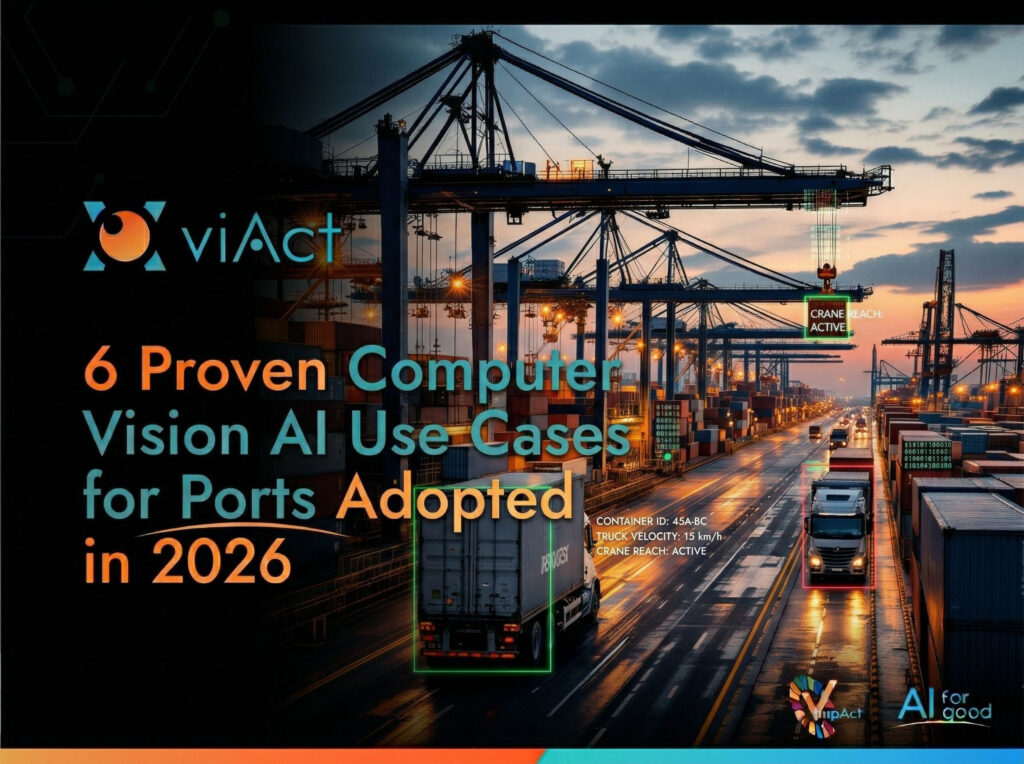

Port terminals represent the interface between international commerce and working environments where high occupational risk exists. At any point in time, there is a multitude of potentially hazardous activities occurring at these terminals; loads being suspended, large machinery operating, vessels moving in/out of the terminal, and the workers involved in these activities are all in the same live and compressed work space.
For decades, managing this complexity fell on safety officers, radio communication, and manual inspections. That model has a ceiling, and in 2026, the adoption of computer vision use cases for port operations has moved well past the pilot stage.
Ports around the world, including those in Hong Kong, Singapore, and the Gulf Cooperation Council (GCC), have begun implementing computer vision to assist with the unique, high-consequence hazards associated with port operations and have begun to show significant effects as a result.
The Risk Gaps in Port Operations that No Safety Officer Can Close Alone
The EMSA Annual Overview of Marine Casualties and Incidents 2025 states that there were 2,659 reported marine casualties and incidents in 2024. This is lower than the previous ten-year average of 2,675 (from 2015-2024). In total there have been 6,534 marine casualties and incidents during this period which resulted in 7,479 injuries which is an average of 748 injuries per year during this time period. Of the marine casualties and incidents that were investigated almost all (78.8%) had some element of human involvement while approximately two thirds (64.5 %) were attributable to direct human actions.
The statistics presented here do not reflect rare occurrences. Rather, they represent the routine cost of a monitoring model that was never designed to keep pace with the operational complexity of a modern port terminal. Manual supervisor works in shifts, and has a fixed area of visual analysis. Computer vision uses cases for port operations increases the potential of supervisors to evaluate and monitor a significant number of operational areas, continuously, and without fatigue.
The six use cases below are not theoretical. They reflect where port operators across Asia, the Middle East, and beyond are deploying computer vision in 2026 to address the specific hazards that traditional safety frameworks were never built to handle.
An unsafe load is one of the most dangerous hazards on a container terminal. Workers often work directly under a suspended container or in the swing radius of a suspended load during ship-to-shore crane operations, quay crane lifts and rubber-tyred gantry cycles. The majority of these workers are either working to deadlines or are simply unaware of the presence of a suspended load above them.
Regulatory frameworks across key port markets enforce strict exclusion zones for personnels during lifting activities. For example, the 3-3-3 lifting protocol exists within the marine department of Hong Kong, which specifies that the defined lift zone must be clear of all non-essential personnel during active hoisting. However, the number of cranes operating simultaneously at a live berth, makes it physically impossible to manually enforce 3-3-3 protocol across various cranes.
This is what computer vision does. The site monitoring system powered by computer vision defines dynamic exclusion zones at the time of lifting operation and triggers real-time alerts the moment any worker or vehicle enters the designated exclusion zone. These notifications are sent out to the crane operator, lift supervisor, and control room simultaneously, with timestamped visual snapshot as compliance records.
Real-World Results
Operators at Hong Kong’s Kwai Chung Container Terminal, faced increased risk around suspended load zones as multiple cranes operated simultaneously. Despite strict Marine Department safety codes, enforcing the 3-3-3 lifting protocol and monitoring lift exclusion zones in real-time proved structurally impossible through manual supervision alone.
To directly monitor and cover this gap, the Asia’s busiest container terminal operator implemented viAct’s AI-powered crane hoisting and safety modules. The outcome was a 10x improvement in lift zone safety score, with AI monitoring extended across all suspended load areas.
Operations at container terminals continue without interruption. The crane operators, RTG operators, and yard equipment drivers operate for 8 to 12 hours on average, with very high cognitive demands. Thus, in this context, fatigue is not just a wellness concern, but a direct operational hazard. A momentary lapse during a crane swing or a container placement due to operator’s fatigue can result in a dropped load, a crush incident or a major fatality in the site.
Traditionally, fatigue management during shifts relied on self-reporting. However, with the introduction of AI and edge-computing for monitoring in-cab operators through video feeds, the scenario of operator fatigue monitoring is changing significantly. The AI CCTVs detect fatigue-related micro-expressions, eye motion patterns, blink duration, and drop-in head position and sends supervisors an alert when chronic fatigue develops into acute fatigue before the operator’s performance decreases to an unsafe level.
For instance, viAct’s AI-powered operator fatigue monitoring module successfully reduced fatigue-related errors by both yard and crane managers, by 60% at Kwai Chung Container Terminal, thereby reducing near misses during peak congestion periods. Of all the smart port safety solutions available for use in 2026, operator state monitoring has one of the greatest ROI cases because the cost of an undetected fatigue event is both measurable and catastrophic.
Use Case 3: Straddle Carrier and RTG Proximity Detection for Yard Worker Safety
Straddle carriers and rubber-tyred gantry cranes are large pieces of equipment that are primarily found at ports. They are large, operate at high speeds, and have large blind spots under and around them, making the workers on foot sharing the same yard like the lashers, maintenance crews, surveyors, and truck drivers, more vulnerable to proximity risks.
To ensure workers are always safe while working around these types of equipment, the AI-powered proximity detection solution uses both fixed cameras and vehicle-mounted sensors to monitor the real-time location of both equipment and personnel throughout the yard. When a worker enters a pre-determined “unsafe boundary” around or near an active straddle carrier or RTG, all three stakeholders, that is, the worker, the equipment operator, and the yard controller, are immediately notified through push alerts.
Integrating the framework with fleet management systems enable port operators to monitor the patterns of vehicle movement to identify high-risk traffic corridors and determine an effective means for organizing the yard layout, as well as managing access to and within the yard. This turns reactive incident prevention into structured port terminal risk management.
Use Case 4: Snap-Back Zone Monitoring During Vessel Mooring Operations
The most port-exclusive use case and one of the most under monitored fatality in the industry are mooring operations.
As a general safety principle, all mooring lines have a defined danger zone based on their angle and tension. According to maritime safety codes, once mooring lines are being tightened, all workers must be at least 10 feet away from the lines to avoid injury. However, as mooring lines are frequently worked by multiple gangs at once, using mooring lines on multiple boats, constantly moving, alongside multiple gangs working on the berth, the enforcement of the above regulations depends solely upon the use of verbal communication and individual awareness.

In this regards, computer vision & AI-powered systems can define dynamic boundaries of snap-back zone in real-time based on the position and angle of camera detected lines. Any worker who enters the arc during active mooring is instantly detected, and automatic alarms are triggered. No periodic walkthrough can replicate this level of continuous, context-aware detection across a busy port berth.
This use case fits within the larger framework of AI in maritime risk management. The argument here is not about replacing human judgment; rather, it is giving humans a fighting chance against hazards that develop faster than human reaction time.
Use Case 5: Vessel-Berth Interface, Gangway Access and Quay Edge Safety Monitoring
When a vessel is at a berth, there is always a big risk of fall-into-water for workers crossing from the ship to shore as well as a chance of being crushed between the ship and quay. This risk is intensified during loading and unloading when the ship’s position changes as it goes up or down in the water, thus changing the angle of the gangway and the width of the gap suddenly. If a worker falls into the gap between the ship’s hull and the quay, the conditions leave very little opportunity for survival.
Computer vision powered safety systems deployed at the vessel-berth interface can monitor gangway access to identify all instances of unauthorized crossings, employees approaching the quay edge without proper clearances, and unsafe behaviour at the hull-berth boundary while the vessel is actively moving. The system provides the kind of always-on quay edge surveillance that ports cannot replicate through a safety officer stationed at the gangway foot.
Gangway access control also connects to the wider compliance documentation challenge at ports. A digital permit-to-work system paired with visual monitoring creates a verified access record that satisfies audit requirements without adding administrative burden to the team on the ground.
Use Case 6: Perimeter Intrusion, Unauthorized Vehicle Detection and Cargo Theft Prevention
Safety and security of ports have typically been treated as two different areas. However, in practice they share the same infrastructure and have the same blind spots and increasingly, the same financial consequences when either fails.
According to Verisk CargoNet Analysis, cargo theft across the supply chain costed almost $725 million in 2025. This is 60% more than 2024, with the average value per theft rising the cost to $273,990 per incidents. Ports are uniquely positioned to experience this increased risk due to their open perimeter, the high value of goods stored and the complex multi-party access.
Common concerns across ports in every region include unauthorized vehicles accessing restricted yard areas; unregistered personnel accessing vessel berths or cargo storage areas, and cargo tempering during overnight operations. Traditional perimeter security measures included access control gates, CCTV surveillance, and guard patrols. However, these security measures react after an incident has occurred rather than prevent an incident from occurring.
This is yet another strong use case of computer vision in ports. Automated Number Plate Recognition also called Automated Licence Plate Recognition (ALPR/ANPR) powered by AI video analytics can continuously read numbers plates of vehicles entering and leaving a port and cross-reference it against the list of authorized vehicles, to instantly alert any unregistered vehicle trying to enter the port premises.
Similarly, the AI-powered theft detection solutions can undergo round-the-clock monitoring of activities around storage facilities of high-value cargo, monitor access patterns outside operational hours, and monitor containers to prevent tempering, all without requiring a guard to be physically present.
AI-powered camera systems have also proven to be among the fastest-growing smart port safety solutions, allowing safety directors to manage both safety and commercial aspects of port activity simultaneously. It also complements the larger discussion about the role AI plays in port security and operational efficiency that has been a matter of prime focus across Asia and Middle East. In an environment where a single theft incident can cost a quarter of a million dollars, real-time visibility is no longer optional infrastructure, but it is core to how a port manages risk.
What Makes Computer Vision Use Cases Deliver Results at Ports?
All six use-case applications are aimed at eliminating hazards that either cannot be observed via human supervision, or cannot be checked consistently from one site to another or are too dynamic for fixed rule-based systems to keep track of accurately.
Additionally, these use cases share an underlying system architecture specifically designed for port environmental conditions. They are all designed to be able to do edge AI processing to detect accurately even in conditions of limited internet connectivity. They operate continuously on a 24/7 basis without losing capability during night time shifts and weekends, and they communicate alerts in real-time to the correct stakeholder rather than waiting for the e-mail report to be generated several hours later.
Industry players are also reacting in response. The Smart Port Market Report by Mordor Intelligence has predicted the global smart port market to expand to $11.06 billion by 2030, at a compound annual growth rate of 19.78%. Computer vision and AI-based monitoring technologies constitutes the two primary technology categories driving growth in smart ports by increasing the efficiency of the port operations and minimize the need for human oversight.
The results obtained by the Kwai Chung port operator is an ideal case that provides some valuable information about what that change looks like today: a 10x lift zone safety score improvement, a 60% drop in fatigue-linked errors, and a 50% gain in yard productivity through fewer incident-related stoppages. When the monitoring systems are able to match the complexity of the environment it is designed to protect, the results speak for themselves.
Conclusion: Key Takeaways
Ports are among the most operationally complex and risk-dense environments in the world, and the safety frameworks built around manual supervision were never designed to keep up with that complexity at scale.
The computer vision use cases covered in this blog share a common logic. Each one targets a hazard that is either too fast, too dynamic, or too distributed across a port for any human-led monitoring system to address consistently. Suspended load zones, mooring snap-back arcs, fatigue in crane operators, yard proximity risks, gangway access, and perimeter security all have one thing in common: they need eyes that are always on.
A few things worth carrying forward:
-
Suspended load zones require dynamic, real-time exclusion monitoring. Static signage and manual enforcement cannot keep pace with simultaneous multi-crane operations on a live berth.
-
Fatigue in crane and RTG operators is a detectable and preventable risk. Computer vision powered cameras identifies onset fatigues before performance fails, not after an incident occurs.
-
Straddle carriers and RTGs create blind spot risks that are unique to ports. Proximity detection built for port-specific machinery is fundamentally different from generic vehicle monitoring.
-
Snap-back zone monitoring during mooring remains one of the most under deployed safety interventions in the industry, despite being one of the most predictable and preventable fatal hazards at any berth.
-
The vessel-berth interface needs continuous coverage, not periodic checks. Gangway access and quay edge safety are active risks that shift with every tide and cargo cycle.
-
Port security and port safety run on the same infrastructure. AI-powered ANPR/ALPR closes the gap between access control on paper and what is actually moving through the yard in real time.
1. Can computer vision solutions for ports by viAct be deployed without replacing existing CCTV infrastructure?
Yes. viAct’s computer vision-based solutions for ports uses RTSP to integrate with already existing IP camera networks, meaning port operators can begin utilizing viAct AI without the need to change any of their existing camera infrastructure. The viAct platform connects with existing CCTV feeds and then toggles on the AI detection modules on top of those existing feeds allowing for a much quicker and less expensive deployment than a full hardware replacement.
2. How does viAct handle multi-operator port environments where multiple contractors share the same yard?
With the use of viAct’s Enterprise Management Platform (ECMP), safety teams can monitor various contractors, multiple zones and access levels from just one viewing space. Compliance rules and alert thresholds can be set by both zone and operator type so that consistent safety enforcement is achieved, no matter how many parties are on-site at any given time.
3. What is the difference between traditional CCTV monitoring and computer vision at ports?
Traditional CCTV monitoring systems captured and stored images for human observation after they happen. Unlike that, computer vision continuously analyzes every scene and reports unsafe events, unauthorized entry and behavioral abnormalities as they happen. Given that ports have a continuous operational cycle with vast and complex areas of operation, moving from recording video that can be viewed at a later time to real-time detection allows ports to preventing that event from occurring.
4. How does viAct’s computer vision differ from other AI safety platforms available for ports?
viAct’s solution uses unique AI scenario-based recognition systems developed through the study of actual industrial events rather than generic datasets. Therefore, the detection models have been calibrated to the specific micro-actions and risk scenarios by which they occur (e.g., snapback zone violations during mooring, fatigue onset in crane operators), instead of using a broad object identification method based on a contextually different object.
5. How does viAct ensure data privacy at ports where sensitive cargo and consignment information is visible on camera?
Privacy is built into viAct’s platform architecture from the ground up. The system processes video data locally via edge AI devices, meaning footage and consignment-related visual data never needs to leave the port site or be transmitted to external cloud servers. On-premise deployment combined with face masking and data encryption ensures that sensitive information captured on camera, including container IDs, cargo markings, and operational documentation, remains within the operator’s-controlled environment and does not expose commercially sensitive data to third parties.
viAct is a leading Impact AI company focused on improving safety and efficiency in high-risk industries. Since 2016, we’ve implemented innovative “Scenario-based Vision Intelligence” solutions across hundreds of organizations. Recognized by Forbes and the World Economic Forum, we aim for a sustainable future through responsible technology.