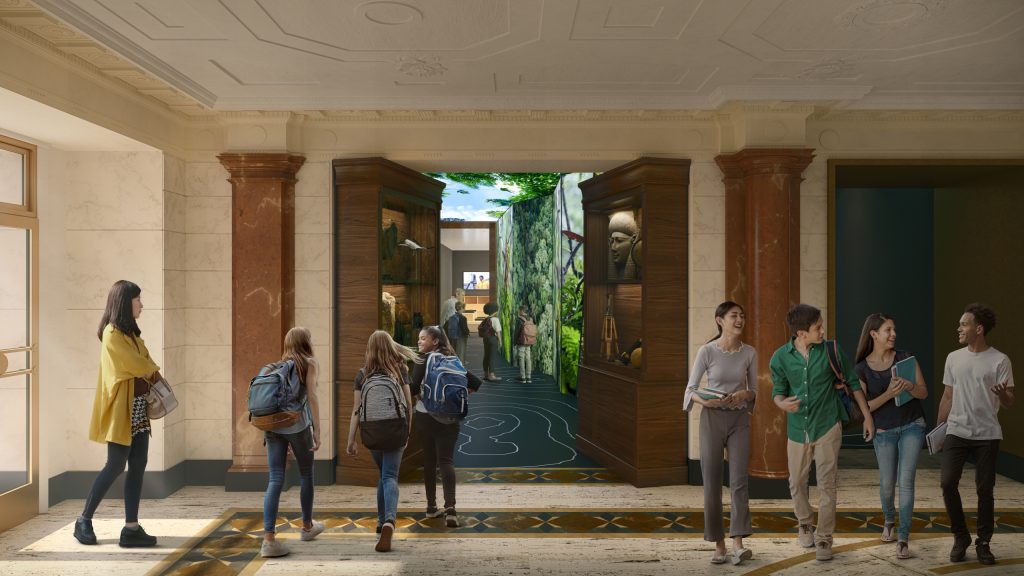

The newest wonder of the world might just be in Downtown D.C., in the form of National Geographic’s Museum of Exploration.
The National Geographic Society published its very first magazine issue in 1888 for distribution to a grand total of 165 readers. From its origins as a group of 33 scholars and scientists to what is now a ubiquitous household name, National Geographic has amassed a followership of 60 million monthly magazine readers, 280 million website and television viewers, and more than half a billion followers across its social media platforms.
Construction of the society’s D.C. campus began in 1904 with the erection of Hubbard Hall, named for the group’s first president, Gardiner Greene Hubbard. The hall was followed by an administration building in 1912-1913, the south wing and central pavilion in 1932, the Stone building in 1964—named for its architect Edward Stone—, and a fourth modern wing in 1984.
In October 2022, architect Hickok Cole and Virginia-based general contractor HITT broke ground on a fifth building: the National Geographic Museum of Exploration at 1600 M Street NW. All four original buildings will also be renovated and connected to the new museum. In summer 2026, those museum doors will open to bring a whole new world of wonder to patrons young and old.
WHAT A WONDERFUL WORLD
When designing plans for major construction projects, Hickok Cole likes to draw from inspiration. The theme for this project? Wonder. But, when designing for a space to be used by both children and adults, what does ‘wonder’ really mean? Jason Wright, principal and director of technical operations at Hickok Cole, says, “Guided by the National Geographic Society’s mission, to illuminate and protect the wonder of our world, we combined inspiration from nature with cutting-edge digital fabrication technologies to envision and then construct the unprecedented Museum of Exploration—a cultural landmark that sets a new benchmark for innovation. The natural wonder of our world provided ample inspiration and depth to encourage and educate both children and adults alike. The moment visitors enter the campus there is a series of overlapping and varied experiences that tell the story of impact and inspiration. From the plaza ecosystems, to the cases that tell the story of National Geographic, or the hidden easter eggs—each time a visitor comes to the MOE, they will learn or discover something new.”
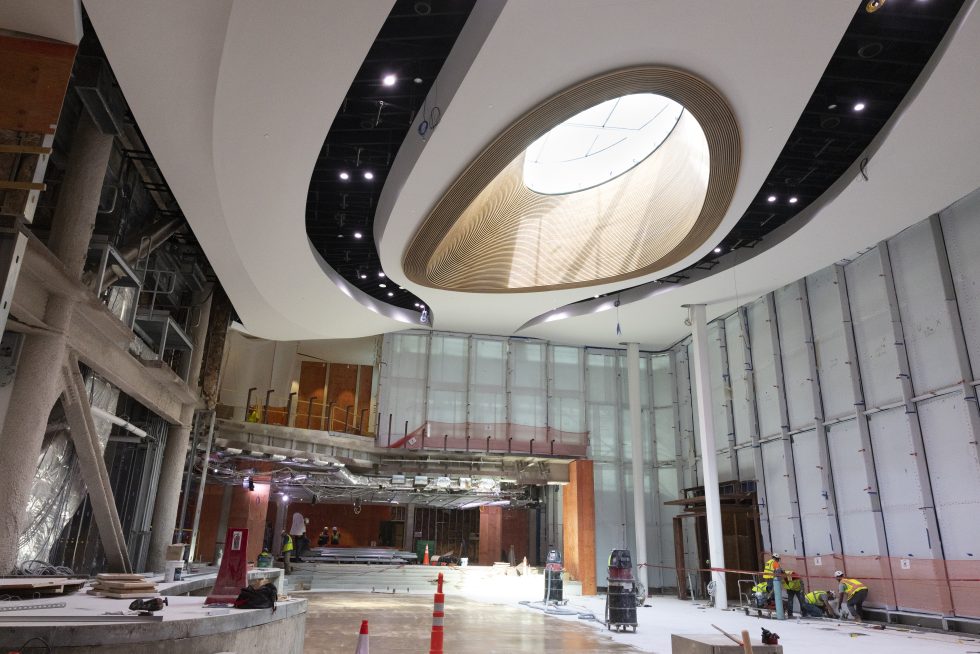
The new design will cover more than 100,000 square feet, including both original and new structures, featuring: a grand entrance courtyard which will house a larger-than-life version of the iconic yellow border; a rooftop terrace that overlooks the courtyard to host immersive nighttime experiences and other events; a main pavilion with an oculus skylight; a high-tech video wall; a new store; a renovated eatery and theater; archives, an education center dubbed the National Geographic Learning Launchpad; and so much more.
But with so much being shiny and new, that doesn’t mean Hickok Cole left out the rich history of both the National Geographic Society and of the buildings themselves. Wright says, “The new design of the museum will honor the historical 16th Street, 17th Street and M Street buildings through the preservation, renovation and expansion of the preexisting spaces. The society has always been on the forefront of discovery and utilizing new technologies in its exploration. In this project we utilized new systems that have never been done before or never been done before at the same scale.”

He goes on to detail some of the new features and experiences and how they exemplify the National Geographic Society’s legacy:
- New Courtyard and Visitor Entry Experience: Sweeping curved planters and intricate paving patterns evoke the natural forms of island archipelagos and meandering glacier rivers, welcoming visitors into an environment of discovery.
- Sculptural Pavilion Ceiling: Drawing inspiration from rippling water, this dramatic architectural centerpiece not only enhances the space’s ambiance but also serves as the foundation for state-of-the-art show systems.
- Interior Woodwork: Advanced 3D modeling meets revolutionary digital fabrication in these geologically inspired surfaces. The design captures the majesty of Arizona’s natural slot canyons, seamlessly integrating the outdoors with the museum experience.
- Auditorium Ribbons: Inspired by sand dunes and seashells, these acoustically transparent structures define the theatre space while serving dual purposes: internal illumination and a canvas for immersive presentations.
- Parametric Molded Cornice: A striking architectural feature on the facade echoing sand dunes that required complex 3D modeling never previously seen in the United States.
As wonderful as new technology, immersive and interactive experiences, and new opportunities for nightlife are, a sense of wonder cannot be created without a practical foundation—in this case, steel, concrete, and accessibility and sustainability efforts. From braille to wellness rooms and electric vehicle charging stations, bike racks, a rainwater collecting cistern and solar panels, the Museum of Exploration comprises a multitude of efforts that uphold the society’s broader efforts around the globe.
THE NEW MILLENIUM
As a leader in micro and macro sustainability efforts, it comes as no surprise that the National Geographic Society is at the forefront of some of the latest sustainability construction technology and techniques, but some things that did come as a surprise were the physical obstacles that appeared during the demolition process.
While merging the buildings from two separate centuries, Joseph Kmiecinski, vice president, site operations at HITT Contracting, had his fair share of unforeseen conditions during demolition. “Although we would not call them surprises,” he says, “we expected to find conflicts and the need to work with the team to move quickly to remediate and keep progress moving. Demolition was handled very carefully during construction, especially the structural demolition work. Specific elements to be demolished or modified were evaluated by third-party engineers specific to individual areas for bracing, shoring, construction loading, sequence of element removal, and methods of cutting and removing. Because the campus is occupied during construction, consideration of office worker protection, ventilation, dust control and access to work areas was also planned and considered.”
Just like the wildlife photographers and Antarctic scientists supported by the National Geographic Society, the contractors at HITT employed for this project loved challenging their problem-solving skills—as well as their creativity. While some elements forced them to think outside the original blueprints, others invited them to think like their inner child.
From their own mid-century inner children to the iPad child of 2025, Hickok Cole and HITT of course had to employ technology—and they got to have a little fun using it, too. According to Wright and Kmiecinski, the project is 100% BIM level 400 modeled, and HITT used its latest scanning technology throughout the project to provide point clouds of existing conditions to the coordination team. This, alongside digital fabrication and prefabrication, made navigating the complex curves, grand ceiling, auditorium ceiling, pavilion wood forms and the exterior pavilion cornice less complex.
Now here comes the fun part: The MOE was also used as a test case for HITT’s robotics team. “We used a robot to scan areas and test potential use of robotics on a construction site,” says Kmiecinski.
The Museum of Exploration was truly built for the future and should last well into it. “Just like the other structures on the campus,” says Wright, “the new pavilion and public space was designed to be a 100-year building, with durable materials and timeless design components.”
There is still work to be done before it opens next year, but construction is tracking on schedule, and the teams at Hickok Cole, HITT and the National Geographic Society are excited to show everything off—and for patrons of all ages to enjoy the space for the next 100 years.
SEE ALSO: STATUE OF LIBERTY MUSEUM USES STRUCTURAL THERMAL BREAKS