

The construction industry has never lacked data; it lacks usable intelligence at the moments that matter most. In the high-stakes phases of tendering and pre-construction, the industry still relies on manual “Control-F” searches through thousands of pages of unstructured documents.
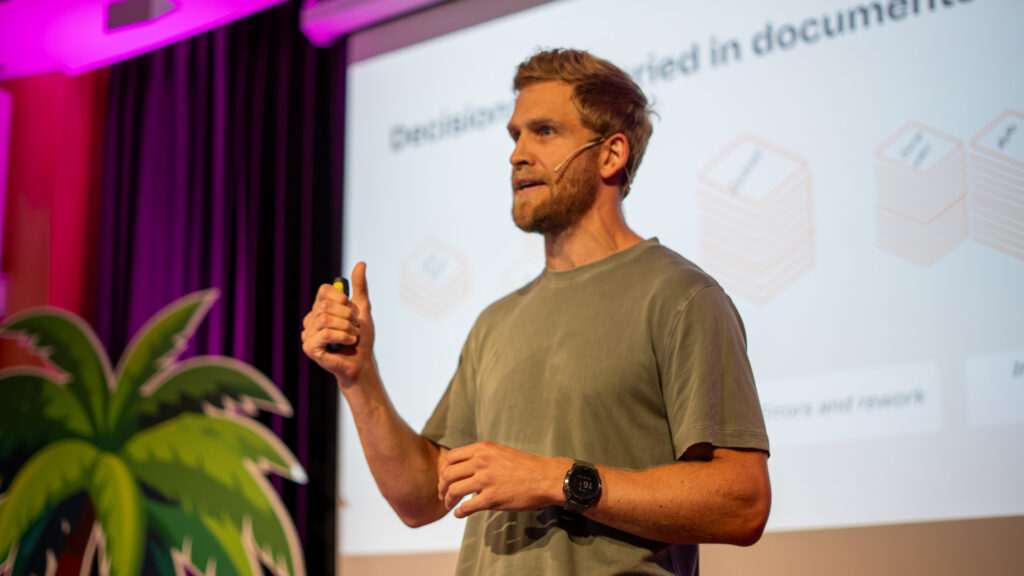
I recently spoke with Herman Smith, a civil engineer and former Chief Digital Officer at Multiconsult, who left the corporate world to solve this specific bottleneck. His startup, Volve, isn’t just another AI wrapper; it is a specialized “drill” designed to penetrate the complexity of construction documentation.
The paradox of digitalization without a productivity boost
For years, the AEC industry has faced a frustrating paradox: we have more digital tools than ever, yet productivity has not improved. Herman observed this from the inside, managing hundreds of unique software licenses while seeing companies struggle to adapt to new workflows.
“I have seen from the inside how the industry is struggling to adopt new practices and technologies,” Herman notes. “With AI emerging, the pace goes up. There’s a need to create tailored solutions that can actually apply across the industry to change something, but the established players are not able to do it themselves.”
This realization led to the founding of Volve, an intelligence platform for tendering and pre-construction.
The problem isn’t a lack of information; it’s that the core of every project sits within a massive set of documents where responsibilities are defined and risk goes “sky high”. If a team misses a single requirement in a 1,000-page Request for Proposal (RFP), the cost can be devastating for both the contractor and the client.
The “Swiss army knife” vs. the specialized drill
One of the most compelling insights from our discussion was Herman’s perspective on the current AI landscape. As Large Language Models (LLMs) like ChatGPT become ubiquitous, many firms are tempted to build their own internal “Custom GPTs”. Herman warns that this approach has significant limitations in a professional engineering context.
“I compare these general solutions to a Swiss Army knife,” Herman explains. “They can do a little bit of many things, but if you push them too hard, they will break. In construction, you don’t use a Swiss Army knife on-site; you use very specialized tools for each process. I see Volve as a drill”.


Generic AI solutions often fail in AEC for two primary reasons:
- Context Window Limitations: They are often unable to handle the sheer volume of information a multi-billion-dollar infrastructure project entails.
- The “Hallucination” Risk: LLMs are creative by nature, but creativity is a liability when you need to know the exact technical requirements for a bridge’s concrete grade.
“Generic AI can give you a flavor of really good outputs, but it will never give you the same flavor twice, and it can also give you false flavors,” says Herman. To counter this, Volve builds advanced agentic pipelines and leverages Retrieval-Augmented Generation (RAG) to ensure that every answer is anchored in the project documents.
Turning text into normalized data
The core of Volve’s value proposition is its ability to “normalize” the chaos of construction documentation. Whether a client uses a Finnish standard, a FIDIC contract, or a bespoke template, the platform crunches the text and treats it as data rather than just prose.
Once a project team “dumps” their 40 or 1,000 documents into the platform, Volve takes about 20 minutes to crunch through and organize the information. From there, users can trigger specific “features” or workflows:
- Legal Risk Review: Scanning for critical contract terms.
- WorkPack Extraction: Translating consultant requirements into site-ready language (e.g., turning “structural engineering” requirements into specific “cast-in-place concrete” tasks).
- Standard Deviation Detection: Identifying where a specific RFP deviates from industry standards.
“We don’t have a better format than documents today to describe these projects,” Herman admits. “We go on top of that and fill the gap between the documents and the intelligence needed for decision-making”.
From tendering to execution: The learning loop
The industry’s greatest weakness is arguably its inability to learn from past mistakes. Most knowledge resides in the heads of senior experts and leaves the building when they retire. Volve attempts to institutionalize this knowledge by allowing firms to upload historic tender feedback.
“Construction is not known to be learning more than you and me being experts and learning from ourselves,” Herman observes. “We can apply learning so that when a client tells you that you lost a bid because of X, the system automatically gives you feedback next time you call it to enhance your next bid”.
This “learning loop” extends into the execution phase through change assessment. By uploading meeting minutes, change requests, and claims, contractors can use the platform to build data-driven arguments for their positions during negotiations.
Eventually, the strategic value of AI emerges not by focusing on a single project at a time, but by considering the entire project portfolio, past and present, as a data asset.
The Human in the Loop: Responsibility in the AI Age
As AI moves closer to the point of decision-making, the question of liability becomes paramount. Herman is clear that Volve is a “superpower support” tool, not an automation of the human professional.
“The final responsibility is with the person making the decision,” Herman insists. “That’s why we always provide sources back to the original document. We don’t know the risk appetite of our clients. We can provide a proposal, but we cannot replicate the Redline process without the user’s input”.
Implications for the industry
The emergence of tools like Volve suggests a shift in how AEC firms will compete in the near future. It is no longer enough to have the best engineers; firms must have the best “operating layer” for their project data.
When general contractors like Skanska or NCC use these platforms to enhance the quality of their bids, the “subjective” parts of a proposal, such as methodology and risk mitigation, become more robust and data-driven. As Herman notes, some clients are already reporting that they are winning more projects because they can demonstrate to public clients that they respond precisely to every requirement without error.
The goal is not just time efficiency; it is business impact. In an industry where margins are razor-thin, the ability to control risk and win the ‘right’ projects is the ultimate competitive advantage.
The question for AEC leaders is no longer whether to use AI, but how to use it. They must decide whether to rely on a “Swiss Army knife” or invest in the “drills” built for the rigors of the industry.
The title image is courtesy of Volve.






