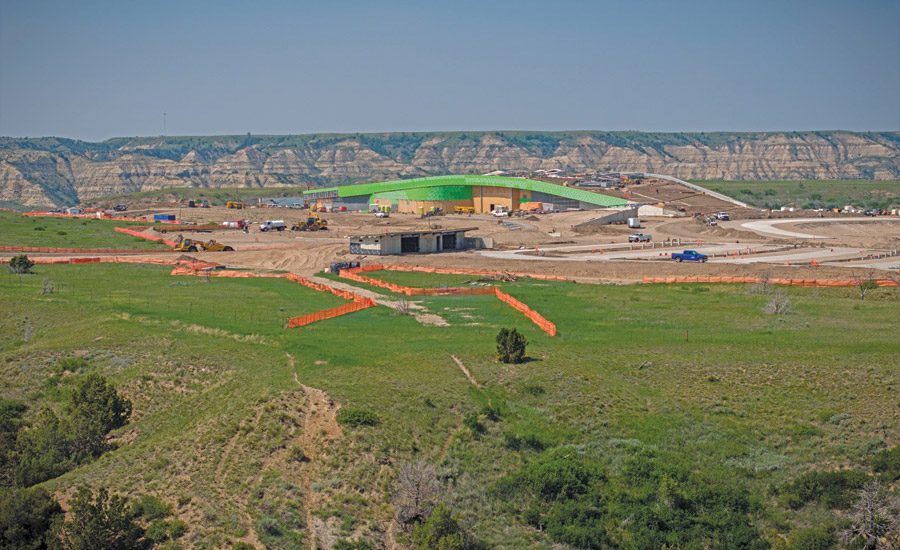

Honoring America’s larger-than-life 26th president, known for his commitment to preserving the environment and his exuberant public persona, the Theodore Roosevelt Presidential Library is being constructed atop a butte with only one road into and out of the rugged terrain of the North Dakota Badlands, offering dramatic views of the surrounding multicolored striped hills, sharp ridges, gullies and canyons.
Construction of the $450-million structure in a harsh, irregular landscape is one challenge faced by the team building the library and museum on a 93-acre site in Medora, N.D., just west of the Burning Hills Amphitheater and adjacent to Theodore Roosevelt National Park.
“One of the most significant construction challenges has been navigating the rugged terrain of the North Dakota Badlands, which demands careful planning around site access, logistics and environmental protection,” says project manager Trevor Leingang of Kansas City, Mo.-based JE Dunn Construction, construction manager for the 96,000-sq-ft facility. It broke ground in June 2023 and is set to open on July 4, 2026.
The building was designed by architecture firm Snøhetta, which has offices in Oslo and New York City. JLG Architecture, founded in Grand Forks, N.D., serves as architect-of-record. Snøhetta is known for designs that thoughtfully blend natural landscapes with forward-thinking architecture.
Describing the building, Craig Dykers, founding partner of Snøhetta, says “the main library building rises from the butte, echoing the surrounding landforms. Visitors are invited on a journey through a preserved landscape of diverse habitats, punctuated with small pavilions providing spaces for reflection and activity.”
Elements include a walkable green roof, large windows, rammed earth walls and a campus dotted with walking trails and other public spaces planned to highlight the natural environment and Roosevelt’s strong interest in conservation.

Mass timber was chosen for the project due to its ability to store carbon and because it creates a warm and natural atmosphere that connects to the surrounding landscape.
Photo courtesy of JE Dunn Construction
Timber Takes Center Stage
Timber, which plays an important role in the building “was selected for its renewability and ability to store carbon, aligning with Roosevelt’s conservationist values,” Leingang says. “Much of the material is sustainably harvested and prefabricated, which helps reduce waste and supports efficient construction.”
He points out that “this approach allows the building to feel warm, natural and deeply connected to the surrounding landscape—an embodiment of Roosevelt’s belief in preserving and wisely using natural resources.”
Mercer Mass Timber, Spokane, Wash., has provided nearly 1,800 cu meters of cross-laminated timber and glue-laminated timber (glulam). The roof structure is built with glulam beams, and the timber in the ceilings was designed to support the green roof that is planted with native vegetation.
All of the structural steel that bolsters the frame, steel columns and hangers are clad in glulam timbers to create an all-wood ambience.
The library is being built with 1,800 cu meters of cross-laminated timber and glue-laminated timber.
Photo courtesy of JE Dunn Construction
“We have a part steel, part mass timber building, and a lot of those connections can be tricky,” says Tony Erickson, director of design and construction for the library. “JE Dunn did a lot of site visits to the plants [providing the steel and timber] and a lot of mock-ups.”
Leingang agrees that “one of the project’s major complexities lies in integrating those prefabricated mass timber elements—glulam and cross-laminated timber—with the concrete and steel systems.” He notes that “this has required detailed early modeling, extensive use of BIM and mock-ups to ensure precision and avoid surprises.”
The structure’s western wing will have 40,000 sq ft of exhibition space, a café and gift shop; the eastern wing will house administrative offices, academic spaces, classrooms and a 300-seat auditorium.
“We have a part steel, part mass timber building, and a lot of those connections can be tricky.”
—Tony Erickson, Director of Design and Construction, Theodore Roosevelt Presidential Library
If connections between the steel and timber had not gone smoothly, Erickson says it would have increased the project cost and extended its schedule—which is regarded as immovable. The building’s opening date is set to coincide with the 2026 celebration of the country’s 250th birthday.
“There isn’t a lot of leeway for these types of things [that involve rework] to happen,” Erickson says.
To address the harsh terrain, and equally harsh weather, JE Dunn “has implemented strategic staging areas, defined haul routes and prioritized stewardship of the sensitive landscape,” Leingang says.
“It’s up on a butte, and there’s only one road in there,” Erickson adds. “It’s very difficult working all winter long. There were days when it was minus 10 degrees, and they were still out there pouring concrete—that’s when most of the foundation work was done.”
Leingang says the team has dealt with the region’s sometimes difficult weather—marked by high winds, temperature extremes and sudden storms—by taking a flexible approach. “We’ve built in schedule buffers, selected weather-resistant materials and adapted workflows to align with seasonal conditions,” he says.
In keeping with Roosevelt’s lifelong commitment to conserving America’s environment and natural resources—the former president who served in office from Sept. 14, 1901, to March 4, 1909, was pivotal in establishing the U.S. National Park System, and he frequently visited North Dakota. The project is striving for Living Building Challenge sustainability certification, which Erickson says is more demanding than LEED Platinum certification.
A construction team member passes a hand across a rammed earth wall inside the library.
Photo courtesy of JE Dunn Construction
The nonprofit International Living Future Institute provides the certification, which imposes various requirements including not using materials containing a banned list of chemicals such as formaldehyde, volatile organic compounds and toxic heavy metals that include arsenic, cadmium and mercury. It also prioritizes local sources for materials and requires submitting detailed product data.
“It was a learning curve for both JE Dunn and us,” Erickson says. “We had to figure out the vetting process.”
In one example, the team worked with Dickinson Ready Mix & Concrete Products, Dickinson, N.D., to develop a lower carbon concrete mix. Erickson says the type of portland cement used in the project contains more fly ash than usual, which is a more sustainable solution.
Ben Olin, the company’s ready mix division manager, says the cementitious mix used for the project has 70% recycled materials, including fly ash, and 30% cement.
“It’s unheard of in this area—in western North Dakota, in a town of 200 people—because it’s so aggressive in terms of its replacement rate,” he says.
If the building earns its Living Building status, Erickson says it will be a huge achievement, since the museum-library will be only the 36th structure worldwide to meet the standard.
Workers pour concrete while a mass timber wall is installed in the library’s interior.
Photo courtesy of JE Dunn Construction
Keeping the Workforce Engaged
At peak, the project will employ more than 150 workers on site, including carpenters, ironworkers, electricians, plumbers, masons, glaziers, roofers and mass timber installers.
Keeping the many different project contributors on track is another challenge.
“We’ve built in schedule buffers, selected weather-resistant materials and adapted workflows to align with seasonal conditions.”
—Trevor Leingang, Project Manager, JE Dunn Construction
“To maintain alignment and clear communication across all stakeholders, we conduct weekly all-hands coordination meetings, regular owner-architect-contractor sessions and use tools like Autodesk and model-based coordination platforms for real-time documentation,” Leingang says.
He adds that daily jobsite manager huddles and owner walk-throughs further support transparency and ensure that all team members stay informed and engaged on the project that seamlessly blends architecture with ecology.
“This approach transforms the building into more than just a structure—it becomes a living dialogue between past, present and future, echoing the multifaceted legacy of Theodore Roosevelt himself,” Leingang says.
The manager describes being part of the project as a “once-in-a-career opportunity—not just due to the technical complexity, but because of the deeper meaning behind it.” He says, “Knowing that we’re contributing to a legacy that blends innovation with purpose is incredibly fulfilling, and working alongside a team of passionate craftpeople and visionary designers makes every challenge worthwhile.”