 Skip to content

I view airport terminals not only as a passenger but also as someone deeply engaged with their architectural DNA, first as a designer and later as a management consultant.
In the 1990s, when my company won the design-build competition for the Helsinki Airport domestic terminal, we were already grappling with the complexities of passenger flow and the travel experience.
At that time, 3D modeling was a slow, painstaking process, where high-quality renders could take hours to produce. Yet even those rudimentary visualizations helped decision-makers grasp concepts that 2D floor plans simply couldn’t convey.
Air travel stress at the airport
A 2023 report from The Hill noted that 40% of Americans feel stressed about flying, with about 5% avoiding it. Most stress at airports stems from three core factors: time pressure and uncertainty (fear of missing the flight), loss of control, and sensory overload (crowds, noise, and complex navigation).
A recent case study used wearable sensors (electrodermal activity, heart rate) and video analysis to map stress levels throughout the airport journey. It found that stress peaks sharply during security screening and boarding, and that the main triggers are:
- Time sensitivity and uncertainty (e.g., “Am I in the right queue? Will I be late?”)
- Interactions with authority figures (e.g., security agents)
- Crowding and confined spaces, especially when interacting with strangers


Simple communication is best
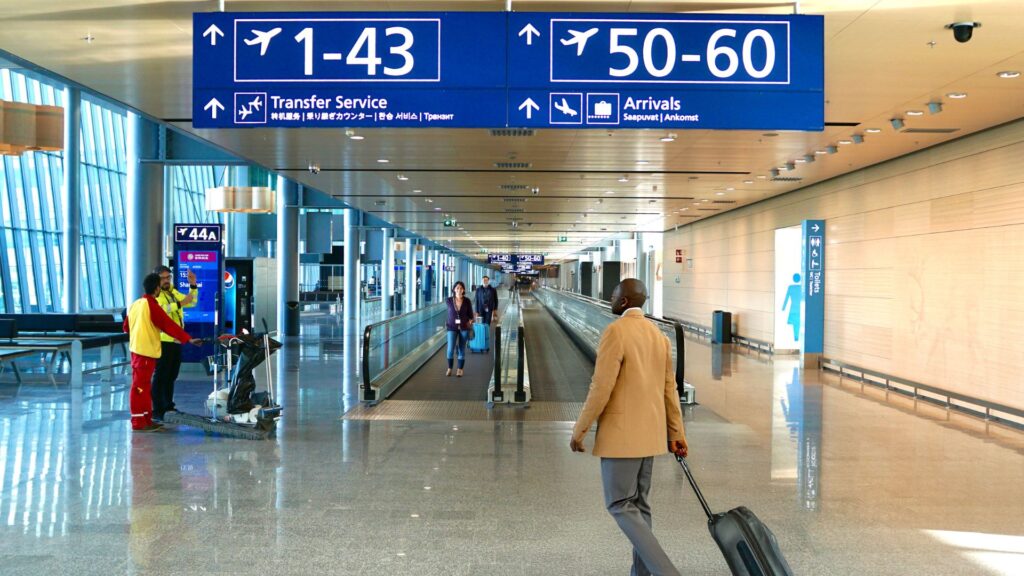
Airport design plays a big role in the passenger experience. Stressful terminals are often characterized by long, narrow corridors, poor acoustic design (echo and noise), harsh lighting, and confusing layouts that make navigation difficult. Modern “stress‑reducing” terminals increasingly use environmental psychology: natural light, greenery, calm materials, and clear wayfinding to lower cortisol and perceived anxiety
During the Helsinki airport project, I was assigned an unexpected task: creating wayfinding maps and signage for the terminal. I sought advice from a veteran UX designer. His advice was transformative: “You have to design the signage so that a 7-year-old can understand it.”
If a child can navigate your terminal, your most stressed adult passenger can, too.
The “Virtual Safari”
The principle of reducing complexity to its most intuitive form applies not only to the physical environment but also to the design phase. Instead of using 2D drawings, virtual, interactive models and simulations help in understanding and decision-making.
During the most recent Helsinki Airport extensions, this collaborative design process evolved into what Finavia called “Virtual Safaris“. By running a Unity 3D model on a large screen during nearly every meeting, project stakeholders could perform virtual walkthroughs.
These sessions weren’t just for aesthetic approval; they informed critical operational decisions, from optimizing passenger flow to the precise placement of security cameras. This level of immersion allowed even those who couldn’t read technical plans to provide feedback on the terminal’s functionality.
Today, the BIM-based design practice has grown significantly. The billion-euro Helsinki Airport Development Program used more than 400 detailed models and involved more than 200 designers across eight organizations.
The rise of the “customer experience” digital twin
When we discuss BIM, we most often focus on the technical aspects of the design and construction. The industry is now extending beyond these design-phase previews toward “evergreen” digital twins, and even what I call “customer experience digital twins.”
A great example is Vancouver International Airport’s (YVR) digital twin. The airport’s vision to reimagine the passenger experience led YVR to build the first-to-market real-time 3D digital twin of an airport in North America in 2022.
YVR used CAD and Revit files, images, and lidar scans to build a virtual replica of the airport in Unity. The digital twin aggregates hundreds of disparate data sources into a single, intuitive platform. The airport uses the twin to manage increased passenger, baggage, and cargo volumes, saving resources and avoiding physical expansion. It also helps reduce the airport’s carbon emissions.
The YVR Digital Twin monitors queues at check-in, pre-board screening, customs, and connection points using sensors, cameras, and AI-driven analytics. It identifies potential congestion areas and enables staff to be redeployed where most needed, ensuring a seamless and consistent passenger experience.

A future grounded in data
As Lynette DuJohn, the former CIO of the Vancouver Airport Authority, stated, an airport is a city, a construction zone, and a mall. Airports are ideal, controlled environments for innovation in built-environment technologies.
The most significant shift in modern airport design is the move from subjective opinion to objective data. Whether simulating passenger queues to optimize staffing or analyzing solar panel placement to meet ESG goals, decisions are now supported by empirical evidence.
With this level of technical support, at least the environmental stress of air travel can be significantly reduced.







