

Amid all the AI hype, it was refreshing to catch up with Augmenta’s co-founders again. When I interviewed them in late 2024, the Canadian startup already stood out. They provided clear evidence that AI could accelerate design work while improving quality and sustainability in construction. Now, they have crossed the hardest ConTech threshold: repeat usage.
Francesco Iorio’s and Aaron Szymanski’sbackgrounds in design technology and industrial design provided fertile ground for turning an idea into an AI company. They met by chance at a wedding and discovered they were tackling the same problem from different angles. Both were frustrated by rigid design tools that failed to address the industry’s efficiency and quality challenges.
Francesco had applied machine learning and generative design in a novel way at Autodesk. Encouraged by the results, he and Aaron founded Augmenta in 2019. They identified electrical raceway design as an ideal first challenge for generative design. It became the initial module of the Augmenta Construction Platform (ACP).


AI automates millions of small decisions
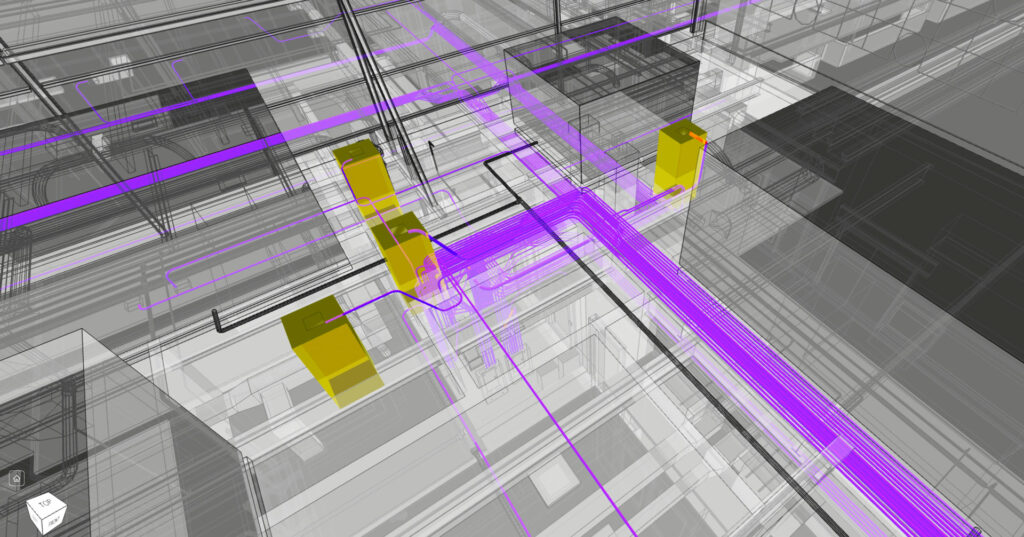
Raceway design involves mapping the routes of all wiring, their protection, and their interconnections with electrical fixtures. This must be done over long distances and through complex, three-dimensional space. At the same time, routing decisions must comply with safety codes, ensure maintainability, and optimize for cost, prefabrication, and installation.
It is no surprise that manual raceway layout and routing often take weeks in BIM tools, given the millions of small decisions involved. It takes professionals years to truly master this task.
ACP changes how raceways are designed by automating the laborious parts of the process while leaving critical decisions to the designer. The system can generate multiple feasible design solutions rather than a single fixed output. With AI, tasks that used to take days or weeks can now be completed in hours.
Augmenta does not aim to turn novices into instant experts; instead, it amplifies the expertise of seasoned professionals.
Measurable benefits and repeat projects
The technology proved its worth in its first real-world applications, most notably the widely reported Mt. Hope Elementary School project. The electrical contractor, C&R Electric, reported a 25% reduction in design time, a 15% reduction in material waste, and faster prefab readiness, all attributed to Augmenta. Since then, C&R has used ACP on other projects with continued compounding performance improvements.
Following the official launch of ACP in April 2025, the customer base has grown significantly, all in the U.S. The scale of projects has also expanded, not just to schools but also to hyperscale data centers, large manufacturing facilities, and pharmaceutical labs.
Some customers are already using ACP on their second or third project. This is a strong signal that adoption is driven by real work, not experimentation.

Not your typical SaaS rollout
A typical SaaS onboarding is standardized and designed to get users “up and running” quickly with minimal human assistance. Users explore features independently and submit support tickets when issues arise. Pricing is usually seat-based, with managers purchasing additional licenses if adoption appears productive.
This is not how Augmenta conducts rollouts.
The company works closely with customers, typically with one or more senior BIM or VDC professionals serving as internal champions. Training is tied to real projects, a differentiator that customers consistently highlight.
Onboarding begins with a live project rather than a sandbox. The goal is to demonstrate value under real constraints: tight schedules, coordination challenges, standards, and delivery pressure. This approach avoids the familiar “looks good in a demo, fails in production” problem.
ACP pricing is not based on individual seats. Instead, Augmenta uses a value-based, organization-level pricing model that reflects a customer’s expected project volume, team size, and overall design throughput.
Proactive support
Augmenta’s BIM experts actively help configure, test, and validate outputs, reducing risk for customers already stretched by delivery demands. “Our BIM team is larger than our sales force,” Francesco notes.
Because ACP is a cloud platform, the team can detect issues early, making support proactive rather than ticket-driven. This is particularly important for complex design automation, where users may not immediately understand why something did not work as expected.
Internal champions gradually become resident experts who support their VDC teams and take ownership of the platform. Their feedback, in turn, is invaluable to the software developers.
From machine learning to human learning
Augmenta combines classical rule-based logic with machine learning and optimization algorithms. These algorithms systematically explore routing alternatives to minimize cost, material usage, bends, and clashes.
Users interact with the AI by placing equipment in a BIM model, defining spatial preferences, providing schedules and specifications, selecting parts, and applying templates and rulesets.
The company is now extending its foundational technology to enable agentic, iterative collaboration with AI beyond traditional design optimization. The goal is not to bypass professional judgment, but to allow users to intentionally control the AI’s level of autonomy, avoiding what is often described as “black box AI.”
There is a belief that AI could relieve the construction labor shortage in the future. The talent shortage is not just about headcount; it also reflects the loss of accumulated expertise as senior professionals retire. Augmenta addresses this by embedding construction knowledge and manufacturability logic directly into the design process, helping younger designers achieve greater productivity more quickly, without years of trial and error.
Accuracy and shortened lead times contribute to sustainability
Construction has a significant impact on material and energy use. Approximately one-third of building materials are wasted due to overdesign, manual errors, and rework; problems that ACP helps address. “If it can’t be built, it shouldn’t be designable” is the idea.
The foundation for long-term building performance is laid during design. ACP helps ensure buildings are maintainable and energy efficient from the outset.
The company’s efforts and achievements were recognized in Cleantech Group’s 2026 Global Cleantech 100, whose selection criteria emphasize innovativeness, market readiness, and scalability, not just research or prototypes.
Moving upstream and making coordination redundant
The founders are preparing Augmenta’s next move: applying its spatial AI technology to mechanical and plumbing systems. This opens up broader optimization opportunities but also increases complexity.
“We’re going to be routing all three trades simultaneously. It is a significantly more complex problem from a software engineering perspective, which is also why it’s so much more valuable,” says Aaron.
This shift brings another fundamental change. Coordination, as we know it, becomes redundant as AI agents handle it by default. “Coordination is waste. It is an after-the-fact process,” as Aaron puts it.
The next interview will be even more interesting once these new modules move from roadmap to reality.
Listen to my previous interview with Aaron and Francesco






