
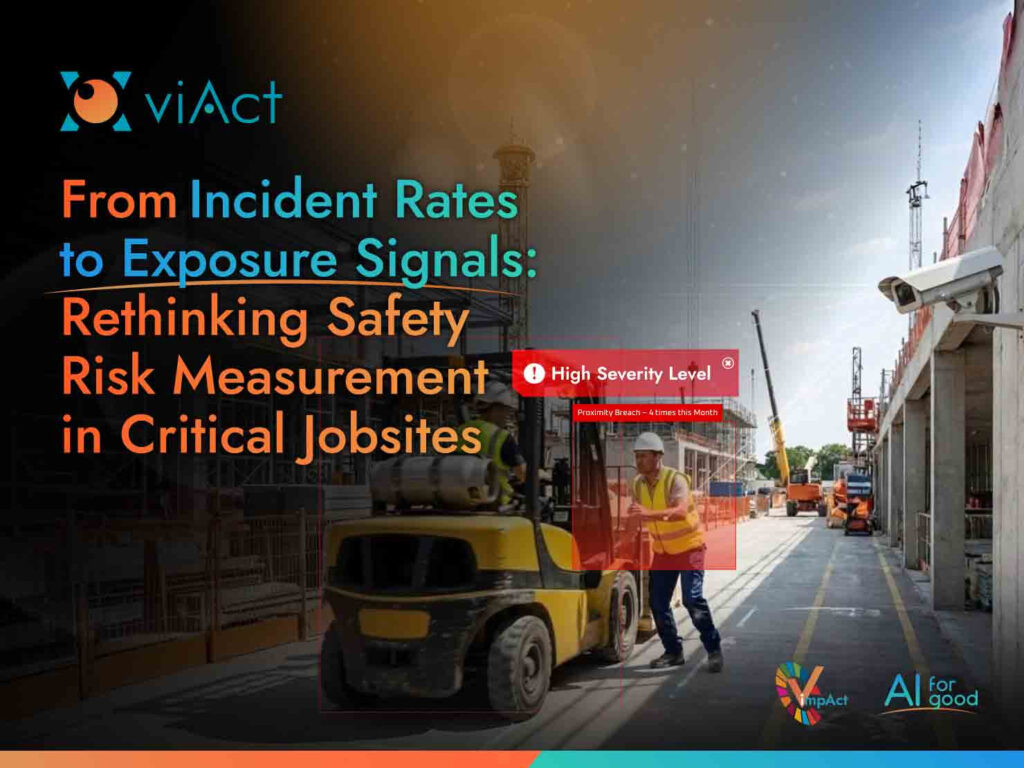

Let’s walk through a large construction site nearing completion!
The safety dashboard looks reassuring—no recordable incidents in the past 90 days, no lost time injuries (LTIs) and the project timeline looks accurate.
Yet, on the ground, workers routinely walk beneath suspended loads, forklifts pass within inches of pedestrian routes, and temporary barriers are repeatedly shifted to accommodate schedule pressure. The site is officially “safe” by traditional metrics, but any experienced safety leader knows the reality is far more fragile.
This disconnect is not unique.
Across high-risk industrial sectors like construction, manufacturing, oil & gas, mining, logistics, or shipping operations, safety performance is still largely measured by what has already gone wrong. Metrics such as Total Recordable Incident Rate(TRIR) and Lost Time Injury Rate remain central to reporting and compliance.
However, they tell a story only after harm has occurred.
As jobsites become more complex, dynamic, and AI-driven, the safety risk measurement across industries is undergoing a quiet but fundamental shift: from incident counting to exposure reduction. This evolution reframes safety not as the absence of accidents, but as the continuous management of risk exposure before incidents happen.
What are Exposure Levels in Workplace Safety?
Exposure levels in critical jobsite risk assessment measure how often, how long, and how intensely workers interact with hazardous conditions. Unlike incidents, exposure is continuous. It accumulates quietly, often invisibly, until an event occurs.
Exposure-based safety risk measurement focuses on:
-
Frequency: How often unsafe conditions occur
-
Duration: How long workers remain exposed
-
Severity: How dangerous the exposure is if it escalates
-
Repetition: Whether the same risks persist over time
These scenarios can occur across different industries as follows:
-
Construction: Repeated worker presence under crane lifting paths
-
Manufacturing: Extended time spent near unguarded machinery
-
Oil & Gas: Persistent exposure to high-temperature or flammable zones
-
Mining: Vehicle–personnel proximity in confined haul routes
-
Warehousing: Congestion-driven near-collisions during peak hours
None of these may immediately result in injuries, but all significantly elevate risk.
Why the Shift from Incident Counting to Exposure Reduction in Safety Risk Measurement is Accelerating
In 2026, several forces acting around the operations of a critical site are driving this industry-wide change.
-
Increasing Jobsite Complexity: Modern industrial sites are no longer static. Layouts change weekly, workflows overlap, and contractor density fluctuates. Risk is dynamic, not fixed.
-
Regulatory and ESG Pressure: Regulators and investors are demanding proof of proactive safety management, not just low incident numbers. Safety maturity is increasingly judged by systems, not statistics.
-
Advances in AI and Sensing Technologies: Computer vision, video analytics, edge AI, and machine learning now make it possible to measure exposure continuously and objectively—something that was previously impractical at scale.
-
Lessons from High-Consequence Incidents: Major industrial serious injuries and fatalities (SIFs) often reveal a long history of ignored near-misses and exposure signals. Post-incident investigations consistently show that warning signs were present but unmeasured.
From Observations to Signals: The Role of AI in Exposure Measurement
Traditional safety observations rely heavily on manual reporting—spot checks, walkthroughs, and checklists. While valuable, they capture only snapshots of reality. Today, AI-powered systems for safety management transform this model by converting everyday activity into structured exposure signals.
According to Markets and Markets, the global AI risk management model is predicted to reach an estimated USD 10.5 billion by 2029. With companies like Amazon, IBM and Microsoft using AI to automate risk assessment the a CAGR of 12.9% is expected during this period.
For example, when the static CCTVs in an industrial environment are integrated with AI modules equipped with computer vision and video analytics, they can:
-
Detect unsafe behaviors automatically (e.g., unsafe proximity, PPE non-compliance)
-
Measure time spent in high-risk zones
-
Track frequency and recurrence of near-miss events
-
Classify environmental conditions (congestion, poor housekeeping, restricted access)
-
Generate objective, time-stamped datasets at scale
This shifts safety measurement from subjective observation to continuous, data-driven insight.
Key Exposure Signals That Matter on Critical Jobsite Risk Assessment
As safety management evolves beyond incident counting, the focus shifts from tracking isolated events to quantifying patterns of exposure that precede incidents. Mature safety programs recognize that not all data is equally valuable. Instead of monitoring dozens of disconnected indicators, they concentrate on a small set of high-signal exposure metrics—leading indicators that reveal how risk is forming, accumulating, and persisting within real operating environments.

Here are some of the effective exposure signals that can predict a site’s safety levels:
1. Near-Miss Frequency Index
Near-miss reporting is often treated as anecdotal warnings rather than measurable indicators. However, when analyzed systematically, near-miss frequency becomes one of the most powerful leading indicators of underlying risk.
A Near-Miss Frequency Index tracks how often similar unsafe interactions—such as worker–vehicle proximity, intrusion into danger zones, or near-contact with moving equipment—occur within the same location or task. AI-powered video analytics enable these events to be detected consistently and logged automatically, removing reliance on voluntary reporting.
Over time, clusters of recurring near-misses can be visualized on safety heatmaps with color-coded areas or mapped onto a site’s digital twin, revealing risk concentrations that may not yet have produced incidents. A rising near-miss frequency, even in the absence of injuries, signals increasing exposure and deteriorating control effectiveness.
2. Exposure Duration Score
While frequency indicates how often risk appears, duration captures how long workers remain exposed. This distinction is critical. A worker briefly crossing a high-risk zone is fundamentally different from one operating within it for extended periods.
An Exposure Duration Score measures cumulative time spent in hazardous conditions—such as proximity to heavy machinery, presence within lifting zones, or exposure to environmental hazards. AI systems calculate this continuously by tracking movement patterns and dwell time within predefined risk areas.
When aggregated across workers, shifts, or zones, duration-based metrics reveal chronic exposure that may otherwise be normalized as “part of the job.” Trending exposure duration over time allows EHS teams to evaluate whether engineering controls, workflow changes, or scheduling adjustments are genuinely reducing risk—or merely shifting it elsewhere.
3. Severity-Weighted Risk Index
Not all exposure carries the same potential consequence. To reflect this reality, advanced safety programs apply severity weighting to exposure signals, transforming raw event counts into meaningful risk indices.
-
A near-miss involving a pedestrian and a light utility vehicle may carry a lower severity weight.
-
A similar near-miss beneath an active crane lift or near heavy haulage equipment carries significantly higher potential consequences.
By combining frequency, duration, and severity, organizations can generate a Severity-Weighted Risk Index that more accurately represents true risk. These indices feed into site-wise safety scores to find where your business stands, enabling comparison across projects, zones, or contractors while maintaining context about risk magnitude—not just activity volume.
4. Recurrence Ratio
One of the most revealing exposure signals is recurrence. A single unsafe act may reflect a momentary lapse; repeated occurrences indicate systemic failure.
The Recurrence Ratio measures how often the same unsafe condition or behavior reappears after corrective action has been taken. High recurrence suggests that controls are ineffective, poorly designed, or inconsistently enforced—shifting the focus away from individual behavior toward process and system design.
Tracking recurrence over time supports trend-based safety management, where success is measured not by temporary compliance but by sustained risk reduction. When recurrence ratios decline, it provides objective evidence that interventions are working.
Visualising Exposure through Proactive Safety Management: From Dashboards to Decisions
One of the most transformative aspects of exposure-based safety measurement is how risk becomes visible. For decades, safety data has lived in spreadsheets, incident logs, and static reports—useful for compliance, but disconnected from the dynamic reality of worksites.
Exposure-focused visualisation changes this by translating continuous operational data into intuitive, decision-ready insights.
Modern safety dashboards do more than display numbers. They contextualize risk in space and time, allowing safety leaders to see where exposure is accumulating, how it is evolving, and whether interventions are working.
For instance, heatmaps reveal high-exposure zones within a site, often highlighting risks that have become normalized through routine activity. Trend lines show whether near-miss frequency or exposure duration is increasing or stabilizing over time, shifting conversations from isolated events to systemic patterns. Comparative exposure scores enable objective benchmarking across shifts, contractors, or locations, while before-and-after views validate the effectiveness of corrective actions.
|
Quick Case Insight: A construction giant in Singapore managing multiple sites used viAct AI modules for exposure level-based monitoring for recurring hazards like PPE non-compliance and near -misses around heavy machinery, confined spaces and open edges.
“Within six months of deployment, we were free from fragmented safety data management across sites. Our safety score improved 10 times and we saved 7000+ working hours” – says the EHS Director of the Firm.
Know how: https://www.viact.ai/case-studies/singapore-construction-giant |
This visual, evidence-based approach fundamentally changes how safety decisions are made. Instead of debating perceptions or relying on lagging indicators, teams can prioritize interventions based on measurable exposure reduction, aligning safety efforts with real operational risk.
How Visualisation Changes Safety Decision-Making
|
Traditional Safety View (Before AI) |
Exposure-Based Safety View (After AI) |
|
Safety performance is reviewed monthly or quarterly |
Safety exposure is monitored continuously from mobile devices, whether on-site or off-site |
|
Decisions driven by incident counts |
Decisions driven by exposure trends |
|
Risk discussed qualitatively |
|
|
Near-misses treated as isolated events |
Near-misses analyzed as recurring patterns |
|
Corrective actions were evaluated subjectively |
Impact validated through before-and-after data |
Rethinking Safety Risk Measurement: From “How Many” to “How Much”
The most profound change exposure-based measurement brings is philosophical.
Safety leaders begin asking:
-
How much risk are we allowing every day?
-
Where is exposure accumulating silently?
-
Which controls are failing repeatedly?
This shift aligns safety with systems thinking—recognizing that incidents are outcomes of unmanaged exposure, not random events. It represents a maturation of safety thinking—one that prioritizes prevention over reporting, foresight over hindsight, and systems over statistics.
In an era where safety performance is increasingly tied to operational excellence, sustainability, and trust, the most resilient organizations will be those that stop counting accidents—and start measuring exposure.
Because the safest sites are not the ones with the best injury statistics. They are the ones where risk is seen early, understood deeply, and reduced deliberately.
1. How does AI-based systems measure exposure levels versus incidents?
The modern AI systems designed for risk assessments tracks frequency, duration, severity, and recurrence of unsafe behaviors and high-risk conditions, creating exposure scores and risk indices instead of waiting for incidents to occur.
2. How quickly can AI safety monitoring be deployed on a critical jobsite?
Deployment typically takes days to a few weeks depending on site size, existing camera infrastructure, connectivity, and the number of AI modules being configured. Pre-existing CCTV or sensor networks reduce setup time significantly.
3. Can AI measure multiple safety risks simultaneously?
Yes. Modern systems like viAct can detect PPE compliance, unsafe proximity, high-risk zone exposure, lifting operations, vehicle interactions, and more—often using a single camera.
4. Does AI for critical site risk assessment require constant internet connectivity?
Not necessarily. Edge processing allows AI to analyze data locally and trigger alerts in real time. Only aggregated insights or reports need to be sent to central dashboards. Hence, in remote or confined sites, on-prem processing can used to continue risk measurement without internet or electricity.
5. Can AI systems to measure risk work on both drones and fixed CCTV?
Yes. AI modules from viAct can be deployed on fixed cameras for continuous monitoring or on drones for mobile, aerial inspection of temporary, high-risk, or blind-spot areas.
Rethinking Safety Risk Measurement in Critical Jobsites with AI?






