
A Message from the Safety Week Executive Committee
All In Together | A Vision to Transform Health and Safety
Imagine a world where safety is woven into every decision and every plan by all stakeholders—where protecting lives is the common thread that unites us all. All owners champion safety throughout every project. Every architect and engineer designs with foresight, anticipating and eliminating hazardsbefore construction begins. All contractors and project teams integrate direct controls into work plans to prevent Serious Injury and Fatality (SIF) events through elimination, reduction, or isolation.
Every skilled craft professional upholds these controls with confidence, empowered to act and stop work whenever safety is at risk. The outcome is that a culture of care has created safe places to work for all involved.
This vision is possible and is the driving force behind Construction Safety Week 2026. This year’s theme, All In Together: Recognize, Respond, Respect is a unified call to action on high energy, high hazard work to prevent Serious Injuries and Fatalities.
Our first two technical bulletins established the importance of recognizing and responding to high energy, high hazard activities, establishing shared terminology, and putting in place direct controls to mitigate risks and prevent SIFs.
Now we turn our focus to Respect: respecting every hazard, every person, every life, and every role. All team members play a critical role in planning and executing these direct controls at every step of the project. If something changes, we stop, we reassess, and we re-plan. This is how we own and respect health and safety, both physical and psychological. This will make a difference in preventing serious injuries and saving lives and is how we build a stronger, safer future for our industry.
By embracing this vision, we are not just building projects—we are building a legacy of safety, respect, and trust. Together, we can ensure that every worker goes home safe, every day. This is our moment to make a lasting difference. All In Together.
All In Together
RECOGNIZE, RESPOND, RESPECT
Serious Injuries and Fatalities (SIFs) remain a critical challenge in the U.S. construction industry, with high energy hazards those capable of causing life-altering harm—at the heart of many incidents. Often referred to as STCKY (“Stuff That Can Kill You”), these hazards demand not just compliance, but deep respect and deliberate, proactive measures to prevent harm.
This technical bulletin champions a comprehensive approach to preventing SIFs at every stage of a project. It calls for respect in both the planning and execution of controls, urging teams to respond directly to high energy hazard recognition. From initial concept through to project completion, our goal is clear: to prevent serious injuries and fatalities by eliminating or reducing exposure to high energy sources, and by embedding safety as a core value in every decision and action. This approach of respect not only addresses the risks of physical harm, but can also create environments that are psychologically safe and where people can be at their best.
Unlocking Early Influence: Enabling Upstream Partners to Champion Safety and Prevent SIFs
Among the various stakeholders involved throughout every phase of a construction project, owners, architects, designers, and engineers possess significant potential to influence safety risk management and SIF prevention controls. However, these groups are frequently either unaware of their capacity to intervene or reluctant to do so, often due to concerns regarding potential litigation, insufficient training, or lack of information. This position can lead to missed opportunities to address high energy hazards at an early stage, when cost-effective solutions are more readily available, which may increase the demands placed on downstream partners.
Elevating Health & Safety
Respecting every hazard, every person, every life, and every role in safety
Traditional safety programs focus primarily on compliance, relying heavily on the expertise of skilled craft workers, forepersons, and superintendents for hazard identification and control. This method has demonstrated limited effectiveness in Serious Injury and Fatality (SIF) prevention for several reasons. Studies indicate that construction workers’ hazard perception remains low under traditional compliance-based approaches compared to more contemporary energy flow models. Of greater significance is the role played by owners, architects, engineers, and preconstruction stakeholders in SIF prevention. If high energy hazards are not identified early, opportunities for meaningful intervention are significantly diminished, often resulting in workers facing complex decisions under the pressure of tight schedules. Furthermore, it is well established that workers subjected to high workload demands and minimal decision-making authority may experience increased susceptibility to mental health challenges and a higher likelihood of errors.
Risk-based safety programs mark a cultural shift, requiring us to adapt our mindset to this framework. They focus on early identification of high energy hazards throughout every phase of the project, allowing for the development of targeted controls that can be incorporated into cost planning. These programs involve comprehensive training in hazard recognition, designing tasks with safety in mind, selecting equipment based on suitability using engineering principles and incorporating features that account for human error to reduce serious incidents. Such approaches strengthen safety culture and workforce participation, empowering workers to pause and reconsider procedures when necessary.
Respect in Action
This third bulletin focuses on strengthening organizational culture, a critical factor in achieving lasting safety success. Unlike previous bulletins that addressed technical solutions, this challenge calls for adaptive strategies and meaningful behavioral change from key participants throughout every project phase. By embracing this shift, we create an opportunity to build a safer, more collaborative, and resilient work environment.
Respect In Action, our proposed solution, seeks to foster a shared understanding among owners, architects and designers, engineers, contractors, and the skilled craft, thereby establishing a culture of responsibility in which all stakeholders demonstrate respect for human life and established safety protocols designed to protect it. Examples of these commitments in action are outlined below.

Workforce Empowerment
When workers see that hazards are identified and controlled before they arrive on site, it sends a powerful message:

Empowered workers are more likely to speak up about unsafe conditions, use stop work authority, and participate in safety innovation. This creates a feedback loop of respect and vigilance when efforts to keep the workers from harm is clearly evident. We honor the principles of change management by empowering our workforce to take action when change occurs. If something shifts, we stop, we reassess, and we re-plan with the right controls in place. Stop work authority—taking that critical pause to understand the hazards and determine necessary direct controls to be put in place—is a shared commitment, rooted in a culture that puts empowerment and safety first. When workers are consulted in the development of the plan they are more likely to respect it.
Owner Commitment
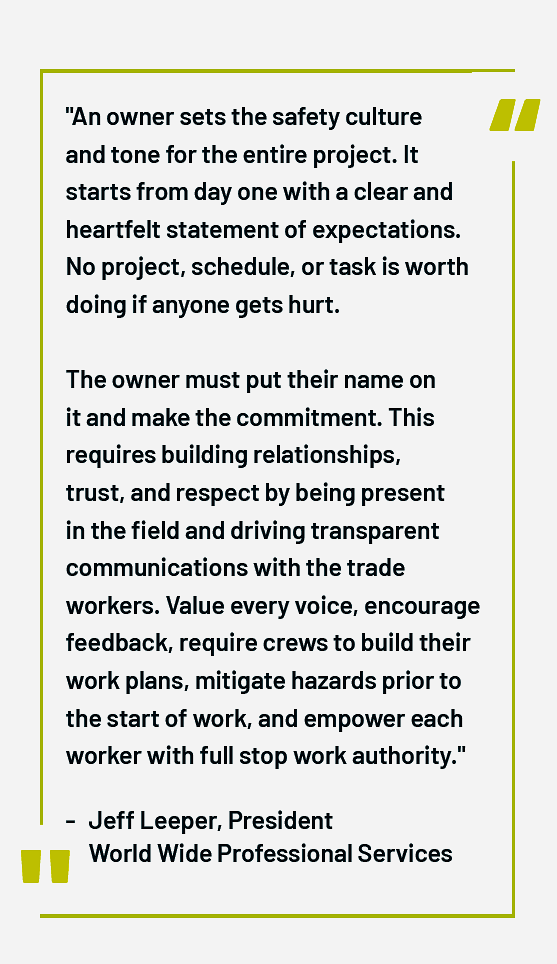
When owners consistently demonstrate respect for worker safety, both physical and psychological, it elevates the entire project standard. Their commitment goes beyond compliance: owners who invest in safety training, support open communication, and prioritize accident prevention set the tone for all other stakeholders. And when owners fund safety innovation and demand hazard elimination, overall safety performance is high.
This collaborative approach ensures every participant feels valued and protected, reinforcing a culture where safety is integral to project success.
Designer Commitment
Incorporating safety strategies during the design phase of construction projects can substantially reduce serious incidents. This is primarily achieved through the identification and elimination of high energy hazards before they materialize on site. Designing for safety means proactively modifying plans, materials, and workflows to eliminate or mitigate these risks. This approach is part of Prevention through Design (PtD).

The U.K. construction industry has historically faced high rates of workplace injuries and fatalities. In response, the U.K. introduced the Construction Design Management (CDM) Regulations to address systemic safety issues and clarify responsibilities across project stakeholders.
The objectives of the CDM regulations:
- Improve safety outcomes: reduce fatalities and injuries
- Clarify roles and responsibilities: ensure accountability for all stakeholders
- Integrate safety into design: address risks early
- Promote collaboration: encourage communication among stakeholders

The CDM regulations represent a significant shift in how construction safety is managed in the U.K. By embedding safety into the design and planning phases and clarifying stakeholder responsibilities, CDM has contributed to a safer, more accountable construction industry. Continued education, enforcement and adaptation are essential to maintain and build upon these gains.
Since CDM 2015, workplace injuries in U.K. construction have decreased by 28% and projects with full CDM compliance are 35% less likely to experience serious safety incidents. Much has been written on the important role designers play in influencing safety outcomes.
When architects design with safety as a core value and when designers integrate risk controls into the blueprint the results are compelling. Nearly half of construction site incidents can be avoided with changes to the permanent structure’s design, and an even higher percentage can be avoided if better pre-work decisions had been taken.
The message is clear: influencing safety is most effective at the early stages of a project, particularly during planning and design.
Contractor Commitment
Evidence from safety research consistently supports the prioritization of leading indicators in SIF prevention programs. Research has demonstrated that organizations with proactive risk-based safety programs experience lower rates of SIFs compared to those relying solely on lagging metrics. By shifting focus from outcome-based measures to exposure-based controls, contractors can intervene earlier, preventing the escalation of risks that lead to serious injury or fatality. This proactive approach is especially effective in environments where high energy hazards are present, as it enables timely identification of critical controls and facilitates targeted interventions.
Effective SIF prevention requires the integration of organizational policies with field-level practices. This means aligning leadership commitment, safety culture, and management systems with the practical realities faced by workers on the ground. Evidence indicates that contractors who foster two-way communication between management and field staff, empower frontline workers to halt unsafe work, and embed SIF prevention into daily operations see measurable improvements in SIF exposure reduction.
A study published in the American Society of Safety Professionals (ASSP) Professional Safety Journal described a multinational contractor’s approach to integrating SIF prevention through leadership safety walks, real-time risk assessments, and frontline involvement in control implementation. The contractor reported a 40% reduction in SIF exposures over three years, attributing success to organizational alignment and field empowerment.
Contractors who spend the time to plan and embed health and safety into the DNA of every project, have a greater reduction in SIF-type events.
Respect-Based Hazard Prevention
The Respect-Based Hazard Prevention Model brings every element of our safety approach together. It shows how safety is embedded into every phase of our work, engaging all stakeholders in hazard prevention throughout the project. In doing so, we create an environment where everyone is empowered to identify risks, take proactive action, and uphold an unwavering respect for human life. This model represents our shared commitment: true safety happens when we are “All In Together,” continuously collaborating to prevent Serious Injuries and Fatalities.

A Unified Call to Action
This bulletin underscores the critical role that all stakeholders–owners, architects, designers, engineers, skilled craft professionals, suppliers, and industry partners–play in shaping safety risk management and Serious Injury and Fatality (SIF) prevention throughout every phase of a project.
Their proactive engagement holds far greater potential than traditional compliance-driven approaches. Identifying high energy hazards early is essential. Delayed recognition drastically reduces the chance for effective intervention.
True success lies in cultivating a culture of accountability where clear expectations are set and every participant upholds a deep respect for human life and the safety systems designed to protect it. When the industry unites under a shared framework to identify and control high energy hazards, it sends a powerful message: we will not tolerate preventable harm, both physical and psychological. We will act together. We will protect those who build our world.
This collective commitment represents the highest form of respect and is the foundation for a transformative shift in construction safety culture.
A Special Thanks To Contributors To This Technical Bulletin:
Executive Committee
Chair, Adam Jelen, President & CEO, Gilbane Building | Co-Chair, Kyle Larkin, President & CEO, Granite
Russell Becker, President & CEO, API Group, Inc. | Mike Choutka, CEO, Hensel Phelps
Rebekah Gray, President & CEO, Gray Construction | Jason Hendricks, CEO, Performance Contracting
Chris Beck, SVP, Managing Director, Turner Construction Company
Technical Committee
Heidi DeBenedetti, Chief Operating Officer, Gilbane Building | Steven Carter, Global Health & Safety Director,
Gilbane Building | Michael Sharpe, Safety Director, Gilbane Building | Jesse Torres, Corporate Compliance Safety
Director, Granite | Wendy Warner, Safety Systems & Compliance Manager, Granite | Clint Coberly, Vice President,
Global Safety & Risk Management, APi Group, Inc. | Tim Gattie, Senior Director Industry Data Analytics, Oracle
Billy Naylor, Senior Vice President of Safety, McCarthy | Sean Blakemore, Regional Safety Director, McCarthy
Doug LaPlante, Vice President Operations Safety Executive, Turner | Stephen J. Spaulding II, Vice President,
Chief EHS Officer, Turner | Dean Bitter, Vice President, Operations Safety Executive, Turner | Camille Ford, Principal
Consultant, JMJ | Tim Fisher, Chief Technical Officer for Safety, Health & Well-Being, American Society for Safety
Professionals (ASSP) | Brian Connearney, Technical Coordinator, Carpenters International Training Fund
Jeff Leeper, President, World Wide Professional Solutions | Dan Smolik, Vice President, Risk Management, Garney
Eyal Nafrin, Global EHS – Construction, Intel | Ben Wilson, CEO & Founder, HSE Global
Chris Doyle, Chief Operating Officer, HSE Global | Brock Myers, Chief Operating Officer, Allan Myers
Emma Matlage, Safety Manager, The Weitz Company, LLC