Skip to content

For years, the safety industry has been improving its ability to detect incidents. New technologies, such as smarter cameras, faster algorithms, greater coverage, and improved accuracy are now available to help detect incidents. However, the current incident rates on high-risk industrial sites, like construction, oil & gas, manufacturing and mining highlight that detection alone is not sufficient.
It is because detection was never the hard part, but getting the correct person to take action on the information provided from the detection system, on time, was always difficult.
Most safety systems are designed primarily for detecting incidents. However, very few safety systems include provision for responding to issues. The gap between the two is where incidents happen. This blog is about closing this gap and about why the shift from Vision AI detection to smartwatch-delivered haptic alerts is not an upgrade. This blog rethinks of what a safety system is actually supposed to do.
What Does Vision AI Actually Detect on an Industrial Site?
The applications of Vision AI for workplace safety have evolved greatly beyond basic motion detection. Current examples use AI CCTVs that are always watching a live site for detailed list of at-risk conditions based on their continuous scanning function, and they do it automatically without fatigue, distraction or gaps in monitoring the identified at-risk conditions.
At industrial sites, Vision AI actively identifies unsafe scenarios the moment they occur, because of its specificity and consistency that is unmatched by a human supervisor. For example, on a construction site, Vision AI identifies when a worker enters a restricted zone, flagging the violation and identifying the worker so they do not enter the risk area. Similarly, at an oil and gas facility, Vision AI identifies a worker in a confined space showing signs of physical distress, a situation that has exponential risks as time passes.
At a mining site, it detects when heavy machinery is too close to ground-level workers and alert the operator even before they know there is a risk. Likewise, in a manufacturing facility, Vision AI monitors every worker on the shop floor to ensure that they comply with appropriate PPE protocols. It tracks compliance with PPE requirements continuously and identifies unguarded machines and/or missing PPE the minute they occur and does so for every shift without suffering from fatigue.
Precision isn’t the limiting factor. An AI camera with computer vision hazard detection can identify a particular worker and link it to his/her Worker ID, then create an alert about the risk event, all within seconds. This capability happens continuously across multiple camera feeds over the entire site and over the course of the full shift, providing coverage that no human supervisor can achieve.
What it cannot do is decide what happens to the alert next. The decision-making authority lies with the system the camera is connected to, which means that most sites are still using infrastructure that hasn’t been built to provide real-time responses. There is intelligence available to create real-time actions; however, the mechanism for delivering these actions is the missing piece.
Why Safety Alerts Fail Before They Reach the Worker?
The usual alert process for most websites today goes as follows: the AI camera detects a risk; an alarm is produced and sent to a supervisor’s device or control room. If a supervisor is viewing the screen at that moment, they will then relay this alert; via radio, phone call, by shouting across the workplace. If a worker has the radio turned on, if the phone call connects and if the noise levels permit it, this alert should be received by him/her.
There are several points of failure at each point in the chain. Each failure creates an additional loss of seconds, which adds up to minutes. Imagine this in case of a confined space scenario, or in a red zone breach, or in a case of worker malaise, where minutes are not a margin. They are the difference.
An alarm or hooter is also no better option. It will not notify just the concerned worker, rather it will alert everyone in the area that something is wrong, causing panic, confusion, and a productivity shutdown amongst all other workers in the area.
Beyond operational disruption, “alert fatigue” is yet another issue. When alerts are frequent and non-specific, workers stop responding to them with urgency. This is because the overall understanding of what the alarm is meant to communicate diminishes over time, since all alarms sound alike.
Industrial IoT smartwatch safety infrastructure, designed specifically for field-use, was driven by the inadequacy of dashboards and hooters, to allow field workers to react promptly to situations of imminent danger. Both dashboards and alarms were designed for the people who were watching the field work and the person who needs to act (i.e., the worker) is always the last one to know, and by the time they know, the risk window has often been closed.

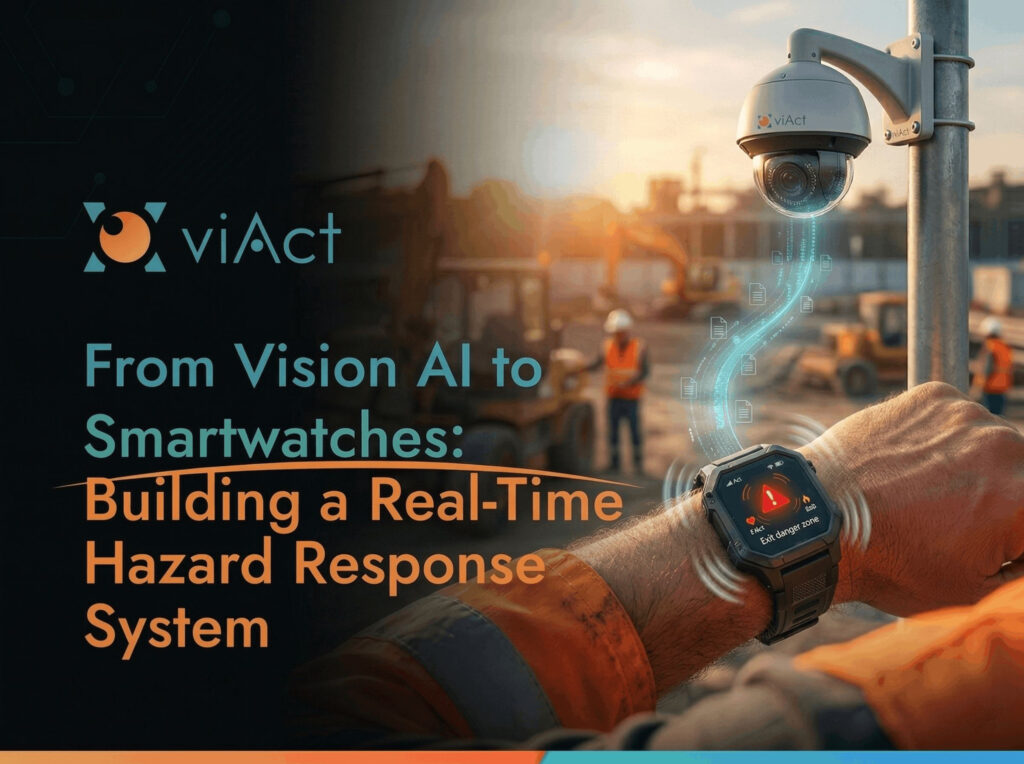
This is where smartwatch integration dramatically alters the landscape. An alert goes directly to the worker’s wrist without using any intermediaries and does not require that the supervisor first sees the dashboard and then act. The alert can be sent directly to the person who was identified by the AI as the agent to take action, at their wrist and with no noise or delay.
What Is Haptic Feedback and Why Does It Matter for Industrial Safety?
Haptic feedback is an information delivery system, via physical vibrations, instead of electronic (screen) or auditory (speaker) method. For example, when receiving a call on their mobile device, users feel the vibration (tactile signal) from the device in the palm of their hand. In consumer applications, that is what is referred to as a ‘buzz’ at that point in time. However, in an industrial safety application, haptic feedback is something categorically more significant.
On a live industrial or oil & gas site, the difference between haptic feedback safety alerts and any other alerting method available is that: haptic feedback safety alerting systems are the only way to alert a worker without requiring him/her to do anything to receive them. For example, there is no need for the worker to look at a screen (display), listen for an audio alert or hope they have their cellular telephone turned to vibrate and/or that the worker’s cellular phone is in their pocket underneath their PPE.
The vibration happens on the wrist. It is immediate and personal (sent to one specific worker), identified by the AI, and not broadcast to the entire site. And it is not possible to be ignored, like a distant alarm or an unread dashboard notification.
This is important because of the way that workers actually perform their jobs at a worksite. When a worker is busy, his attention is focused on the task, be it operating machinery, moving materials, or in a confined space where he cannot view a device display. Workers are not in a position to hear an incoming radio call cleanly because their cognitive load is significant. Haptic feedback safety alerts, on the other hand, gives the worker the ability to receive the alert directly at their body (wrist) and immediately interrupt their task at that specific time, not after the moment has passed.
In addition to the above, it’s worth noting the things that haptic feedback does not do. It does not stop the whole jobsite. It does not create panic amongst the workforce who are working safely. Further, it doesn’t add noise and cognitive load to the already demanding workplace environment. It is designed to be precise, contained, and purposeful.
That is why haptic feedback is not a feature upgrade on a smartwatch. Rather, it the real-time hazard response system that truly works in real-time. Without it, the intelligence processed by Vision AI is only displayed on a screen. But with it, the intelligence reaches the correct person in real-time.
The market reflects this shift in thinking. The IoT-enabled industrial wearables market was valued at USD 5.2 billion in 2024 and is projected to reach USD 18.4 billion by 2034, growing at a CAGR of 13.5%, driven primarily by the demand for enhanced worker safety and real-time response capability in industrial operations.
How Vision AI and Smartwatch Integration Creates a 3-Second Corrective Action Loop?
Integration of Vision AI with connected worker safety technology like smartwatch, does not just speed up the alert chain; but virtually eliminate most of it. This is how the loop works in a fully integrated system:
AI Camera detects hazard → System identifies worker in that detection event → API send alert to Smartwatch Platform → Haptic feedback delivered to wrist → Worker makes corrective action → Correction logged back to the AI Platform with timestamp and geolocation.
The entire chain, from the moment the camera sees the risk to the worker’s response is recorded, and completes in a matter of seconds.
The AI smartwatch corrective action management cycle is not a relay chain. It is a closed system. Since all activities are time-stamped and attached to a specific Worker ID, there is a complete audit trail from the moment the camera identifies the risk till the worker took the corrective action. There are no paper works, no manual data entry, and no need for reconstruction of events once the shift has ended.
Here are different examples of what this might look like in different scenarios:
In case of a PPE violation, the worker is notified prior to entering into a risk zone, rather than three minutes after the supervisor could see it on the monitor. Similarly, if the worker were to enter into a confined space, he would receive a personal alert, that does not trigger a site-wide response but requires the concerned worker to take immediate action. Likewise, a worker entering a danger zone would be corrected before the entry leads to an incident.
For the HSE teams, this changes what is measurable. AI-based safety responses have traditionally generated data based on what was seen; while, smartwatch systems generate data regarding what happened (i.e., corrected), and by whom and at what speed. The two datasets are fundamentally different, and the latter is much more valuable for driving continuous safety improvement.
Real-world deployments are already validating this. A 2024 manufacturing safety pilot in Japan deploying AI-powered smart wearables reported a 22% reduction in workplace accidents along with a 15% improvement in worker productivity.
Similarly, a leading construction company in Saudi Arabia managing over 15,000 workers under extreme desert heat deployed viAct AI-powered video analytics integrated with its IoT smartwatches and recorded a 63% reduction in on-site medical emergencies, prevented 4,800 lost work hours, and achieved a 95% compliance rate with heat safety protocols. All these results were driven by real-time wrist alerts that caught early signs of heat stress before they escalated into emergencies.
Why Corrective Action and Not Detection, Is the Real Safety KPI?
The industry currently measures what it can see, such as incident rates, near-miss logs and the number of alerts generated. When the industry measures such parameters, it actually relies on lagging indicators, that tell happened after the time frame has elapsed. However, there are limitations to this approach in that it provides little or no idea whether or not anything has changed due to an improvement made as a result of those events.
Detection metrics also suffer from the same flaw. If an AI camera detects 47 violations during the month, the safety manager only knows that 47 safety violation events occurred during that time period, but has no way of knowing whether or not things changed afterwards.
The corrective action metric is a true indicator of how well (or poorly) a safety program is functioning. Corrective action is not about “how many hazards were identified”, rather it is about “how many hazards were corrected in real-time by the right individuals before the risk was realized”. While this distinction may sound simple, it actually requires an integrated system built to respond to the hazards rather than just observe them.
The industrial IoT safety systems, like smartwatches have made corrective actions measurable like never before. Every alert sent, vibration received, and correction confirmed are documented. The data exists at each step because the integration is designed to close the loop. Over time, this data becomes a leading indicator, showing which zones, behaviors, and conditions generate the most risk events and how effectively they are being resolved.
Connected worker safety technology represents the major shift in how an organization builds their safety culture from documenting to preventing injuries. The KPI has transitioned from measuring how well organisations recorded injuries to how fast and consistently they corrected them before they occurred. Integrated Vision AI and smartwatch-based safety systems have now made this achievable.
Conclusion: Key Takeaways
Vision AI has provided the safety sector with a unique way to observe every aspect of a project in real-time with accuracy that far exceeds any human site supervisor. However, sight can’t reach beyond physical human limitations. The link between an AI camera and the worker, through the use of IoT devices like smartwatch, enables Vision AI to overcome those limitations. As such, the alert process is not limited to the visual representation of an event on a dashboard or via a relay process; rather, the worker will receive a personal and non-verbal alert that gets them to respond in less than 3 seconds with the only correction that truly matters: to correct the hazard.
The effectiveness of a hazard response system, in real-time, does not solely rely on the speed of detection but, rather, the speed of correction. Therefore, through Vision AI and integrated smart-wrist technologies, this effective response standard is now quantifiable, actionable, and replicable across the many high-risk environments that can no longer afford to treat detection and response as a separate issue.
Below are a few key takeaways:
-
Vision AI detects hazards with precision. But detection without delivery is just data.
-
Traditional alert systems like dashboards, hooters, radio relays were designed for supervisors, not for the worker who needs to act.
-
Haptic feedback via smartwatch is the only alert mechanism that reaches concerned worker, instantly and personally, without requiring them to continuously check, look, or listen.
-
The integrated safety loop: AI detects → worker identified → haptic alert (through smartwatch) → corrective action confirmed, closes risks in under 3 seconds.
-
Corrective actions, not detection, are the metrics of the success of a safety system.
-
Every step in the loop is timestamped, geolocated, and logged, creating an audit trail that holds up under any HSE inspection.
-
Connected worker safety technology shifts organizations from a documentation culture to a preventive safety culture.
1. What is the role of haptic feedback in industrial safety smartwatches?
Haptic feedback delivers silent and personal alerts directly to the worker in real-time when the AI CCTV detects any danger on-site. Unlike the traditional alarms, hooters or dashboard notifications, the haptic alerts do not require the worker to be constantly watching it to receive alerts. This makes haptic feedback the only alerting mechanism that works consistently and reliably in a high noise, high cognitive load industrial environment where visual and audio notifications fail all too often.
2. How does viAct’s AI camera integrate with its smartwatch to prevent workplace incidents?
AI-powered computer vision system by viAct constantly analyzes the construction site for possible risks, including PPE non-compliances, danger zone intrusions, worker fatigue, heat stress, etc. As soon as a hazard is detected by the computer vision AI, immediate notification is sent to the worker’s smartwatch using API technology so that a vibration can be felt by them on their wrist. The worker then makes an adjustment to correct the hazard, and this action is logged back to viAct’s AI platform with a date and location, which closes the safety loop in a matter of seconds.
3. What is a real-time hazard response system and how is it different from traditional safety monitoring?
A real-time hazard response system links hazard detection straight to worker notification and corrective action, with no human reliance or manual intervention. Traditional methods of monitoring workplace safety stop at detecting hazards. An alert gets sent to a dashboard or supervisor, and relies on human intervention, adding critical delay in the process. A real-time system eliminates that gap, ensuring the worker who needs to act receives the alert personally and immediately, with every step of the chain automatically gets logged for traceability.
4. Can viAct’s smartwatch detect heat stress and fatigue on industrial sites?
Yes. viAct’s AIoT-enabled smartwatch can continuously monitor worker’s heart rate, body temperature, and hydration levels; while simultaneously analyzing all of those data points using viAct video analytics to monitor posture deviations and micro-sleep patterns. The AI systems provide early identification of heat stress and fatigue before they become serious issues. This dual-use capability was validated in a Saudi Arabian deployment where a major construction company realized a 63% reduction in medical emergencies on the jobsite as well as successfully prevented 4,800 lost work hours due to heat injuries and/or fatigue.
5. How does Vision AI and smartwatch integration by viAct help HSE teams shift from lagging to leading safety indicators?
Traditional Health, Safety and Environmental (HSE) reporting metrics focus on lagging indicators, such as, incident rates, near-miss reports, and alert logs. The integration of viAct’s Vision AI and smartwatches provide data focused on what was corrected, how long it took to complete corrective action, in which area was the majority of risks experienced, and whether the corrective action was verified as completed. viAct’s AI platform captures this full chain, from AI detection to haptic alert to photo-confirmed correction, turning every safety event into a leading indicator that drives prevention rather than documentation.
– viAct is the leading Impact AI company enhancing safety in high-risk industries for a sustainable future.