
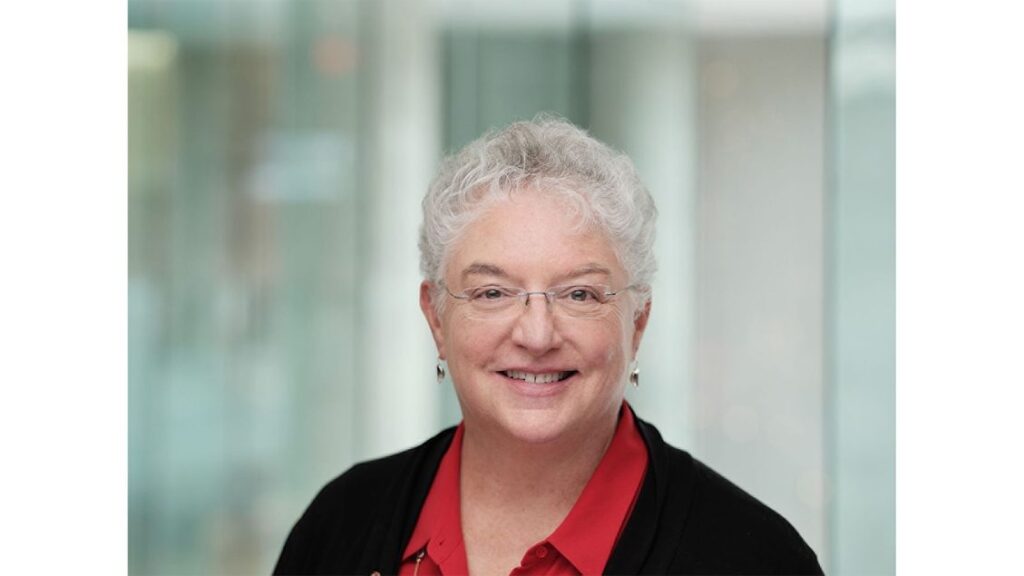


Earlier this month, newly instated American Institute of Architects EVP/CEO Carole Wedge joined Aaron Prinz, host of RECORD’s DESIGN:ED podcast, for a wide-ranging conversation. Topics included her vision for the AIA moving forward, advocacy and inclusion, climate change, challenges faced by young architects, and her own humble beginnings in the mail room of Shepley Bulfinch (she later went on to become the Boston’s firm’s president and CEO). Below are select highlights from that conversation. (You can listen to the full podcast episode here).
In addition to joining DESIGN:ED, Wedge will also be making remarks at RECORD’s forthcoming Sustainability in Practice conference on February 25 at the Massachusetts Institute of Technology’s Schwartzman College of Computing. Featured speakers at the event include Andrew Barnett, principal of London-based Hopkins Architects; AMMA founder Michael Murphy; and Brandon Clifford and Miho Mazereeuw, associate professors at MIT Architecture. Today is the final day to register for complimentary early bird tickets.
On her mail room beginnings at Shepley Bulfinch:
I started in the mail room [at Shepley Bulfinch] while I was at school at Boston Architectural College. The best part about it in 1986 was that all the action happened in the mail room—I opened and read all the mail. Imagine if you could read the emails of all the principals in the company! That’s what looking in the mail room at Shepley Bullfinch was like: you could actually read the letters. And I’m a pretty fast reader, so I knew more about what was going on at the firm than the principals because they didn’t see each other’s mail.
Well, maybe the firm’s CFO knew more than I did, but as a way of introduction, I could see that there were great things happening and we were invited to incredible opportunities. But I also saw clients that weren’t happy with us—and read letters from lawyers of clients who weren’t happy with us. I saw the whole spectrum of the culture in the mail room.
On the business of running a successful firm:
I would tell young architects to take a business class.
I graduated in a recession, and architecture firms weren’t hiring interns with almost no experience. So I got a job working on Wall Street. I had to take the stockbroker’s license and learn to read a balance sheet. I became an assistant to portfolio managers after three years. But I didn’t find it particularly interesting. I looked at the people I worked with and thought, ‘I don’t really want to be you in 25 or 30 years.’ And that’s what drove me to go back to school.
On just saying ‘no’:
Sometimes I worry that we’re our own worst enemies when we think the answer to winning a project is to offer it for cheaper. Instead, offer your client a better idea and be willing to listen to them and understand what their challenge really is. There are areas to provide them with the service that they really need and are willing to pay for. But you must be able to articulate your value and be willing to work with them. One of the interesting expressions that I love, which I learned from another firm was, that what you say ‘no’ to is important. For example, we’d be asked to pursue an RFP that we didn’t know was coming and that no one knew anything about. And I was like, how about we say ‘no?’ And we’d go on to do the things that we knew we wanted to do before.
On the foundation of the AIA Women’s Leadership Summit:
What we really wanted to talk about was leadership and design. And what we had found was a lot of women were asked to talk about the culture of architecture or work-life balance or being a parent in architecture–and a lot of us were tired of those topics. We thought they were important, but kind of overwrought, and that women weren’t being put forward to talk about leading their firms, teams, and clients. And so we created a conference, the Women’s Leadership Summit.
One of our goals was to create a network for women in design because people were having trouble finding that mentorship locally. We need to continually showcase women in architecture and create comaradery. I started inviting men to the conference, relaying that ‘you need to be here to hear what these people are saying.’
On her vision for the AIA moving forward:
[AIA National] is very healthy financially. It went through some ups and downs and some difficult chapters. But right now it’s doing very well—we’ve renovated the headquarters building and paid off the mortgage for that. The new net-zero headquarters is a member-centric building in that it’s there for all members to use and for people to be engaged by. My hope is that the headquarters becomes a metaphor for architecture and the value of architecture. We want school children, tourists, and other associations to use our building to gather as a community and really understand the power of place.
I feel like we need to do a better job of being connected with local chapters and better coordinated around issues of advocacy. One thing that’s bubbling up is advocacy on housing is critical across the country, including on the ground locally. What can the AIA do nationally to advocate for housing policy at the federal level, but in partnership with our chapters and members at the local level?
On the state of architecture in 2026:
I think the state of architecture is to focus on climate and the existential threat of climate change. I remember being at the first presentation where I met [Architecture 2030 founder] Ed Mazria and being startled at all of the energy that buildings used around the world—it was a wake-up call. When I look back, we’ve made great progress on moving the needle, but we haven’t moved it far enough.
I feel like the place of architects—and this is something 2026 AIA president Illya Azaroff will talk about deeply—is to address resilient communities. How do we prepare communities to know that these storms and fires are going to happen and that we have to protect ourselves. The AIA’s participation in the UN Climate summit is incredibly important.
I also think we need to better question where building materials come from—not just being focused on what something looks like, but how well it performs or how well it contributes.
On the Department of Education’s delisting of architecture as a professional degree:
This isn’t about the value of architecture—or engineering, nursing, accounting, or mental health professionals. It’s a very bureaucratic change so that they can reduce the budget for the Department of Education student loan program. We’ll write during the comment period about how inappropriate this move is and how we could work together with them to come up with different alternatives.
De-professionalizing these incredible professions is not an appropriate path. It’s a slippery slope. We must stand up for what we believe in and the profession of architecture. I will add that the cost of an architectural education is expensive, and I think that’s also a little bit of a wake-up call for us to think about what do. What do we do to make it more approachable? How do we understand what a living wage in architecture is?
Borrowing money isn’t the only way to pay for education. We’re trying to make Architects Foundation scholarships more visible and make local chapters’ grants and scholarships more visible to students. Maybe this crazy department of education redefinition is waking us up to bigger conversations about the viability of the profession.






