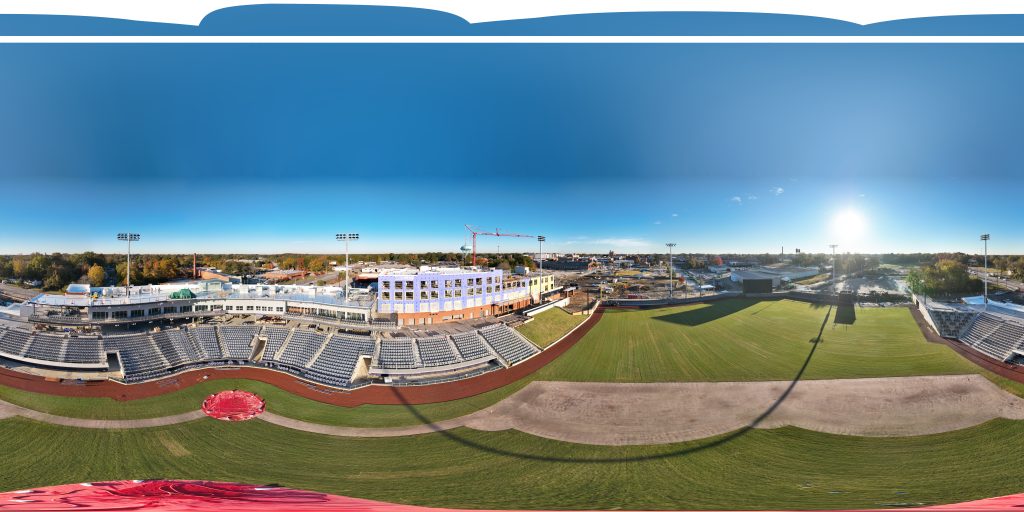

North Carolina-based Clancy & Theys is building a brand-new home for the Carolina Mudcats, complete with luxury amenities, high-tech training facilities and a healthy dose of nostalgia.
As a young boy, Charlie Lewis attended Carolina Mudcats baseball games with friends and family. These days, he’s more than just a fan: Lewis is the project lead for Wilson Sports and Entertainment (WiSE) Park, the team’s new $64-million, 102,000-square-foot, 3,500-seat ballpark. After 34 years in Zebulon, the Mudcats—a single-A affiliate of the Milwaukee Brewers—have moved to nearby Wilson, North Carolina, and rebranded themselves as the Warbirds. The team’s new home will open in April 2026, and for Lewis, a veteran of other stadium and sports facility projects, building the ballpark is almost as enjoyable as watching a game.
“It’s fun to see the lights turn on and the grass go down,” says Lewis, a project executive with Clancy & Theys, which is building WiSE Park as a joint venture with Barton Malow. “It’s an exciting job. Downtown Wilson is already being revitalized, and this should be a catalyst.”
WiSE Park will be a great place to root for the home team. Fan amenities include a 360-degree concourse, suites, two party decks, a centerfield beer garden and a stadium view of nearby Whirligig Park, which features wind-powered sculptures. Second and third phases of construction will include apartments, townhomes and condos with views of the field, along with over 100,000 square feet of retail space. Team facilities will range from offices to player development spaces, such as an indoor batting tunnel and fitness area. The ballpark’s most unique feature? A hotel that’s rising behind the left-field fence.
“The hotel is literally on top of the stadium,” says Lewis. “They even share a group of bathrooms in left field. You can see right down on the field out of the windows.”
The hotel has created challenges, however. The two projects are in different phases: Construction on the ballpark started about nine months before work began on the hotel. Because the hotel currently lacks a roof, Lewis and his team have installed a quarter-inch-thick cementitious waterproofing product on one level of the structure to keep the stadium work dry.
“We needed a temporary roof,” he says. “We even cored 12 holes in their slab and tied temporary drains to them to help give the water somewhere to go.”
Another challenge: Poor soil underneath the stadium. “There are a ton of geotechnical challenges on this job,” Lewis says. “We had some huge footings that created a challenge for some underground utilities. We were able to redesign some underground systems through our BIM and with our trade partners to solve some problems that weren’t obvious during design.”
A particular concern was groundwater “pretty close to the elevation of the stadium,” Lewis says. “With where the water table is, we were concerned that we wouldn’t get the stability of the subgrade that we needed to perform our installs on top of it.”
For months, Lewis and his team met with the geotechnical engineer and the field designer. Their solution: “Basically doubling the underground drainage system on the field and adding a ton of extra pipe and stone to help gravity flow that groundwater out of the stadium. It really tightened up the subgrade. It wasn’t cheap, but when it came time to start installing the field, we could see that the water was going where it needed to go. And so that field that can hold concerts. An 18-wheeler can drive on it. We’re not worried that something like that could destroy the field.”
About 80% of a stadium project is similar to most commercial buildings, Lewis notes, though some aspects are unique. Major League Baseball, for example, requires netting at minor league parks along the baselines, from foul pole to foul pole. Crews will also install a pitch clock, a HawkEye system (which uses cameras to capture video of everything from pitches to batted balls for player analytics and to help umpires make calls), a centerfield scoreboard and a video board on the left field wall.
“I’d say the most unique thing about this is definitely the low-voltage package: The broadcast [facilities] and the game-day type stuff, like the scoreboard, that you don’t typically see on other commercial buildings,” Lewis says. The key, he adds, is “making sure that all the electronics work together in sync. I lean on our experts and trade partners that do this every day. We put a lot of effort into making sure that we’ve got everybody in the room talking and that we’ve got a good plan and we’re executing that plan. That’s no different when you’re building a school or an office building.”
The first home game is scheduled for April 14, 2026, and the project is on schedule. “We feel comfortable that we’ll deliver well before that and give the team a chance to move in and get comfortable and get their operations down so they’re not scrambling,” he says.
Lewis will attend the home opener. But will he be there as a project lead or a fan? “We’ll see how the next hundred days goes and whether I’m thinking about construction or actually enjoying the game,” he says with a laugh. He expects, however, to simply be like his younger self: eating a hot dog and reveling in the national pastime on a lovely spring night. Play ball!
SEE ALSO: WALKING ON WATER: SEATTLE’S NEW OVERLOOK WALK