 Skip to content
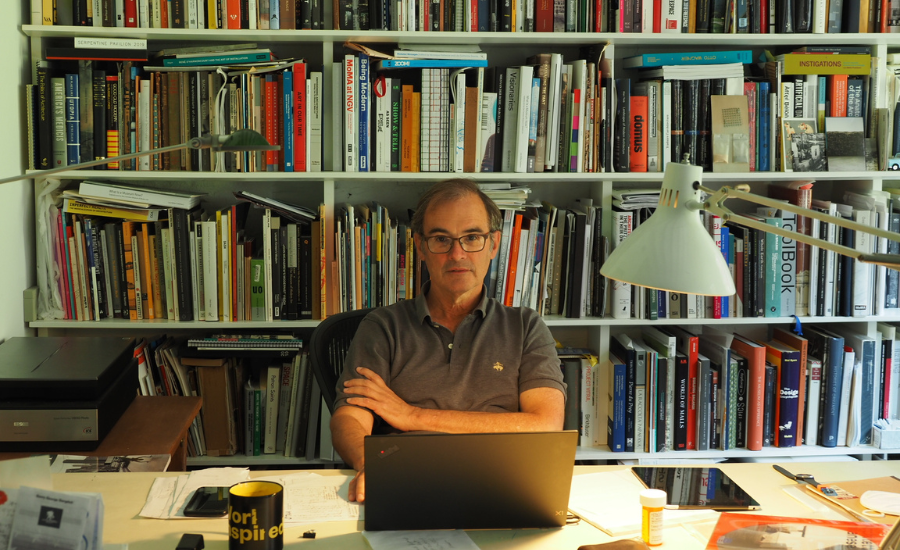


The National Building Museum announced that renowned architectural historian and former Museum of Modern Art (MoMA) curator, Barry Bergdoll, has been selected as the 27th recipient of the Vincent Scully Prize. Established in 1999, the award recognizes excellence in scholarship, criticism, or practice in architecture, historic preservation, and urban design. Bergdoll joins an illustrious group of past recipients, including Theaster Gates, Walter Hood, Jane Jacobs, Laurie Olin, Denise Scott Brown, Robert Venturi, and Mabel O. Wilson.
A public celebration honoring Bergdoll will be held at the Museum on Wednesday, October 22, 2025, from 5:30 to 9 pm. The evening will include the formal presentation of the prize, remarks by the honoree, and a conversation with Philip Kennicott, Pulitzer Prize-winning art and architecture critic at The Washington Post. A reception will follow.
“Barry Bergdoll embodies the spirit and intent of the Vincent Scully Prize,” said Aileen Fuchs, president and executive director of the National Building Museum. “Through his scholarship and exhibitions, he has opened up architecture to wider audiences, made visible its relevance to our daily lives, and helped us see the built environment with new eyes. We are thrilled to honor his remarkable impact with this year’s prize.”
Bergdoll is the Meyer Schapiro Professor of Art History at Columbia University, where he has taught for more than thirty years. He is internationally recognized for his contributions to the history of modern architecture and for his innovative curatorial work. From 2007 to 2014, he served as Chief Curator of Architecture and Design at MoMA, where he redefined the role of architecture exhibitions. Among his most influential shows were Rising Currents: Projects for New York’s Waterfront (2009–10), Foreclosed: Rehousing the American Dream (2012), and Latin America in Construction: Architecture 1955–1980 (2015), all of which explored urgent environmental, social, and political questions through the lens of design. He continued this ethos in the exhibition: Reset: Toward a New Commons (2002) during his tenure as President of the New York AIA’s Center for Architecture.
Throughout his career, Bergdoll has emphasized architecture’s place within broader cultural and historical contexts. His curatorial work has extended beyond MoMA to include exhibitions at the Musée d’Orsay, Centre Canadien d’Architecture, the Banamex Cultural Center, and Bard Graduate Center. He is currently co-curating an exhibition on the drawings of Viollet-le-Duc, opening at the Bard Graduate Center Galleries in New York in late January 2026. He is the author of numerous publications, including European Architecture: 1750–1890, monographs on Karl Friedrich Schinkel, Mies van der Rohe, and Léon Vaudoyer, and co-editor of Marcel Breuer: Building Global Institutions. Currently he is working on a forthcoming volume based on his 2013 Mellon Lectures at the National Gallery of Art.
In their unanimous selection, the Vincent Scully Prize jury, chaired by Paul Goldberger and including Nancy Levinson, Stephen Luoni, Toshiko Mori, and Andrea Roberts, praised Bergdoll for bridging academic scholarship with public engagement. In a statement, the jury noted:
“We took special note of the extent to which his career has been devoted not solely to scholarship, but also to public outreach, which is consistent with the commitment of the Scully Prize to honoring scholars, writers and public figures who have shaped public understanding of the built environment. Barry Bergdoll has consistently presented architecture not as hermetic, but as enmeshed in wider issues of society, politics, economics, and culture. The jury particularly recognizes Bergdoll’s transformative tenure as Chief Curator of Architecture and Design at MoMa, beginning at the pivotal moment of the 2008 financial crisis. At a time when architectural exhibitions were highly specialized and tended toward the monographic, Bergdoll mounted exhibitions that brought key social issues to the forefront, helping to redefine the museum’s role for the public.”







