 Skip to content

Nonresidential construction planning slipped for a second consecutive month to start 2026, according to Dodge Construction Network.
The Dodge Momentum Index, a measure which tracks nonresidential construction projects entering the planning stages, tumbled 7.3% month to month in February. The drop follows a 6.3% decrease in January, according to Dodge.
“Planning momentum continued to normalize in February after a surge in activity in the back half of 2025,” said Sarah Martin, associate director of forecasting at Dodge Construction Network. “Elevated risks around costs, labor and geopolitics will continue to constrain builder confidence in the near-term but the robust planning pipeline suggests an acceleration in construction spending in 2027.”
Healthy planning around data centers and healthcare facilities continued during February. Other project types such as retail stores and warehouse construction also posted strong demand, according to the report.
But planning momentum for the most part slowed on the commercial side, according to the data.
 Planning for commercial projects dropped 8.9% month to month, though still sits 12.3% higher compared to February 2025. Much of that strength is due to data center planning.
Over the past year, commercial planning would have ticked up 4.4% without data center projects, according to Dodge. Institutional construction, such as education and public builds, also ticked down month to month, dropping 4%. Industrial planning increased 34% year over year, according to the report.
A total of 23 projects valued at $100 or more entered planning in February, according to Dodge Construction Network. Major commercial projects included:
- A combined $580 million for Buildings 5 and 6 of the QTS DFW2 data center in Wilmer, Texas.
- The $500 million CyrusOne data center in Whitney, Texas.
- The $448 million TX12 data center in San Antonio, Texas.
The largest institutional projects to enter planning included:
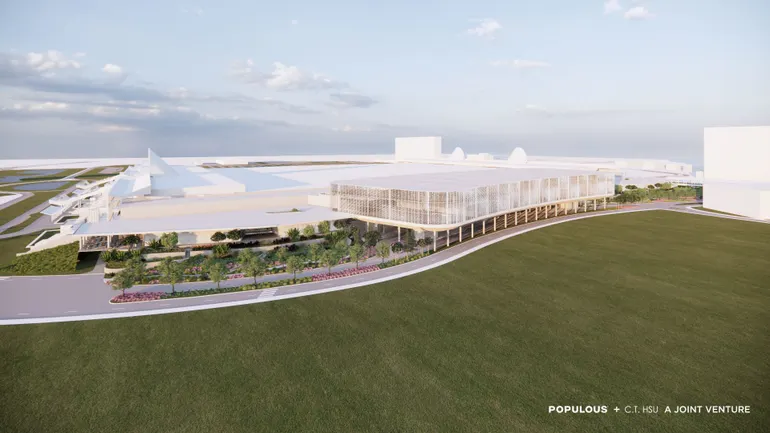
- The $400 million Orange County Convention Center Grand Concourse expansion in Orlando, Florida.
- The $254 million school replacement project in Upper Marlboro, Maryland.
- The $250 million Langley F-22 Dormitory Building in Mclean, Virginia.







