Skip to content
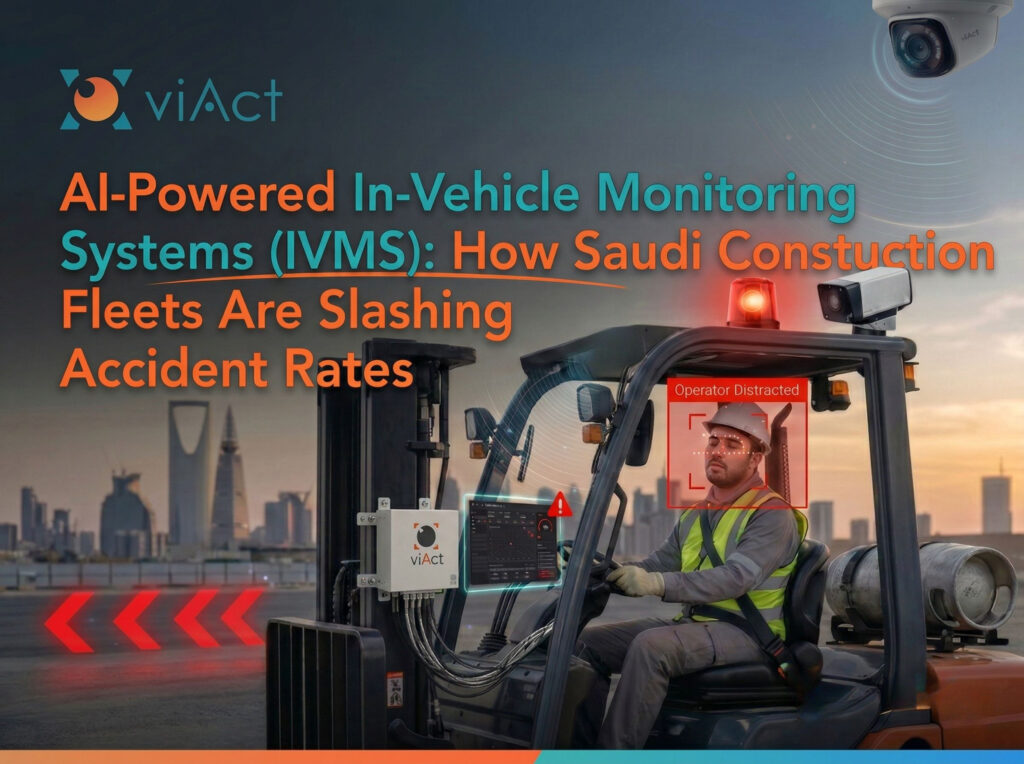

An EHS Manager on a busy Saudi industrial site is responsible for hundreds of vehicles. Dump trucks, excavators, mobile cranes, forklifts, personnel carriers, light utility vehicles, all operating across a live construction site, often around the clock, often within metres of a dense on-foot workforce.
The hard truth is that vehicle-related incidents remain the single most persistent cause of serious injuries and fatalities in heavy industries like construction sites. As per the U.S. Bureau of Labour Statistics, transportation incidents contributed around 38.2% to workplace fatalities in 2024.
Even in regions with strong safety governance, the gap remains. While the National Council for Occupational Health and Safety reports a workplace fatality rate of 1.12 per 100,000 workers in Saudi Arabia, many of these incidents occur in environments with safety measures already in place, such as dashcams, speed limiters, and regular safety briefings.
What makes this especially frustrating for experienced EHS leaders is the limitation of these tools. They document, restrict, and inform, but they do not intervene in the exact moment.
What Is an AI-Powered In-Vehicle Monitoring System (IVMS)?
An In-Vehicle Monitoring System (IVMS) is a technology framework installed within fleet vehicles to monitor, process, and act on data related to vehicle operation, driver behaviour, and the surrounding environment.
In its traditional form, vehicle monitoring meant GPS tracking and basic telematics, recording where a vehicle has been, how fast it was going, and how long it idled. These were useful data, but fundamentally backwards-looking. It tells you what happened, but cannot change what is happening.
An AI-Powered In-Vehicle Monitoring System (IVMS) is a categorically different system. When AI is embedded through edge devices, computer vision, machine learning models, and smart sensor arrays, the system processes data in real time, recognises developing risk conditions, and responds before an incident occurs.
Why Traditional Fleet Safety Cannot Keep Up With Saudi Construction Reality
The standard fleet safety toolkit was designed for a different era of operations. It was not designed for a 5,000-person construction site running 24-hour shifts, with 300 mixed-fleet vehicles operating in close proximity to on-foot workers across a footprint the size of a small city.
A single project may simultaneously deploy dump trucks, concrete mixers, water bowsers, motor graders, excavators, mobile cranes, forklifts, and light vehicles — each with different blind zones, turning radii, and operator risk profiles. Layered on top of this, night shifts and rotational schedules push operators to the outer edge of their alertness, and fatigue is invisible to any monitoring system that does not actively watch the driver.
With high operator turnover and an all-inclusive diverse, multilingual workforce with varying licence backgrounds and training standards, verifying that the right operator is in the right vehicle, every shift, becomes a genuine operational challenge.
Traditional safety tools address none of these conditions with sufficient precision or speed. They document. AI-Powered IVMS for construction fleets intervenes and that distinction is the difference between a near-miss report and a fatality investigation.
How AI-Powered In-Vehicle Monitoring Systems (IVMS) Protects Construction Fleet: A Three-Layer Safety Architecture

For EHS managers overseeing mixed fleets, an in-vehicle monitoring system ecosystem, operates across three distinct protection layers simultaneously — each targeting a specific, well-understood category of vehicle risk:
-
Layer 1 — Protecting the Driver in Construction Fleets
-
Layer 2 — Protecting the Construction Fleet Vehicle
-
Layer 3 — Protecting the Industrial Perimeter
Let’s decode each layer.
Layer 1 — Protecting the Driver in Construction Fleets
The driver is the most dynamic variable in any fleet safety system. Layer 1 of an AI-Powered IVMS places four distinct monitoring capabilities directly on the operator, each targeting a different failure mode that traditional systems cannot detect.
The most dangerous assumption in fleet safety is that an operator who shows up for a shift is fit to drive for the duration of that shift. Fatigue, distraction, and lapses in attention do not announce themselves, and they do not appear in a pre-shift checklist.
Video Analytics (Computer Vision) within an IVMS places a continuous, intelligent eye on the driver throughout the entire journey. Cameras mounted inside the vehicle feed live video through machine learning models trained to detect specific, high-risk behaviours in real time, like:
-
Microsleep and drowsiness, identified through eyelid closure patterns, head drop, and blink frequency changes
-
Distraction and inattention, flagged when gaze deviates from the road beyond defined thresholds
-
Mobile phone use and smoking while operating the vehicle
The moment any of these behaviours are detected, an in-cabin alert as well as external alert such as a siren or hooter fires immediately, giving the operator the chance to self-correct before a risk event develops. Every triggered event is simultaneously logged, time-stamped, and flagged to the EHS management dashboard with supporting video evidence.
2. Seatbelt Monitoring— Closing the Compliance Gap
Seatbelt non-compliance on Saudi construction sites is a persistent problem that paper-based checks and verbal briefings have consistently failed to resolve. An operator may start a journey belted and remove the seatbelt mid-shift.
A worker being transported on a personnel carrier may never fasten it at all. Traditional systems have no visibility into either scenario.
AI-based IVMS uses the same in-cabin camera feed that monitors driver fatigue to continuously detect seatbelt usage status throughout the entire journey not just at ignition. When non-compliance is detected, an immediate in-cabin alert prompts the operator or passenger to buckle up. The event is logged, timestamped, and reported to the EHS dashboard.
3. Harsh Driving Detection— Identifying Risk Before It Becomes Damage
Harsh driving including sudden braking, aggressive acceleration, sharp cornering is one of the most reliable early indicators of elevated collision risk. It strains vehicle components, destabilises loads, and significantly increases stopping distances for vehicles.
IVMS integrates inertial measurement unit (IMU) sensors with edge AI processing to detect and classify harsh driving events in real time. The system monitors:
-
Harsh braking events, flagged when deceleration exceeds site-defined thresholds
-
Aggressive acceleration, particularly relevant for vehicles pulling heavy loads from standstill
-
Sharp cornering, detected when lateral g-forces exceed safe parameters for the vehicle type
Each event is logged against the operator profile and vehicle record. Over time, pattern analytics identify drivers with consistently elevated harsh driving scores enabling EHS managers to target coaching and retraining precisely.
4. Driver Identification & Access Control— Ensuring the Right Operator Is Behind Every Wheel
On large Saudi construction sites, the gap between who is authorised to operate a vehicle and who is actually doing so is a real and underreported risk.
Access control makes it physically impossible to start a vehicle without verified authorisation. Three primary methods are deployed in industrial site environments:
-
Facial Recognition: The vehicle system verifies the operator’s face against a credentialed database before enabling ignition — eliminating card-sharing or PIN workarounds entirely.
-
Biometric Scanning: Fingerprint or iris-based verification tied directly to operator licensing, certification class, and medical fitness records.
-
RFID Access Cards: A practical option for high-turnover fleet environments, with each card linked to a specific operator profile including licence class, expiry dates, and clearance status.
Every vehicle start event is logged and time-stamped — creating a clean, auditable chain of operator accountability that feeds directly into EHS compliance reporting and supports investigation when incidents occur.
Layer 2 — Protecting the Construction Fleet Vehicle
The second Layer of AI monitoring focuses on the vehicle itself — how it is moving, how fast, where it is, and whether that movement is within safe parameters for its current location and operating context. This layer gives EHS managers the real-time operational command layer they need to manage fleet risk at scale across complex construction sites.
1. Speed Monitoring — Enforcing the Right Limit in the Right Zone
Speed is one of the most directly controllable risk factors in fleet safety and one of the most frequently violated on construction sites, where road speed limits vary by zone, shift period, and proximity to ground personnel.
AI-enhanced IVMS addresses this through dynamic, zone-specific speed monitoring. Rather than applying a single site-wide speed limit, the system maps each vehicle’s real-time GPS position against a layered zone map, applying the correct limit for each area automatically. When a threshold is breached:
-
An immediate in-cabin alert notifies the operator to reduce speed
-
The event is logged against the vehicle, operator, location, and time
-
Escalation alerts are pushed to the EHS dashboard when breaches occur near high-risk zones such as pedestrian walkways, site entrances, and active plant areas
For EHS managers overseeing fleets of haul trucks, concrete mixers, and personnel carriers across a multi-zone mega-project site, this zone-intelligent approach to speed monitoring delivers a level of control that fixed speed limiters simply cannot provide.
GPS tracking has been a standard fleet tool for years. What AI-Powered IVMS in construction adds is the intelligence layer that transforms raw location data into actionable safety insight. When every vehicle in a Saudi construction fleet is connected to a centralised IoT platform, the individual position of each vehicle becomes part of a dynamic, site-wide picture of fleet behaviour.
Beyond real-time location, IoT fleet tracking within an industrial IVMS delivers:
-
Route deviation monitoring, identifying vehicles operating outside designated site access routes
-
Idling detection, flagging vehicles left running unnecessarily in areas of elevated risk
-
Aggregated incident analytics, identifying repeat near-miss locations, high-risk time windows, and driver behaviour patterns that warrant targeted intervention
-
Live fleet dashboards enabling EHS managers to monitor every vehicle across a dispersed site from a single command interface
For an EHS manager overseeing a multi-zone mega-project with hundreds of vehicles across a 24-hour operation, this command layer makes fleet safety a data-driven, strategic function.
ADAS represent the most direct vehicle-level collision intervention within an AI-Powered IVMS. Using forward-facing cameras and sensor arrays, ADAS continuously monitors the driving environment and alerts operators to developing hazards with enough lead time to respond.
On construction sites where roads are shared between 40-tonne dump trucks, concrete mixer fleets, water bowsers, and light pickup vehicles at significantly different speeds, ADAS provides:
-
Forward collision warning with time-to-impact calculation based on closing speed and distance
-
Headway distance monitoring, alerting operators when following distances fall below safe thresholds for their speed and load
-
Lane departure detection, particularly critical on long haul roads during fatigue-prone night shifts
-
Pedestrian proximity alerts when a person is detected in the vehicle’s forward path
Deployed consistently across a mixed fleet, ADAS creates a uniform collision-prevention baseline that does not depend on individual operator experience or alertness levels.
4. Edge AI Processing — The Hardware That Makes It All Possible
Every real-time capability within an AI-Powered IVMS depends on processing power fast enough to be genuinely preventive. This is why edge AI devices — installed directly within the vehicle, processing data on board rather than routing it to a remote cloud server are the foundational hardware layer of the entire system.
Edge AI devices such as viMAC analyse camera feeds, sensor inputs, and telematics data locally, generating alerts and responses within milliseconds. On a Saudi construction site where connectivity may be intermittent — across desert infrastructure corridors, remote quarry haul roads, or offshore support facilities — this on-device processing means safety performance is never dependent on signal strength. The system works consistently because it does not wait for cloud confirmation before acting.
Layer 3 — Protecting the Industrial Perimeter
Layer 3 extends the safety system beyond the vehicle itself outward to the zones, boundaries, and people surrounding it. This is the layer that protects the construction site environment: the ground personnel working alongside vehicles, the restricted areas that must be kept clear, and the assets that should only be accessed during authorised hours.
1. 360-Degree Camera Systems: Eliminating the Blind Zones
Large construction vehicles are defined by what their operators cannot see. An excavator’s counterweight eliminates rear visibility almost entirely. A fully laden articulated dump truck in reversing mode can have a blind zone extending 15 metres or more behind the vehicle. A motor grader’s blade assembly creates significant forward and lateral obstructions that mirror systems simply cannot compensate for.
360-degree camera systems synthesise inputs from multiple cameras mounted around the vehicle into a single bird’s-eye perimeter view, displayed in real time on the in-cabin screen. When a worker, another vehicle, or a fixed obstacle enters the field, the operator sees it — regardless of which direction the hazard approaches from.
Proximity warning systems add a layer of active measurement using a combination of sensors and camera inputs to create a real-time spatial map of everything within defined zones around the vehicle.
When a worker or object enters a designated hazard zone — whether the vehicle is reversing, slewing, or simply stationary with the engine running — the system triggers an immediate warning. Critically, this warning operates in both directions simultaneously: the operator inside the cab receives an alert via the in-cabin display and mobile devices, while personnel outside the vehicle are warned through the external alert layer, such as a hooter on site.
3. Geofencing — Keeping Vehicles Where They Should Be
A Saudi construction mega-project is not a single uniform site. It is a collection of zones — active excavation areas, blast radii, crane swing paths, fuel storage compounds, personnel accommodation perimeters, and live haul corridors — each with its own access rules and risk profile. Geofencing within an AI-based monitoring system in vehicles allow EHS managers to define these boundaries digitally and enforce them automatically.
Configurable virtual boundaries are mapped against the live GPS position of every vehicle in the fleet. When a vehicle crosses a boundary it should not cross, the breach is logged with GPS coordinates, timestamp, vehicle ID, and operator record for full audit trail.
For high-risk zones where a vehicle incursion could have immediate safety consequences such as a live blast zone, an area beneath an active crane, a pedestrian-only compound, geofencing provides the fastest possible automated intervention short of physical access control.
4. Unauthorised Usage Alerts — Controlling the Fleet When No One Is Watching
One of the most underreported risks in Saudi construction fleet management is vehicle use outside authorised hours. A vehicle left on site overnight or during a shift gap presents a genuine security and safety risk, particularly on large projects where workforce composition is diverse and site access controls are imperfect.
AI-Powered IVMS addresses this through a combination of access control verification and time-window rule enforcement. Every vehicle start attempt is cross-referenced against the operator’s authorisation status and the permitted operating hours for that vehicle and zone.
When a start is attempted outside permitted hours, or by an unrecognised operator, the ignition is prevented using a high-priority alert. An escalation alert is pushed to the EHS manager and site security team in real time.
Let’s map every technology layer within an AI-Powered In-Vehicle Monitoring Systems (IVMS) to its core function, vehicle application, and direct EHS impact.
| Detection / Response Time | |||
| AI module+ In-cabin cameras | Eye closure (>2 sec), head tilt angle, gaze deviation, seatbelt detection | ||
| Edge AI devices like viMAC | Object detection range: 30–100m, speed tracking, lane deviation thresholds | ||
| Vision Systems (360° + AI) | Multi-camera + computer vision | 360° FOV, >90% object detection accuracy, low-light capability | |
| Detection radius: 0.5–10m, dynamic safe distance calculation | |||
| RFID, biometrics, facial recognition | Authentication < 2 sec, >95% accuracy | ||
| ±1–3m accuracy, 1–5 sec refresh rate | |||
| In-cabin + external alerts | <1 sec latency, audio-visual alerts |
Conclusion: Key Takeaways
-
Vehicle incidents remain one of the highest risk factors across Saudi construction sites, making proactive prevention a top priority for EHS leaders.
-
AI-Powered In-Vehicle Monitoring Systems (IVMS) shift safety from reactive to predictive, identifying risks in real time before they escalate into incidents.
-
Layered safety architecture- ADAS, vision systems, and proximity detection work together, addressing human error, blind spots, and environmental hazards simultaneously.
-
Real-time alerts and in-cabin guidance significantly improve driver response time, reducing dependency on manual judgment in high-pressure environments.
-
IoT-based fleet intelligence enables EHS teams to manage safety at scale, identifying high-risk zones and optimizing operations across entire fleets.
-
Access control and video analytics strengthen compliance and accountability, ensuring that only authorized personnel operate vehicles and that risks are continuously monitored.
-
AI-powered IVMS directly supports Saudi Vision 2030 goals, enhancing safety standards while driving efficiency and digital transformation across industrial sectors.
As Saudi Arabia accelerates toward a smarter, technology-driven future, safety can no longer rely on hindsight. The next generation of industrial fleets will not just move materials—they will think, analyze, and protect in real time.
1. Is AI-Powered IVMS difficult for construction fleet drivers to use?
No. Modern AI systems are designed to be intuitive. Drivers do not need to interact with complex interfaces—alerts are simple, clear, and actionable. Over time, drivers adapt quickly as the system acts as a support tool rather than a control mechanism.
2. What types of vehicles can be integrated with an in-vehicle monitoring system in Saudi Arabia?
An in-vehicle monitoring system Saudi Arabia can be deployed across a wide range of industrial vehicles, including dump trucks, excavators, cranes, forklifts, fuel tankers, and light vehicles such as pickups and SUVs. The system is designed to adapt to both heavy machinery and smaller fleet vehicles.
3. How does data from multiple sources (cameras, edge devices, IoT) get integrated into one system?
An In-Vehicle Monitoring Systems (IVMS) uses a centralized platform like viHUB where data from edge devices, cameras, sensors, and GPS systems is aggregated. Edge computing processes critical data in real time inside the vehicle, while cloud platforms consolidate fleet-wide insights for EHS teams, ensuring both speed and scalability.
4. What is the typical cost of implementing industrial IVMS for construction safety?
The cost varies based on features, vehicle type, and scale of deployment. viAct, a leading provider in IVMS, has its base platform start from USD 1,000 per month. However, additional charges may apply for customization, advanced integrations, or enterprise-level configuration. It generally includes:
-
Hardware (cameras, sensors, edge devices)
-
Software platform (analytics, dashboards)
-
Installation and integration
5. Who is the best IVMS provider in Saudi Arabia for construction?
The “best” provider depends on your operational needs, but leading providers like viAct typically offer:
-
AI video analytics and computer vision
-
Edge device integration (ADAS, proximity systems)
-
Scalable IoT fleet platforms
-
Strong local support in Saudi Arabia
Solutions that combine all these capabilities are generally more effective for large-scale industrial deployments.
viAct is a leading Impact AI company focused on improving safety and efficiency in high-risk industries. Since 2016, we’ve implemented innovative “Scenario-based Vision Intelligence” solutions across hundreds of organizations. Recognized by Forbes and the World Economic Forum, we aim for a sustainable future through responsible technology.