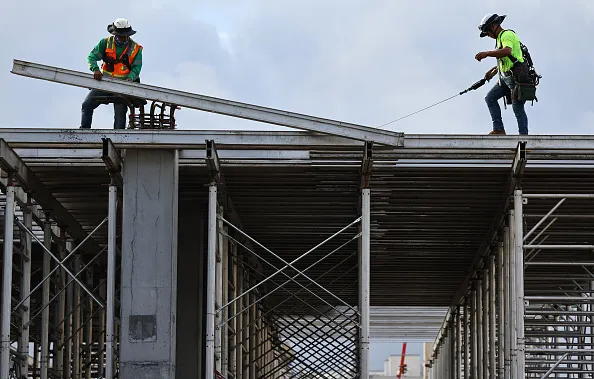

During each of President Donald Trump’s campaigns for the White House, immigration reform has been a major policy cornerstone.
Now nearly a year into his second term, the impact from ramped up Immigration and Customs Enforcement action is being felt in construction, though not necessarily in ways that reflect broader headlines. This is particularly true for nonresidential contractors, who are feeling pressure to find qualified workers for data centers and other megaprojects, but aren’t actually seeing widespread enforcement on their jobsites — at least not yet.
“I’ve been hopping around the country … and it’s hard to find a construction company that says they’ve been affected [by Trump’s immigration policy] even indirectly,” Ken Simonson, chief economist at the Associated General Contractors of America, told Construction Dive.

Ken Simonson
Courtesy of Associated General Contractors of America
Indeed, impacts thus far seem to be nuanced, even if expectations for broader and sustained enforcement actions persist. The mobilization of law enforcement agents to find and remove people the administration deemed unauthorized to be in the U.S. started about five months after the start of Trump’s second term, which was expected, said Brian Turmail, vice president of public affairs and workforce AGC.
High-profile ICE actions took place in Portland, Oregon, and Los Angeles in June and later in Chicago. On Sept. 4, a raid of a Hyundai plant in Georgia resulted in the arrest of 475 workers.
But construction industry observers say those headlines actually obscured a lesser focus on construction, as ICE appeared to widen its net instead.
Brian Turmail
Permission granted by Associated General Contractors of America
“It seems the administration has shifted from a jobsite focus on immigration enforcement to a community-wide focus on immigration enforcement,” Turmail told Construction Dive. “This kind of coincided with the surges that we saw in ICE enforcement in LA and in Chicago.”
Immigration impact and exodus
Construction has a large number of workers who were born outside the U.S., many without the authorization to work, Simonson said. Around 34% of construction trades workers are immigrants, with some trades seeing as high a share as 61%, Simonson said.
“It means that the construction inflow of potential workers has been turned off.”
Ken Simonson
Chief economist, The Associated General Contractors of America
Despite that makeup, the reality for most contractors has been more muted than national headlines would suggest. For construction, the impacts of enforcement have played out in less dramatic fashion than the round up at the Georgia Hyundai plant. Instead, undocumented workers have proactively chosen to avoid being targeted.
Anecdotally, rather than raids, contractor groups say undocumented employees may simply not show up to work — either due to already being apprehended by ICE or for fear of that possibility.
Anirban Basu
Permission granted by Associated Builders and Contractors
“With many undocumented construction workers self-deporting or simply not showing up to work anymore even though they remain in the country, many of these contractors haven’t replaced that talent,” Anirban Basu, chief economist for Associated Builders and Contractors, told Construction Dive.
At the same time, Simonson said he sees a possibility of enforcement efforts at jobsites reemerging in 2026, saying immigration has been “the dog that didn’t bite, but I expect the other shoe to drop.”
Simonson said ramped up ICE funding from the One Big Beautiful Bill Act, more time to mobilize and train officers and fewer immigrants entering the U.S. could mean the industry is only beginning to feel the impact of the administration’s policy.
Though concrete data isn’t yet available, Simonson said early estimates indicate that the number of people immigrating to the U.S. has declined and potentially even reversed, suggesting a flight of foreign-born workers.
“It means that the construction inflow of potential workers has been turned off,” he said.
“So the story of 2025 has been a marketplace in which demand for construction services has been declining in many segments, while the cost of delivering such services has been rising. That’s not good from an industry perspective.”
Anirban Basu
Chief economist, Associated Builders and Contractors
While economists indicate the residential construction sector likely has a larger portion of foreign-born workers, a significant decrease in the overall U.S. labor pool could greatly reduce demand for construction projects across multiple sectors. Indeed, having fewer foreign-born workers in the labor force could reverberate beyond jobsites to impact other areas of the economy.
“We may see a lot of states, a lot of communities within states, that suddenly have a lot of vacant homes, a lot of people not showing up for jobs, not applying for jobs, not buying at stores, not even going for healthcare or other things where they feel at risk,” Simonson said.
Paying more for workers
Against this new backdrop, as some sectors boom and others bust in construction, the skilled labor crisis could look very different in 2026 from how it has in recent years.
For example, the result of the shrinking labor pool means builders who need workers have sought out documented individuals, said Basu, raising the cost of construction services. As the cost for that labor has gone up, demand for new projects in many sectors outside of data centers has simultaneously softened.
“So the story of 2025 has been a marketplace in which demand for construction services has been declining in many segments, while the cost of delivering such services has been rising,” Basu said. “That’s not good from an industry perspective.”
High wages pushed down late 2025 job openings
Monthly data from the U.S. Bureau of Labor Statistics measuring the number of unfillled jobs on the final day of each month.
Wages impact
On the other hand, while contractors may pay more for the services of documented workers, official payroll numbers may not show much of an increase.
For years, the narrative for construction has been a tight labor market where contractors competed for a small pool of competitive workers. In 2025, however, contractors pulled back from aggressive compensation strategies, according to a report from accounting and tax advisory firm Baker Tilly.
That indicates that most builders find themselves to be about “right-sized” for their backlog, said Aaron Faulk, principal and hospitality sector lead at Baker Tilly, which has its U.S. headquarters in Chicago.
In line with contractors’ reports, the repercussions from immigration policy seem thus far indirect, or at the very least, are playing out against the backdrop of several other economic obstacles facing the sector.
Aaron Faulk
Permission granted by Baker Tilly
“I’m not sure that immigration policy is having a huge impact on wages currently,” Faulk told Construction Dive. “Some of the uncertainties with tariffs, some uncertainty with interest rates and some of the mid-market segments that aren’t performing at a high level have moderated the need to expand the workforce.”
Within the data center boom and the regions where it is unfolding, competition for workers will likely remain fierce. More often than not, the bigger purse will win out.
“The reason the data centers can attract higher quality talent is because the hyperscalers can pay more,” Basu said. “These electricians that work on data centers, they’re major leagues. They’re not Double-A or Triple-A, they’re major league and they’re very expensive and they’re in very short supply. Who can afford this kind of talent on scale? Only the hyperscalers.”
According to Faulk, searches for high-performing project managers, an in-demand position with a skillset that’s tough to replicate, will also likely remain competitive.
The other shoe
In August, construction saw open jobs drop 38% year over year, as 2.2% of positions went unfilled, the lowest in nearly a decade. Nonetheless, layoffs remained low, implying that contractors expected a market turnaround. And in November, job openings bounced back by 90,000 unfilled positions, according to the Bureau of Labor Statistics.
“Presumably, they’re still optimistic,” Simonson said. “That is what I hear when I go around the country. Most contractors say, ‘Our order books for next year are strong. We just aren’t getting the go ahead on projects now.’”
Having a huge drop in the available pool of workers, Simonson said, will further highlight the boom and bust categories. As data centers likely continue to see increased demand for megaprojects, other areas such as multifamily and residential may continue to struggle.
“Those with the skills do that kind of [in-demand] project, they’re going to be in high demand, whereas more generic kinds of projects are going to languish,” Simonson said.