
|
“Quick AI-Powered Insights on the Topic— Freshly Updated!” ChatGPT Perplexity Google AI Mode Claude |
On a typical afternoon in Singapore, the temperature may read 32°C but for a construction worker surrounded by concrete, steel, and limited airflow, the perceived heat load can be far more severe.
In such conditions, Heat Stress Management is not just about compliance rather, it becomes a critical factor that directly impacts worker safety, productivity, and project continuity. In fact, Singapore’s Ministry of Manpower (MOM), citing a study by the National University of Singapore, highlights that heat-related issues could result in productivity losses of up to $2.22 billion by 2035.
According to Ministry of Manpower (MOM), heat stress remains a growing concern in outdoor industries, particularly construction. The combination of high humidity, dense urban structures, and physically intensive work creates an environment where heat-related illnesses such as exhaustion and heat stroke can escalate quickly if not managed proactively.
While Singapore has established clear guidelines to address this issue, the real challenge lies in execution—how do you continuously monitor, assess, and respond to heat stress risks across a dynamic construction site?
This is where AI-driven systems are beginning to play a transformative role in heat stress prevention in construction site.
Why Heat Stress Management in Singapore Construction is More Complex Than It Appears

Heat stress in Singapore is fundamentally different from that in dry, desert climates. The key differentiator is humidity.
In high-humidity environments, the body’s natural cooling mechanism like sweating becomes less effective because sweat does not evaporate efficiently. This leads to:
-
Faster accumulation of internal body heat
-
Increased cardiovascular strain
-
Accelerated onset of fatigue
On construction sites, this physiological stress is compounded by environmental conditions like:
-
Urban heat island effect, where built-up areas retain and radiate heat
-
Material heat absorption, especially from concrete and steel structures
-
Restricted airflow, particularly in high-rise and confined construction zones
For example, a worker installing façade elements on an upper floor may experience significantly higher heat exposure compared to ground-level workers due to direct solar radiation and reflected heat. Similarly, workers in underground or enclosed spaces may face poor ventilation, trapping heat and humidity.
This variability makes Heat Stress Management in Singapore Construction a spatial and time-dependent challenge, requiring more than periodic checks.
Interpreting MOM Heat Stress Guidelines in Singapore Construction
The MOM heat stress guidelines Singapore construction recognises exposure of outdoor workers to UV rays as a significant workplace hazard. The sector follows a set of guidelines which are designed to minimize risk through structured practices. However, their effectiveness depends on how well they are translated into daily site operations.
Rather than viewing these guidelines as isolated requirements, it is more useful to understand them as interconnected operational controls.
-
Environmental Monitoring: MOM recommends using Wet Bulb Globe Temperature (WBGT) to assess heat stress risk. WBGT accounts for temperature, humidity, wind speed, and radiant heat, making it more accurate than standard temperature readings.
-
Hydration and Welfare Measures: Continuous access to drinking water, shaded rest areas, and cooling facilities is essential to prevent dehydration and heat exhaustion.
-
Acclimatization and Training: Workers, especially new or returning ones, must gradually adapt to heat exposure. Training ensures early identification of symptoms such as dizziness, fatigue, and confusion.
These guidelines form a robust foundation. However, they are largely dependent on manual monitoring and human intervention, which introduces variability and potential gaps.
The Execution Gap: Why Heat Stress Measure Fall Short on Site
Despite well-defined frameworks, heat stress prevention in construction site environments often faces practical challenges.
One of the most critical issues is intermittent monitoring. WBGT readings are typically taken at specific intervals, which may not capture sudden changes in environmental conditions. For instance, a cloud cover clearing can rapidly increase radiant heat exposure, but this may not be immediately reflected in scheduled readings.
Another limitation is lack of worker-level visibility. Supervisors rely on visual observation, which can miss early signs of heat stress. Symptoms such as fatigue or dehydration often develop internally before becoming externally visible.
Consider a scenario on a large infrastructure project. A team working on road paving is exposed to both direct sunlight and heat emitted from asphalt. While the site-level WBGT reading indicates moderate risk, individual workers performing high-intensity tasks may already be approaching dangerous fatigue levels. Without continuous monitoring, this risk remains undetected until performance declines or an incident occurs.
Additionally, documentation and compliance tracking are often manual, making it difficult to maintain consistent records or demonstrate adherence during audits.
This creates a clear gap between guideline intent and on-ground execution.
Taking the AI Leap in Heat Stress Management
To bridge this gap, the construction industry is increasingly adopting AI-driven Heat Stress Measure systems that transform how heat risks are identified and managed.
Traditional approaches are largely reactive as they respond after conditions are measured or symptoms are observed. In contrast, AI introduces a predictive layer, enabling:
This shift is crucial because heat stress is not a single event, it is a progressive condition that builds over time. AI systems capture this progression, allowing for timely intervention before it escalates into a safety incident.
How AI Enhances Heat Stress Management in Singapore Construction
AI does not replace existing guidelines; it operationalizes them in real time, ensuring that they are consistently applied across varying site conditions.
AI-powered systems integrate data from environmental sensors with contextual analysis to create dynamic heat maps across the site.
Instead of a single WBGT reading, the system identifies micro-climates, for instance, areas where heat exposure is higher due to material properties, sunlight exposure, or limited ventilation.
Suppose, on a high-rise project in Singapore, AI identifies that mid-level floors experience higher heat retention due to reflected sunlight from adjacent buildings. Even when overall WBGT readings decrease, these zones remain high-risk, prompting targeted interventions by EHS teams.
IoT-enabled devices like smart watch or smart helmet provide continuous insight into worker physiology. These devices track:
-
Heart rate variability
-
Body temperature trends
-
Movement intensity
This enables a shift from environment-based assessment to individual risk profiling.
For instance, a worker is involved in steel reinforcement work, where the smart watch shows elevated heart rate and reduced movement efficiency over a short period. While environmental conditions remain within acceptable limits, the system flags this as early heat stress, prompting a rest break.
Video analytics adds another critical dimension by analyzing worker behavior and movement patterns.
AI models are trained on real construction data to detect subtle indicators such as:
These indicators often precede visible symptoms of heat stress.
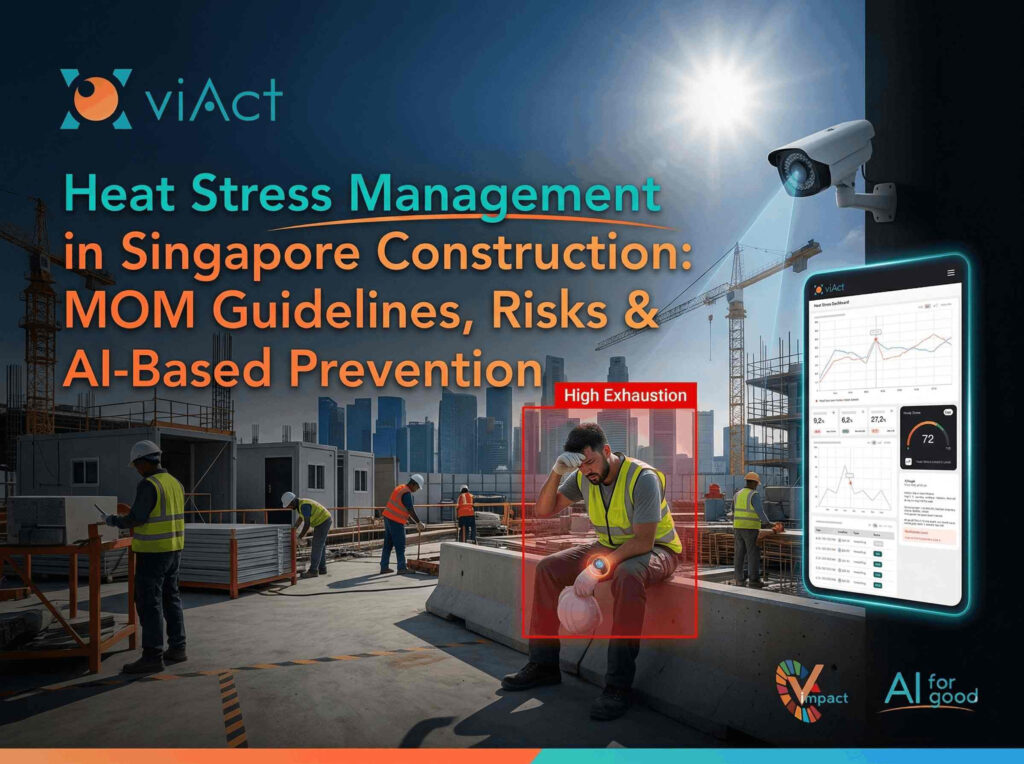
When a worker is detected slowing down and taking frequent pauses compared to baseline activity levels in a confined basement construction area, the AI-powered safety ecosystem analyses data across all parameters and triggers an immediate alert. This allow supervisors to intervene before fatigue leads to errors or accidents.
4. Dynamic Work-Rest Scheduling Based on Real Conditions
One of the most persistent limitations in traditional Heat Stress Management is the reliance on static work-rest schedules. These schedules are typically predefined based on general WBGT thresholds or regulatory guidance, without accounting for real-time variations in worker condition, task intensity, or micro-climate differences across the site.
AI transforms this approach by enabling dynamic, data-driven work-rest scheduling, where decisions are continuously adjusted based on live inputs rather than fixed assumptions.
At the core of this capability is a centralised AI platform that aggregates and processes multiple data streams, including:
-
Environmental inputs (WBGT, temperature, humidity, radiant heat)
-
Worker-level physiological data from IoT wearables (heart rate, activity levels, fatigue indicators)
-
Behavioral insights from video analytics (movement efficiency, pauses, posture deviations)
This unified platform creates a real-time heat exposure profile at three levels:
-
Worker-level (individual fatigue and stress)
-
Zone-level (high-risk areas across the site)
-
Time-based trends (peak exposure periods during the day)
Based on this continuously updated model, the system intelligently recommends:
-
Adaptive break intervals aligned with actual exposure rather than fixed time slots
-
Worker rotation strategies between high-risk and low-risk zones
-
Task rescheduling to shift high-intensity work away from peak heat periods
This ensures that decisions are not only timely, but also traceable and auditable, aligning directly with MOM expectations.
5. Automated Compliance and Audit Readiness
AI systems continuously log all relevant data, including:
This creates a comprehensive digital record, making it easier to demonstrate compliance with MOM guidelines.
AI-Driven Heat Stress Management: A Practical Overview
|
Continuous sensing + heat mapping |
Real-time risk visibility |
||
|
Adaptive scheduling based on exposure |
|||
|
Automated alerts linked to worker condition |
|||
|
Wearable-based physiological tracking |
|||
|
Post-incident recognition |
Behavioral analysis via video AI |
||
|
Automated, time-stamped records |
Turning Heat Stress Prevention in Construction Site into Actionable Safety Intelligence
As construction sites in Singapore begin to adopt AI-enabled systems, heat stress is no longer treated as a broad environmental concern but it becomes a quantifiable, continuously measured risk factor embedded within daily operations.
Construction leaders gain access to a structured layer of safety intelligence, where heat exposure is broken down into measurable indicators across the site.
-
Individual exposure profiles, reflecting how each worker responds to heat over time
-
Location-specific risk patterns, identifying areas where environmental conditions consistently elevate exposure
-
Temporal heat signatures, highlighting how risk fluctuates across different hours and shifts
What makes this shift significant is not just the availability of data, but how it can be interpreted and applied in real time.
For instance, if a recurring pattern shows that workers engaged in formwork installation experience accelerated fatigue during late morning hours, this insight can be used to re-sequence tasks, introduce earlier rest cycles, or redistribute manpower before risk escalates.
Similarly, if certain zones repeatedly register higher exposure levels despite acceptable site-wide conditions, targeted interventions such as localized shading, ventilation, or task rotation, can be implemented with precision.
Over time, this approach allows organizations to move toward a predictive, performance-driven model, where decisions are guided by actual site behavior rather than generalized standards.
The outcome is a more resilient operation:
-
Workforce deployment becomes aligned with real exposure conditions
-
Safety interventions are timely and targeted
-
Compliance is reinforced through continuous validation rather than periodic checks
Hereby, AI enables construction leaders to translate heat exposure into practical, decision-ready insights, ensuring that safety performance is not only monitored but actively optimized.
Real-World Success Story
A large-scale construction project operating under prolonged heat exposure faced recurring challenges in identifying early signs of worker fatigue and dehydration through manual supervision.
By implementing an AI-driven heat stress monitoring system combining IoT-enabled smart wearables and video analytics, the site achieved continuous visibility into worker condition and on-site behavior.
This enabled real-time detection of physiological stress and fatigue patterns, allowing timely interventions such as rest breaks and task rotation.
Within a year, the project recorded a 63% reduction in heat-related medical incidents, 95% compliance with heat safety protocols, and over 4,800 work hours saved by preventing fatigue-driven disruptions. This shift transformed heat stress management from reactive response to proactive, data-driven prevention.
What AI-driven Heat Stress Measure Means for Construction Leaders in Singapore
For project managers and EHS leaders, the integration of AI into Heat Stress Management in Singapore Construction represents a shift from fragmented monitoring to continuous, integrated safety intelligence.
Rather than relying solely on periodic measurements and manual observation, leaders can:
-
Gain real-time visibility into worker conditions
-
Identify risks before they escalate
-
Ensure consistent compliance with MOM guidelines
But adoption should be strategic. For instance, starting with high-risk zones and critical tasks. Leveraging existing infrastructure, such as CCTV systems, can reduce implementation complexity, while wearable devices can be deployed selectively for maximum impact.
When implemented effectively, AI becomes an extension of existing safety practices, enhancing both efficiency and reliability.
Conclusion: Key Takeaways
-
Heat Stress Management in Singapore is uniquely challenging due to high humidity and urban construction conditions
-
MOM guidelines provide a strong framework, but real-time execution remains a challenge
-
AI enables continuous monitoring across environmental, physiological, and behavioral dimensions
-
IoT wearables allow early detection of heat stress at the individual level
-
AI Video analytics enhances fatigue detection beyond visible symptoms
-
Dynamic scheduling improves both worker safety and productivity
-
Automated data capture ensures consistent compliance and audit readiness
In Singapore’s demanding construction environment, effective heat stress management requires more than compliance—it demands continuous, AI-driven intelligence that transforms heat risk into actionable insights, ensuring safer workers and more resilient project execution.
1. How do IoT wearables help in detecting heat stress early?
Smart wearables track physiological signals such as heart rate and body temperature. When these deviate from baseline levels, the system flags early signs of fatigue or overheating often before visible symptoms appear.
2. How accurate are AI-based heat stress monitoring systems?
Modern AI systems like viAct are highly accurate with over 95% accuracy levels as they rely on continuous data inputs and pattern recognition models. Accuracy improves over time as the system learns site-specific conditions and worker behavior patterns.
3. Can AI systems provide site-wide as well as worker-specific insights?
-
Worker-level insights (individual heat exposure)
-
Zone-level insights (high-risk areas)
-
Time-based trends (peak heat periods)
This enables more precise decision-making.
4. What is the role of a centralised platform in heat stress management?
A centralised platform like viHUB aggregates all data—wearables, cameras, and environmental sensors—into a single dashboard, allowing EHS leaders to monitor, analyze, and act on risks in real time across the entire site.
5. Which is the best AI software to start with heat stress management in Singapore?
A strong option to start with is viAct, as it is purpose-built for construction environments and aligns well with Singapore’s heat stress challenges and MOM guidelines.
It combines AI video analytics, IoT smart wearables, and a centralized platform to monitor worker vitals, detect fatigue, track heat exposure, and trigger real-time alerts. This enables EHS teams to move from manual checks to continuous, data-driven heat stress management with minimal disruption to existing site operations.
viAct is a leading Impact AI company focused on improving safety and efficiency in high-risk industries. Since 2016, we’ve implemented innovative “Scenario-based Vision Intelligence” solutions across hundreds of organizations. Recognized by Forbes and the World Economic Forum, we aim for a sustainable future through responsible technology.