 Skip to content
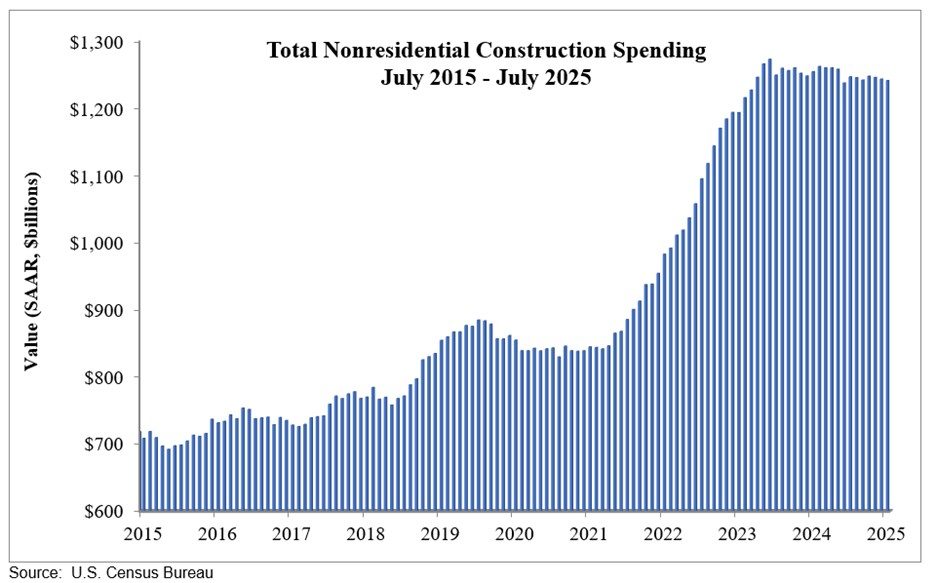


Overall construction spending fell 0.1% in July on a monthly basis, according to data recently released by the U.S. Census Bureau. In the residential sector, spending increased 0.1% while nonresidential spending fell 0.2%.
“Nonresidential construction spending fell for a third consecutive month in July and is now down 2.5% from the December 2023 record high,” Anirban Basu, chief economist at Associated Builders and Contractors (ABC) said in a statement. “With construction materials prices rising rapidly in recent months and set to continue as higher tariff rates go into effect, the recent decline in construction activity is even larger than this data series suggests.”
Jeffrey D. Shoaf, chief executive officer at the Associated General Contractors of America (AGC), also pointed to tariffs as a catalyst for the decline. “It is difficult for developers to launch new construction projects when they don’t know how much the project will cost or how long it will take to finish,” Shoaf said in a press release. “Providing greater certainty on tariff rates and taking steps to address severe construction labor shortages will go a long way in stimulating new demand for construction.
Since July 2024, total construction spending has dropped 2.8% while residential and nonresidential spending declined 5.1% and 1.1%, respectively. While spending for public nonresidential construction increased 3.1% for the year, private nonresidential construction spending fell 3.7%, spurred by large drops in the commercial and manufacturing sectors.
“With economic uncertainty still elevated, labor shortages reemerging and materials prices rising, it may be a bleak second half of the year for the construction industry,” said Basu.
The most recent annual workforce survey from AGC and the National Center for Construction Education and Research showed labor shortages impacting work for 45% of contractors, with 28% of almost 1,400 firms surveyed reporting impacts from immigration enforcement actions over the last six months.







