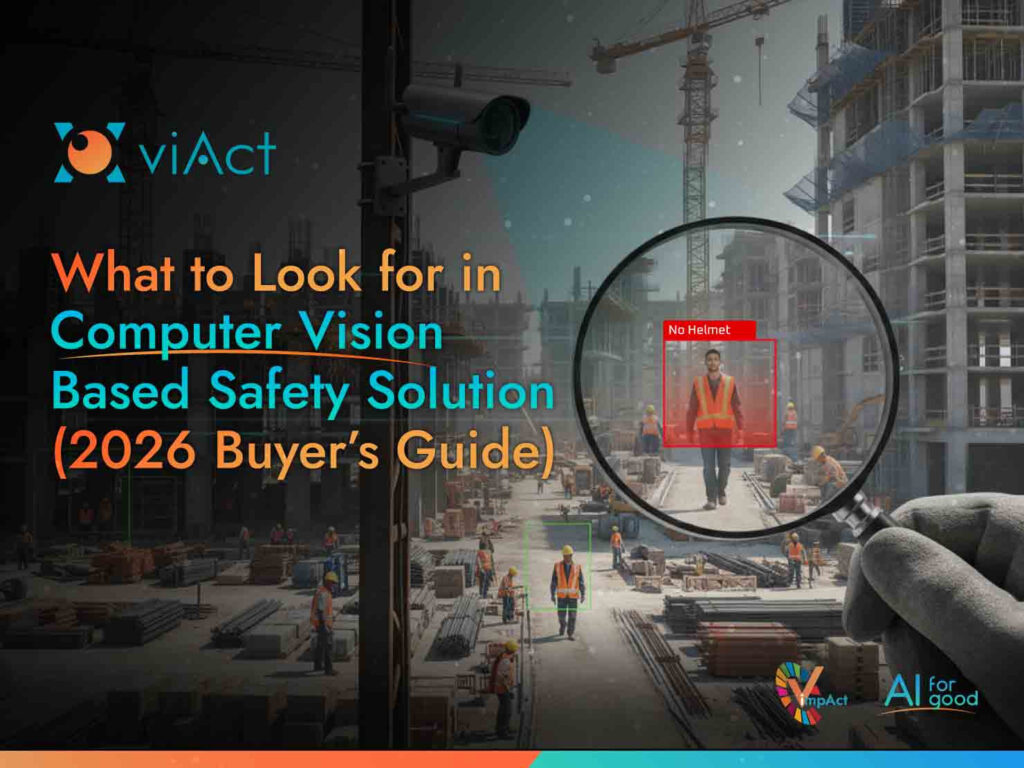

In 2026, workplace safety has already entered a new era. One where the EHS leaders are no longer asking whether AI-powered safety in heavy industries works, but the real question is which solution is truly future-ready.
Rising regulatory pressure, growing ESG expectations, and increasing operational complexity across high-risk industries like construction, manufacturing, oil & gas, and mining mean safety technology must now deliver real-time intelligence, scalability, and measurable ROI.
Today, safety leaders and project managers have an effective AI-based safety aid which can prevent sites from serious injuries and fatalities (SIFs) and train each frontline worker through their jobs.
Why Computer Vision Solutions are Becoming Essential for EHS

For decades, most safety programs were designed around periodic inspections, manual reporting, and lagging indicators such as total recordable incident rates or lost workdays. While these methods helped establish compliance, they were never designed for the speed, complexity, and scale of modern industrial operations.
That model struggles to keep up with modern industrial environments where:
-
Projects run across multiple locations simultaneously
-
Workforces are highly mobile and dynamic
-
Equipment and workflows change constantly
-
Leadership expects measurable safety performance
AI-powered computer vision changes the safety model approach from being reactive after the incidents to being predictive and proactive by detecting the subtle patterns that lead upto the incident.
The best computer vision based safety solution provides quantifiable insights that were previously impossible to capture, such as:
-
How often PPE violations occur and where
-
Which areas consistently generate near misses
-
How quickly hazards are resolved after detection
-
How does safety performance compare across sites
This transforms safety from a compliance requirement into a measurable operational performance metric.
The 2026 Computer Vision Solutions Buyer Mindset: What Has Changed?
The expectations for safety technology have evolved dramatically in just a few years. In 2026, EHS leaders need EHS software with computer vision that:
-
Integrate seamlessly with existing business systems
-
Scale across global operations
-
Provide predictive insights, not just alerts
-
Support privacy and regulatory compliance
-
Deliver clear ROI
This means choosing the right computer vision platform is now a strategic investment decision, not just a technology purchase.
Let’s explore the features that truly matter.
AI Workplace Safety Buyer’s Guide 2026
Here we present to you a guide which can help EHS leaders and project managers in high-risk industries to finalise the Best Computer Vision Based Safety Solution. Any solution today must facilitate the following features:
1. Automated Monitoring Across High-Risk Activities
The first and most obvious capability every EHS leader should prioritise is continuous automated monitoring without any blind spots across a site.
Think about the scale of today’s operations. Construction megaprojects span multiple hectares, manufacturing plants operate across shifts around the clock, drilling rigs run complex processes with hundreds of moving parts and mines operate in harsh and low-visibility conditions. Even the most experienced safety teams cannot observe every moment.
This is where the computer vision solution becomes the always-on safety observer. A strong platform in workplace safety should automatically monitor core risk categories such as:
These are not random features but directly align with the most dangerous workplace hazards. According to OSHA’s list of top 10 safety violations in 2025, transportation incidents, falls, and contact with equipment consistently rank among the leading causes of workplace fatalities. Continuous monitoring directly targets these high-risk categories.
This capability forms the foundation of proactive safety. Without automated monitoring, the rest of the digital safety ecosystem cannot deliver full value.
2. Smart Dashboards for Data Visualisation and Decision-Making
Capturing safety data is only the first step. The real value emerges when leaders can understand risk quickly and clearly. Modern EHS programs with computer vision are shifting toward real-time visual dashboards that transform raw data into actionable intelligence.
A modern platform should provide:
-
Live safety KPIs and compliance scores
-
Risk heatmaps across sites or production lines
-
Incident and near-miss trend analysis
-
Leading and lagging indicator tracking
For example, a manufacturing company might discover that most near misses occur during shift changes. A construction firm might identify that specific zones repeatedly generate fall risks. With visual dashboards, safety leaders can prioritize resources, focus interventions, and clearly demonstrate performance to executives and regulators.
3. Real-Time Alerts Across Multiple Channels
In the situation of workplace safety breaches, response time matters. The difference between a near miss and an incident is often measured in seconds. That is why modern solutions with computer vision must support real-time alerting across multiple communication channels.
Alerts must reach the right person instantly, wherever they are.
Essential alert channels include:
-
Mobile notifications for supervisors
-
SMS or messaging integrations for field teams
-
Email alerts for management
-
Control room dashboards for monitoring teams
-
Workflow integrations for incident response
Across industries, the benefits are immediate. For instance, on construction sites, supervisors can be alerted the moment a worker enters a confined space without a permit. The AI platforms can generate alerts within a second and deliver the right alert to the right person at the right time.
4. Multimodal AI with Contextual Awareness
One of the most important advancements shaping 2026 is the rise of context-aware multimodal AI. Basic computer vision detects objects — helmets, forklifts, people. But advanced platforms understand context. This is a major difference.
Multimodal AI combines live video streams, text, and permit data, sensor inputs, safety workflows and operational information to understand why a situation is risky, not just what is happening.
Some common examples of contextual awareness in heavy industries include:
-
Detecting fatigue combined with unsafe driving behaviour
-
Linking permit-to-work data with live video monitoring
-
Identifying PPE violations specifically in hazardous zones
-
Recognising unsafe behaviour during high-risk tasks
McKinsey research highlights contextual AI as a key driver of productivity and safety improvements in different industries. This capability separates basic monitoring tools from truly intelligent safety platforms.
5. Worker Privacy and Ethical AI Design
By 2026, privacy will have become a major purchasing factor for EHS leaders, and every computer vision solution must adhere to the global requirements, including GDPR.
A responsible computer vision based safety solution should include:
-
Face anonymisation or blurring
-
Role-based access to safety data
-
Configurable data retention policies
-
Transparent governance and compliance features
Adoption depends heavily on workforce acceptance. When employees understand that systems focus on safety rather than surveillance, deployment becomes smoother and faster.
6. On-Premise and Hybrid Deployment Options
Industrial environments often face connectivity challenges. Offshore rigs, remote mines, underground tunnels, and secure manufacturing facilities cannot always rely on cloud connectivity. Modern platforms must support cloud as well as on-prem or hybrid deployment options to ensure reliability.
A flexible deployment model ensures the system works wherever operations happen.
7. Integration of LiDAR Technology
The next frontier of workplace safety is spatial intelligence. Traditional cameras operate in 2D. New systems combine 3D vision, depth sensing, and LiDAR to understand distance and movement in physical space.
In mining, this helps detect proximity risks in low-visibility environments. In manufacturing, it supports safer human-robot collaboration. On construction sites, it improves fall risk detection and heavy equipment monitoring. This shift represents a major step toward predictive safety.
8. Clear ROI and Measurable Impact
The final and often decisive buying factor is the ability to prove value quickly and continuously.
EHS leaders today are expected to show how safety investments contribute to business performance, not just compliance. A strong computer vision platform should include built-in analytics that translate safety improvements into measurable operational and financial outcomes.
Key capabilities to look for:
-
Incident and near-miss reduction tracking
-
Response time measurement for hazards and alerts
-
Automated compliance and audit reporting metrics
-
Downtime and productivity impact analysis
-
Insurance and risk-cost improvement indicators
As per the National Safety Council’s latest report, the total cost of work injuries stands at $176.5 billon. It comprises of $15.7 billion in wages and productivity, $36.8 billion in medical expenses and $59.5 in administrative expenses. This means that preventing even a small number of incidents using vision AI-based monitoring can therefore generate significant ROI.
Clear measurement allows safety leaders to:
-
Demonstrate progress to executives and board members
-
Secure long-term funding for safety initiatives
-
Align safety performance with business KPIs
-
Shift safety from a cost center to a performance driver
AI-powered safety is no longer experimental — it is becoming a measurable and strategic contributor to operational performance.
Implementation Considerations for EHS Leaders
When selecting a computer-vision safety solution, consider these strategic factors:
Start with pilot projects
Begin with high-risk areas to demonstrate quick wins and refine deployment strategies.
Prioritize workforce engagement
Training and communication help employees understand how technology supports—not replaces—them.
Focus on long-term scalability
Choose platforms designed for future expansion and innovation.
Conclusion: Key Takeaways
-
Workplace safety is shifting from reactive reporting to real-time risk prevention powered by AI and computer vision solution.
-
Continuous monitoring and real-time alerts enable faster intervention and significantly reduce incident risk.
-
Multimodal AI, 3D vision, and edge computing are becoming essential capabilities for modern safety platforms.
-
Privacy, scalability, and integration with business systems are critical factors when selecting a solution.
-
Clear dashboards and ROI measurement tools help demonstrate safety’s business value.
-
Organizations adopting AI-driven safety technologies are positioning themselves for stronger resilience and long-term performance.
The best computer vision safety solutions in 2026 will combine advanced technology, ethical design, and measurable business impact.
1. How accurate are computer vision safety systems in real industrial environments?
Modern systems trained on industrial datasets typically achieve very high detection accuracy for common risks such as PPE compliance, vehicle proximity, and restricted zone access. Accuracy improves over time as models learn site-specific workflows and environments. Platforms like viAct have more than 95% of accuracy rate.
2. Will AI vision-focused technology replace safety officers or reduce headcount?
No. The goal is to extend human supervision, not replace it. Computer vision acts as a 24/7 digital observer, allowing safety teams to focus on investigations, training, and proactive risk reduction rather than manual monitoring.
3. Can we use our existing cameras for AI deployment?
Most modern platforms like viAct are designed to work with existing CCTV systems. This reduces upfront cost and allows organizations to upgrade safety capabilities without replacing hardware.
4. How are the AI-powered alerts delivered to the right people?
Modern platforms support multi-channel alerting, including:
Alerts can be customized based on role and responsibility.
5. What industries benefit most from computer vision safety?
High-risk sectors see the strongest impact, including:
– viAct is the leading Impact AI company enhancing safety in high-risk industries for a sustainable future.