

In modern commercial construction, the building envelope has become a key focus for innovation, performance, and sustainability. At the center of this envelope is an essential component: the air and water-resistive barrier (AWRB). These barriers play a crucial role in preventing moisture and air infiltration, maintaining structural integrity, and enhancing energy efficiency. As the industry shifts away from traditional housewraps and mechanically fastened systems, two modern options have emerged as leaders—liquid-applied coatings and self-adhered membranes.
Both systems provide compelling advantages, and each has a place in the architect’s toolkit. But how do they differ? When should one be chosen over the other? And is it possible to use them together for a more resilient wall assembly? Let’s explore the nuances of these technologies and their impact on the future of construction design.
The Rise of Modern AWRBs
The Air Barrier Association of America (ABAA) defines an air barrier as “a material designed to control movement of air throughout the building assembly.” While tar paper and housewraps once dominated the scene, their limitations—particularly in commercial applications—have led to the emergence of more advanced solutions.
Today, liquid-applied coatings and self-adhered membranes form the foundation of high-performance exterior wall systems. These materials are designed not only to resist water and air infiltration but also to accommodate the increasingly complex shapes and mixed-material facades of modern architecture.
Liquid-Applied Coatings: Seamless and Adaptive
Liquid-applied AWRBs are exactly what they sound like—fluid membranes that are sprayed or rolled onto the sheathing. Once cured, they form a continuous, monolithic layer that fills gaps, seals cracks, and conforms to irregular surfaces. This seamless coverage is one of their primary advantages.
These coatings are particularly effective for projects with intricate designs because they excel at waterproofing around penetrations, transitions, and fasteners, while adapting to uneven surfaces. Their versatility allows them to be used behind various cladding systems, including EIFS, fiber cement, resin cast brick, stone, and metal.
Installation is typically fast and efficient. Qualified installers can apply the coating without the need for primers, and the material’s VOC compliance ensures safety and ease of cleanup. During construction, these coatings also serve a protective role, shielding sheathing and rough openings from moisture and reducing the risk of costly repairs.
Despite these benefits, liquid-applied AWRBs have limitations. They often require dry weather, moderate humidity, and protection from precipitation while curing. Application temperatures can also be limiting with many manufactures recommending 40°F and rising, though some newer formulations perform in temperatures as low as 20°F. Lastly, exposure to jobsite dust and debris during the wet phase can contaminate and compromise the coating.
Self-Adhered Membranes: Precision and Consistency
Self-adhered membranes provide a different method. These peel-and-stick sheets bond directly to the substrate using adhesives, forming a tight, uniform seal that instantly blocks air and water intrusion. Unlike mechanically fastened wraps, they do not rely on staples or fasteners, which can compromise the barrier’s integrity.
One of the main advantages of self-adhered AWRB is that they don’t need curing. Once properly installed, they immediately act as an air and water barrier. Another benefit is their uniform thickness. Manufactured to exact specifications, they reduce installation errors and ensure reliable performance across the entire wall assembly. They are also highly durable, offering excellent resistance to tough job site conditions, chemicals, and cold weather.
Installation is simple and doesn’t need specialized tools. The membranes can be applied to a variety of substrates, including glass-mat gypsum, wood, concrete, and masonry. Depending on the project’s requirements, contractors can select between vapor-permeable (VP) and non-permeable (NP) options to match the climate and enclosure design.
Still, self-adhered membranes present some challenges. Certain substrates or conditions may require primers, adhesion to uneven surfaces can be difficult, and complex details
such as corners or penetrations demand careful detailing and rolling to achieve proper bonds.
The Hybrid Approach: Better Together
Considering the strengths and limitations of each system, a common question is whether liquid-applied coatings and self-adhered membranes can be used together. The answer is yes.
In fact, combining the two can result in a more robust, high-performance AWRB assembly. This hybrid strategy offers seamless coverage of liquid-applied coatings and the uniformity of self-adhered membranes, project teams can create a continuous barrier that adapts to the unique demands of each structure.
Consider a building with complex architectural details. Self-adhered membranes may be ideal for large, flat wall areas, but struggle with intricate transitions. In this case, applying liquid-applied coatings around penetrations and corners can ensure continuity and prevent gaps.
Or consider a project with uneven substrates. While self-adhered membranes may struggle on irregular surfaces, liquid-applied coatings can conform and seal effectively. Using membranes on flat areas and coatings in geometrically complex details creates a tailored solution for an imperfect structure.
Compatibility: The Critical Factor
Of course, combining systems isn’t as simple as mixing and matching. Compatibility between materials is crucial to prevent adhesion failures, chemical reactions, or decreased performance.
Manufacturers often provide compatibility charts and testing documentation to assist specifiers and installers. It’s essential to confirm that primers, sealants, and flashing tapes are approved for use with both systems. For critical transitions, don’t hesitate to request additional testing or documentation.
Vapor permeance is another key consideration. When combining materials, Designers must ensure that the vapor permeability of each product aligns with the wall assembly’s design and the climate zone. A mismatch can lead to condensation risks or unintended moisture traps may occur.
Integration: Building a Unified System
Once compatibility is confirmed, proper integration is the next step. The goal is to create a unified barrier that functions as a single system, regardless of the materials used.
Substrate preparation is essential. Surfaces must be clean, dry, and free of debris to ensure proper adhesion. Carefully detailing seams, transitions, and areas between materials is important, utilizing suitable reinforcement, overlaps, and flashing. Primers may be necessary, especially where product chemistries are incompatible or environmental conditions require it.
Sealants play a vital role in closing gaps and ensuring airtightness. All transitions, overlaps, and terminations should be sealed with compatible products. When applying self-adhered membranes over liquid-applied coatings, allow sufficient curing time to prevent adhesion issues.
Performance Testing and Standards
To evaluate the performance of any AWRB system—whether hybrid or not—specifiers rely on codes and standardized tests. ASTM E2357 tests for air leakage in barrier assemblies, while ASTM E2178 measures air permeability of individual materials. NFPA 285 evaluates fire spread in wall assemblies containing combustible components.
These standards give specifiers confidence that their chosen systems meet code requirements and long-term performance expectations.
Embracing Complexity in Design
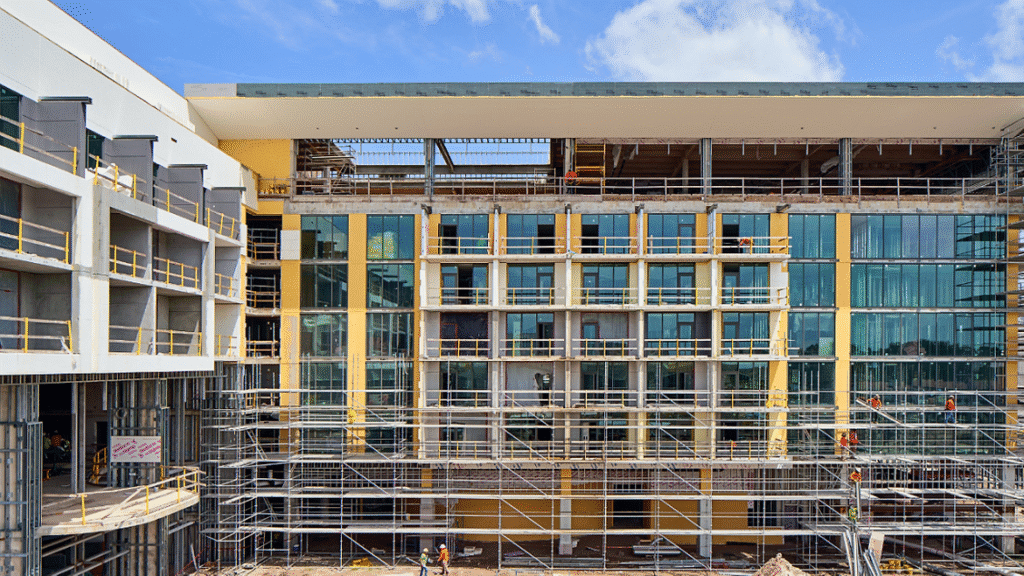
Today’s architectural trends favor mixed-material facades with varied textures and patterns on the same elevation. While visually striking, these designs pose challenges for creating a continuous air and water barrier. A single membrane type may not be sufficient.
By combining liquid-applied coatings and self-adhered membranes, contractors can adapt to the demands of modern design. Seamless coverage in detailed areas, consistent thickness on expansive walls, and proven durability all contribute to a resilient, high-performance envelope.
Conclusion: AWRBs for the Future
In the end, choosing between liquid-applied coatings and self-adhered membranes isn’t a binary decision. Each has its place, and when used together, they can overcome individual limitations and enhance overall performance.
For project teams across the design and construction spectrum, the path forward is clear: don’t fear a hybrid system. Embrace it when it leads to stronger, more resilient buildings. With proper planning, compatibility testing, and integration, these technologies can work in harmony to deliver airtight, watertight, and long-lasting wall assemblies.