Skip to content
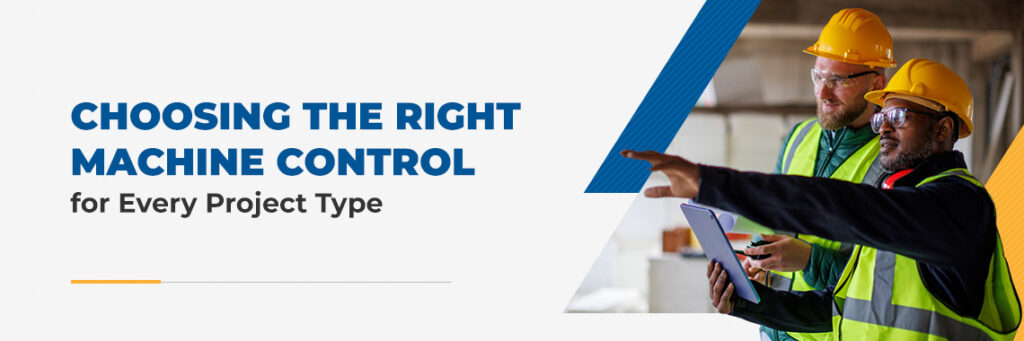

Tight tolerances, faster schedules, and rising operating costs have made precision technology a requirement. Choosing the right machine control solution for every project type has become one of the most important decisions contractors and site managers make today.
The right control solution improves accuracy, reduces rework, supports consistent results across crews, and helps projects stay on schedule. The wrong choice can slow production, complicate workflows, and limit return on investment.
It is now critical to understand how different project types align with specific control solutions—and which evaluation criteria matter most before making a decision.
Understanding the Role of Equipment Control on Today’s Jobsites
At its core, equipment control technology helps operators execute designs more accurately by guiding grading, excavation, and material placement directly from digital plans. Instead of relying solely on stakes or manual measurements, operators receive real-time guidance that enables them to work faster and with greater precision.
Modern machine control systems range from simple elevation guidance to advanced positioning solutions that reference digital models. The best systems are designed to integrate into existing workflows without adding unnecessary complexity.
2D vs. 3D Control: What Is the Practical Difference?
The distinction between 2D and 3D control is not about “basic versus advanced”—it’s about suitability.
2D control uses elevation references such as lasers or sonic tracers to help operators maintain consistent depth or slope. These solutions work well when designs are straightforward and surfaces are uniform.
3D control relies on GNSS, robotic total stations, or site positioning infrastructure to guide equipment based on a digital terrain model. With 3D machine control, operators can execute complex designs without physical stakes—reducing layout time and increasing flexibility as plans evolve.
Projects that rely on digital surfaces, variable grades, or frequent design updates often benefit from 3D machine control, where precision and adaptability are critical to success.
Key Factors That Should Drive Your Control Strategy
Before selecting any control solution, your project requirements should shape the decision—not the technology itself.
Accuracy and Tolerance Requirements
Projects with tight tolerances or layered design elements typically require 3D solutions. Simpler grading tasks with consistent depths may perform just as efficiently with 2D guidance.
Fleet Compatibility and Scalability
A control solution should align with your existing equipment fleet and support future growth. Compatibility across different machine types helps standardize workflows and reduce training time.
Site Conditions and Constraints
Terrain, visibility, space limitations, and environmental factors all influence which control approach makes the most sense. Challenging sites often benefit from systems that reduce reliance on physical layout and improve operator awareness.
Training, Adoption, and Long-Term Performance
Even the most capable control solution delivers limited value if crews struggle to adopt it in the field. Training and ongoing support play a direct role in how quickly teams become productive and how consistently results are achieved.
Well-implemented control technology should shorten learning curves—not extend them. Clear interfaces, logical workflows, and role-specific training allow operators to focus on execution instead of troubleshooting. When crews understand not only how a system works but also why it supports the job, adoption improves and resistance decreases.
Long-term performance also depends on support beyond initial setup. As project scopes shift, new equipment is added, or digital designs evolve, control systems must remain adaptable. Regular updates, calibration support, and access to technical expertise ensure systems continue to perform as expected over time.
This is especially important for operations managing multiple project types. A consistent approach to training and system configuration helps standardize processes across sites, improving predictability and reducing downtime. Over time, this consistency translates into measurable gains in efficiency, accuracy, and cost control—without disrupting day-to-day operations.
Matching Control Solutions to Project Types
Different applications demand different levels of precision and flexibility. Below is how common project types typically align with control strategies.
Earthwork and Mass Grading
Large-scale earthmoving often benefits from 3D control, especially when handling variable elevations and complex surfaces. Real-time guidance allows operators to work efficiently without constant re-staking, improving consistency across the site.
Paving and Fine Grading
Projects requiring smooth surfaces and consistent thickness rely on precision guidance to maintain uniform results. Control solutions help minimize material waste and ensure the finished surface meets design specifications.
Trenching and Utilities
Trenching applications often prioritize depth accuracy and consistent slopes. Depending on complexity, both 2D and 3D solutions can be effective—particularly when working around existing infrastructure or within tight corridors.
Mining and Material Operations
In mining environments, production efficiency and safety are equally critical. Control solutions help operators maintain design intent across repeated cycles, supporting consistency and reducing unnecessary material movement.
Solar and Renewable Projects
Renewable energy projects often involve large footprints with precise grading requirements. 3D control enables crews to maintain accuracy across long runs while adapting quickly to layout changes or evolving site plans.
Making the Right Choice for Long-Term Value
Selecting the right control solution is as much about setting crews up for consistent performance on future projects as it is about meeting the needs of the current job. The most effective strategies balance accuracy requirements, site conditions, and fleet considerations while remaining flexible enough to adapt as project demands evolve.
When implemented correctly, control technology becomes an extension of the operator’s expertise rather than a complication.
Discuss Machine Control with SITECH Southwest
Every project has its own challenges, and no single solution fits every application. Understanding how project type, tolerances, and site constraints interact is key to making informed decisions.
From earthwork to solar development, choosing the right machine control for each project type helps teams work smarter, reduce risk, and deliver better results.
SITECH Southwest supports contractors with expertise, training, and solutions designed to match real-world conditions—not theoretical use cases. When you’re ready to evaluate your options or plan your next step, connect with us to see how the right technology can make a measurable difference on your jobsite.