
Emily Pilloton-Lam is founder and executive director of Girls Garage. Miriam Warren is chief culture officer at Yelp and board chair of the Yelp Foundation. Opinions are the authors’ own.
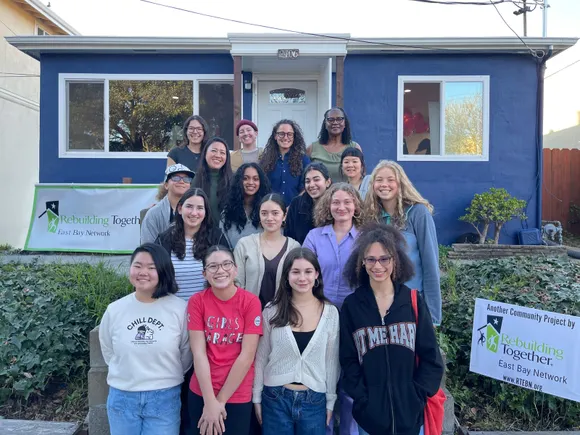
Imagine this: On a home renovation site in West Berkeley, California, a group of high school girls carries drywall, repairs flooring and rolls out ram board. Led by an all-female team, they work together to finish a home for an aging couple in their community.
While this multi-generational, women-led construction crew might surprise you, it’s the norm for participants at Girls Garage, who know the future of the industry is female.

Miriam Warren
Permission granted by Yelp
Girls Garage is the first-ever nonprofit design and construction school for girls and gender-expansive youth ages nine to 18. Through classes in carpentry, welding, architecture and activist art, they support and equip the next generation of builders. The team and participants at Girls Garage are quite literally building the world they want to see — and it’s happening at a critical time.
The construction industry is grappling with a labor crisis. The need for an estimated 349,000 net new positions is contributing to project delays, escalating costs and stagnated growth sector-wide. Staffing shortages in the skilled trades are no secret, but there’s one glaring omission from our national dialogue: the underrepresentation of women in the industry and the untapped potential they represent.
In 2024, a mere 11% of the construction industry, including all office roles, was female, according to the National Association of Home Builders. When you look at construction sites specifically, the number shrinks to just 4%. Addressing this imbalance is a vital opportunity for closing the labor gap and strengthening the future of the field.
Improving environments
Luckily, many regions and construction subcategories are already fostering more inclusive environments. An increasing number of firms are actively seeking women and providing programs and flexible work arrangements to support them. With opportunities ranging from hands-on labor to office-based positions, women can pursue careers that align with their interests, schedules and other responsibilities.
The skilled trades also offer high earning potential. While there’s still work to be done to close the gender pay gap, the gap in construction is among the smallest of any industry, with women earning about 94 cents for every dollar earned by men, according to Associated Builders and Contractors.
This demonstrates both the progress made and a lucrative opportunity for women, who can earn more than twice the hourly wage of a comparable skilled trade job in education or healthcare.
Emily Pilloton-Lam
Permission granted by Girls Garage
Fortunately, today’s momentum is nothing new; it’s building on a growing legacy of women in the trades. From Rosie the Riveters of World War II to present-day female construction networks, there are rich examples of women thriving in this industry. More and more organizations, systems, and women-specific unions (for example, the National Association of Women in Construction and Women in Construction Operations) are emerging to help women thrive at every level.
Real-world examples
As these efforts gain momentum, they challenge long-held assumptions about who belongs in the industry and what skills are required for success. Put simply: a lot of stereotypes related to women in construction are wrong.
Take Erica Chu, a Girls Garage alumni who participated in the program from ages 10 to 18. She went on to study civil engineering at San José State University and, with the support of the Girls Garage alumni network, secured a role as a project engineer at Menlo Park, California-based NOVO Construction before even reaching graduation.
Today, Erica pays it forward as Girls Garage’s alumni coordinator. Christine Cox — CEO of Milpitas, California-based Custom Drywall and a Girls Garage funder — walked a different but equally successful path: taking over her family drywall business and expanding it dramatically, all without any formal construction training.
On the West Berkeley jobsite described above, the Girls Garage team — in partnership with Rebuilding Together East Bay Network — completed their work in January and celebrated with a ribbon-cutting ceremony attended by the city’s mayor and numerous female-led project partners.
As the homeowner and her mother move back in, the true, multi-generational impact of the project becomes clear. It’s not just the residents whose lives have been changed. The Girls Garage participants who carried out the work and the entire community can see what’s possible when women are empowered in construction.