Skip to content
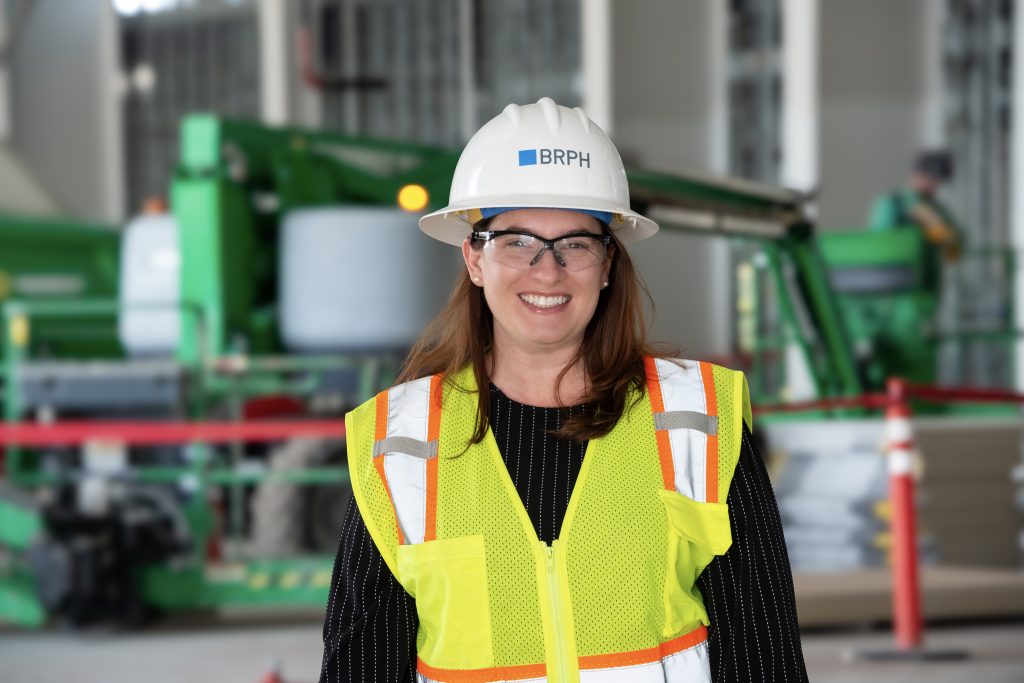

As a kid, Jennifer Lyons thought it would be awesome to be an astronaut. As an adult, she’s an aerospace engineer.
What has been your experience as a female in aerospace manufacturing and how have you seen that grow and/or evolve over the years?
Over the last several years, I’ve been building aerospace satellite processing facilities for Amazon Leo at Kennedy Space Center. There are only a few places in the world you can get that kind of opportunity–fast-paced, high-stakes and high-security. It’s neat to be a small piece in providing infrastructure to get satellites into rockets and up in the air. In my circle here, there’s definitely a strong female presence.
At the University of Florida, when I was attending in the early 2000s, women were only 10% in our construction management program. Yet currently in my jobsite trailer, our team is about half men and half women. Now, I won’t say that it’s all in the same roles—some of those traditional dividing lines might still exist—but there is tremendous respect for the responsibilities each of us navigate, each affecting our business operations and making sure we’re successful.
Did you have a mentor that you looked up to?
My mom is a mechanical engineer who kept a JEA power plant operational during her 30-year tenure through various maintenance and refurbishment projects. Thus, the heavy industrial world wasn’t something I was far from. With much less than 10% women and as a little five-foot-two lady—and I’m only five-three—she showed me that you can earn respect, lead and wield a lot of power even as a woman in male-dominated workplaces. Her advice to me was: When you are one of the few, your actions are always noticed, so be prepared, do your best and be proud of the snapshot anyone will see. My mom knows no limits and has always been a huge role model for me to look up to.
How would you say we get more women—but more people in general considering the labor shortage—involved in these niche sectors of the industry, like aerospace manufacturing?
It’s hard to imagine yourself doing something this niche when, since preschool, you’ve known construction as bulldozers and excavators. We must expand the aperture to show that construction requires everything from concept—like space planning and surveying—to engineering, architecture, construction management, to trade leaders and installers, to precision equipment and interior design with ergonomic considerations for the end users. Young people need opportunities to learn about these fields early so they can imagine themselves in the role. Seeing a woman share her piece of the process can open eyes to that field being viable for anyone. Ideally, we share the path to our field through apprenticeships, trade schools, college, internships and licensure.
Then, specifically to head into aerospace construction, proximity matters. There’s a boom happening right now on Florida’s Space Coast, so there will be lots of women who will have the opportunity to connect to this field because they’re in proximity to it. But that’s not to say that they couldn’t be doing other things across the construction industry as well; we also have a port here, and commercial and residential is always needed when you have general population growth. Our jobs are not going away with the rise in AI. While new tools can enhance our industry, construction will always be in demand.
If given the opportunity, would you go up into space yourself?
As a kid, everyone imagined it would be awesome to be an astronaut. When I think about the realities of that, I don’t know if that’s for me—my family and I always head to our back patio to watch the marvel of rocket launches, but I will keep my feet grounded and keep looking to the stars!
SEE ALSO: THE NEW BALLISTICS TESTING FACILITY AT TEXAS A&M