 Skip to content

Basements are easy to ignore … until they’re not. A basement is, by design, out of sight. Most homeowners venture down only occasionally, and what they can’t see, they tend not to think about. That’s where the problems start.
Moisture seeps in and mold starts to grow, or a leak develops, and the damage is done by the time anyone notices. The good news is that the tools available today make it possible to manage basement air quality continuously, without requiring homeowners to pay constant attention. Automated ventilation systems and real-time humidity monitoring are two popular options.
Basement Problems
Erika Lacroix, owner of EZ Breathe Home Ventilation Systems, deals with two different moisture problems that are often confused. The first is bulk liquid water, which is the seepage that comes through walls and floors and collects on the basement slab. This is what traditional waterproofing systems of drain tile, sump pumps, and vapor barriers address. These systems are designed to capture and redirect water before it can accumulate. “You’re making sure that water never enters that space,” Lacroix explained.

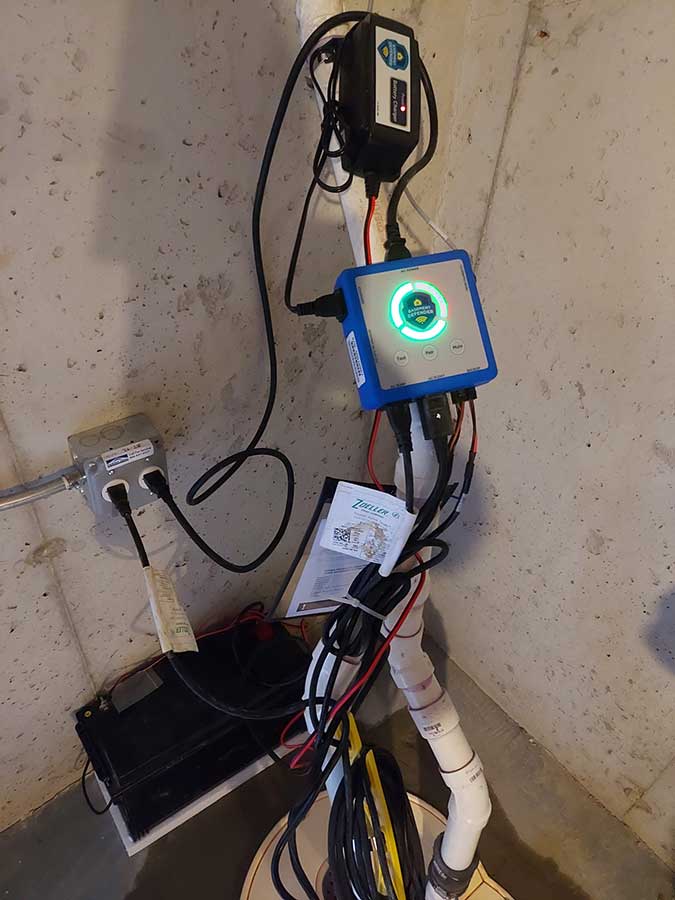
A Basement Defender monitoring unit. Photo courtesy of Basement Defender.
The second problem is airborne moisture. This is ambient humidity that has nothing to do with whether the basement is waterproofed or not. Cool basement walls cause condensation when warm outside air migrates downward. Vapor absorbs through concrete slabs and block. The result is a heavy, muggy feeling which is common in basements, even basements that appear to be dry. “There may be no liquid water present, and you may have a completely wonderful, waterproof basement, but you’re still going to have that airborne moisture issue,” Lacroix said.
EZ Breathe is a ventilation and dehumidification system that pulls air in at floor level, where air quality is worst, and cycles on and off automatically based on real-time humidity readings. A ventilation-only mode runs continuously at a lower fan speed even after target humidity is reached, addressing not just moisture but soil gases, mold spores, VOCs, radon, and odors. Ohio State Waterproofing developed EZ Breathe in 2002 as a solution to the airborne moisture issue their customers struggled with, said Lacroix.
EZ Breathe grew quickly and incorporated as a separate company in 2005. They have been supplying EZ Breathe Ventilation Systems to the greater foundation repair, basement remodelers, mold remediators, and IAQ industries for the last 20 years.
Roy Spencer, president and founder of Basement Defender, created his system to monitor sump pumps and environmental conditions. “Mold spores are always there, but they go dormant until the humidity gets high enough and that’s when they become rampant,” Spencer said. “That affects the air quality not just in the basement, but throughout the whole house.” He puts the threshold at around 50% to 60% relative humidity, above which mold growth accelerates.
The takeaway, Lacroix said, is that you need solutions for both moisture problems in order to have a healthy basement and by extension, healthy indoor air quality. “You can’t just ventilate and expect it to actually control liquid water,” she says. “You can’t put a waterproofing system in and think it’s going to control the airborne moisture. One without the other and you’re spinning your wheels.”
Monitoring
Given that most homeowners aren’t spending much time in their basements, real-time monitoring has an obvious appeal. But both Lacroix and Spencer were careful to distinguish between monitoring that genuinely matters and monitoring that just adds complexity.
Lacroix encourages contractors to offer pump monitoring as part of a complete basement solution. If any monitoring is done, it should be for the sump pump. “We liken that to the heartbeat of your waterproofing system,” she said. “Without your pump running, it could jeopardize everything that you invested in.”


The Basement Defender desktop interface and a humidity alert on the Basement Defender monitoring app. Photos courtesy of Basement Defender
Basement Defender was built around this concern. “We invented it to alert people,” Spencer said. “It tests their pumps every day and alerts them to a pump failure to keep the basement from flooding.”
A power outage, a mechanical failure, or a storm that overwhelms a primary pump can all result in inches of water in a basement that was otherwise protected. The Basement Defender device tests the sump pump every day and sends alerts to the homeowner’s phone or email if a failure is detected. Since the sensor is already installed in the basement, Spencer added humidity and temperature monitoring to the same system.
“You might have a humidistat down there, but if you’re not paying attention to it you won’t know there’s a problem until it’s too late,” he said. The app sends an alert when humidity climbs above a set threshold — typically 50 to 55%. The message prompts the homeowner to take action to avoid mold becoming established. A temperature sensor helps users stay aware of the potential for frozen pipes in the winter.
Lacroix endorsed the pump monitoring concept and went a step further on backup systems. A basic battery backup, she argued, is often insufficient because it is rated to run at reduced efficiency for only a few hours before it’s overwhelmed. A true secondary pump that runs at full capacity on battery power is a meaningfully different level of protection.
“If you have a primary pump and a cheap battery backup that maybe runs for a few hours, you could still end up with water in your basement because your power hasn’t come back on after three days,” she said. Wi-Fi-enabled pumps that can alert homeowners when the secondary unit activates take that protection a step further.

A Basement Defender unit installed in a basement. Photo courtesy of Basement Defender

For Simplicity’s Sake
Lacroix said EZ Breathe began developing an app a few years ago, then decided not to pursue that project any further. The feedback from customers was that they were already overwhelmed with apps and didn’t want to add another one for their basement.
“We were all gung ho that we were going to have an app now,” she recalled. “But the feedback was overwhelmingly, ‘Are you kidding? We’re already kind of overwhelmed. We don’t really want that.” Customers, she said, didn’t want a tutorial on pairing a device or interpreting alerts for something happening in their basement. They just wanted it to work. The company dropped the idea and decided that their premise that customers set up the EZ Breathe then forget about it and trust it to work in the background was their best selling point.
The EZ Breathe system monitors air quality and cycles on and off automatically based on real-time conditions. Homeowners set their desired humidity level and walk away. “It’s a very simple solution to a complex problem,” Lacroix said.

The Ohio State Waterproofing Smart Power Control Panel monitors and alerts on all aspects of the pumping system. Photo courtesy of EZ Breathe
Spencer made the same point from a slightly different angle. A basic humidistat is inexpensive and effective — but only if someone goes downstairs to read it. Most people don’t, he said. The value of monitoring isn’t the technology itself but rather the alert that reaches a homeowner who would otherwise never know there was a problem.
“It’s kind of an insidious thing, like frogs sitting in water,” he said. “You may not notice the humidity level creeping up on you. But by the time you do notice, you generally have unhealthy air in the home.”

An EZ Breathe unit installed in a basement. The EZ Breathe unit provides air exchanges, odor reduction, pollutant removal, and dehumidification benefits to the basement environment. Photo courtesy of EZ Breathe
Ventilation & Dehumidification
Humidity is the most visible basement air quality concern, but it’s far from the only one. Soil gases, mold spores, VOCs, radon, bacteria, and odors all accumulate in below-grade spaces that lack adequate air exchange. Addressing humidity alone doesn’t resolve those problems.
EZ Breathe’s ventilation-only mode runs the system continuously at a lower fan speed even after the target humidity level has been reached. “Continuous mechanical ventilation is really the solution for both dehumidification and indoor air quality,” Lacroix explained. “We’re talking about pollutant removal, soil gases, fungal spores, bacteria, odors.”
Lacroix says contractors who embrace ventilation can expand their service offerings and separate themselves from other waterproofing professionals who don’t offer that service. “Anyone that includes or offers such technologies with their offerings and services has a competitive edge,” she said. Homeowners are more educated than ever, she added, and they’re increasingly talking with contractors after having done a lot of their own research and already knowing what they want, which means contractors who can’t deliver a complete solution will likely lose the job to someone who can.
Putting It Together
Homeowners want a basement that stays dry, smells clean, and doesn’t require constant attention. But the liquid water and airborne moisture, which are the two biggest problems, do require some sort of attention. A sump pump that is monitored, along with a dependable backup, means that even a power outage or mechanical failure won’t result in a flooded basement.
Hand in hand with that is an automated ventilation and dehumidification system that keeps humidity in check and air moving continuously, without anyone having to go downstairs and check on it. Basement air doesn’t stay in the basement. It rises through the whole house, so continuous ventilation that removes soil gases, radon, VOCs, and mold spores protects the entire home, not just the space below grade.
“A system that employs all of these is a true waterproofing solution,” Lacroix said, “not just addressing the liquid bulk water, but also addressing the airborne moisture.” The basement may be out of sight, but with the right systems in place, it doesn’t have to be a source of worry.







