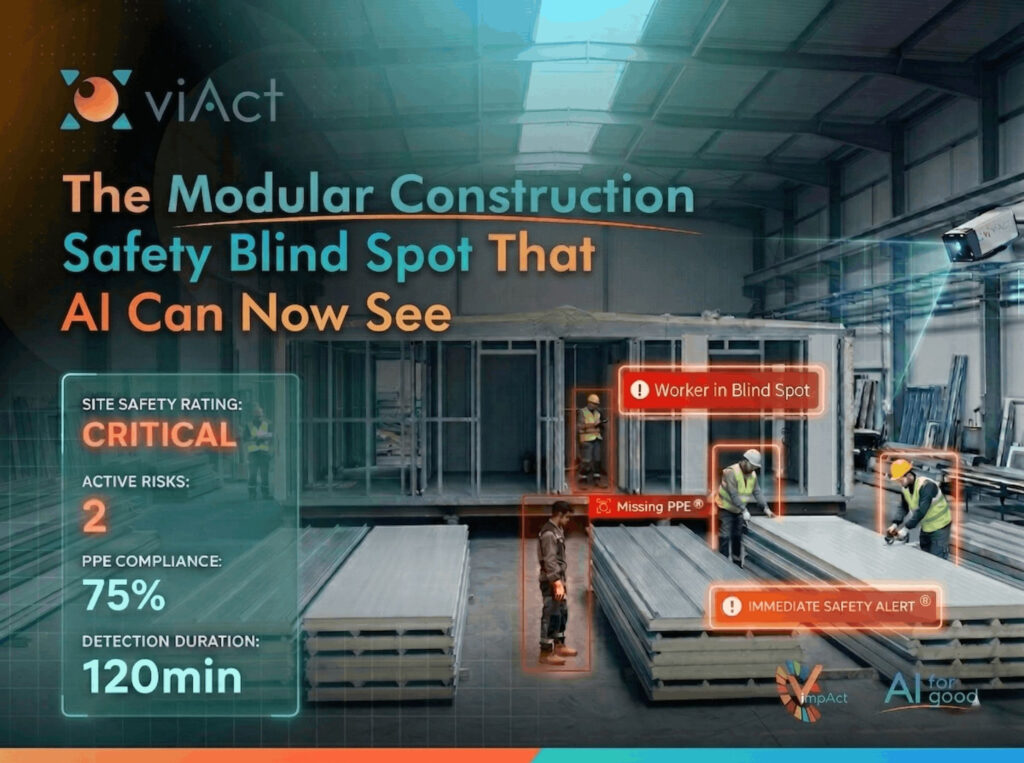

Modular construction safety is rapidly emerging as a critical focus area as the construction industry confronts persistent safety challenges.
Step inside a modular construction facility, and you will find a highly controlled environment where production lines move with precision, workers operate in defined zones, and large building components are assembled systematically—without scaffolding risks, or weather disruptions—making it appear significantly safer at first glance.
But that assumption is exactly where the risk begins.
According to the Bureau of Labor Statistics, the construction sector continues to record one of the highest numbers of workplace fatalities, with 1,032 fatal injuries reported in 2024. As safety pressures and regulatory scrutiny increase, the industry is gradually shifting toward more controlled and structured modes of operation.
Even controlled environments are not immune to failure. Consider a scenario in an offsite fabrication facility where a prefabricated wall module is being moved by an overhead crane. If the load becomes unstable mid-transfer and detaches, a worker positioned nearby could be fatally struck—despite the setting being a “safer,” highly controlled indoor environment.
In such a situation, the issue is not necessarily the absence of safety protocols, but a critical blind spot in modular construction risk management —where equipment movement, load stability, and worker proximity are not simultaneously visible.
This is why AI safety monitoring in construction is increasingly emerging as the technology capable of bridging that gap—providing real-time visibility across both environments and helping EHS leaders address the hidden risks within modular construction workflows.
Why Modular Construction Safety Frameworks Are Struggling to Keep Up
Modular construction is often described simply as “construction done in a factory.” In reality, it represents something far more complex – a hybrid operational environment that blends elements of manufacturing, logistics, and traditional construction.
Most traditional safety systems were designed for linear, site-based construction. Modular construction, however, introduces a distributed workflow with risks evolving across multiple environments:
-
Fragmented Safety Oversight: Safety monitoring is often concentrated on the final construction site, while factory fabrication and transportation phases are treated as separate or secondary.
-
Disconnection Between Project Stages: Fabrication, logistics, and installation are managed independently, with limited continuity in safety tracking as modules move across environments.
-
Loss of Safety Context in Transitions: Critical assumptions made during factory production—such as lifting methods, handling constraints, or sequencing—are not always carried forward or validated during site installation.
-
Mismatch Between Planned and Real Conditions: Site realities like ground conditions, equipment availability, or workforce constraints often differ from factory assumptions, introducing unanticipated risks.
-
Static Frameworks in Dynamic Environments: Traditional safety systems are designed for stable, single-location workflows, while modular construction operates across fast-changing, multi-location settings.
As a result, risks are not consistently reassessed as modules move through the lifecycle. This lack of continuity creates gaps in visibility—where hazards originate in one phase but only become visible in another.
This disconnect is the core reason safety frameworks are struggling to keep up. Without an integrated, end-to-end approach to monitoring and risk visibility, modular construction continues to generate critical safety blind spots across its workflow.
Unique Modular Construction Blind Spots Traditional Frameworks Cannot See
Some of the common blind spots leading to modular construction hazards are as follows:
Repetitive Strain — The Injury That Builds Slowly and Reports Late
Traditional on-site construction work is physically demanding, but tasks change frequently throughout the day. Workers move between lifting, installation, equipment operation, and material handling.
Factory assembly work is different. Workers may perform the same motion repeatedly for hours like fastening structural brackets, installing electrical components, or securing modular panels.
For example, in a modular unit assembly line, a worker had spent an entire shift tightening fixtures in confined positions. The strain on wrists, shoulders, and lower back builds gradually, not enough to trigger immediate concern, but enough to cause long-term injury over weeks or months.
Over time, these repetitive tasks increase the risk of musculoskeletal disorders (MSDs) and cumulative strain injuries.
Chemical Exposure in Enclosed Offsite Construction Environments
Modular construction factories frequently use specialized materials during the prefabrication process.
These materials can include:
-
Structural adhesives
-
Fire-resistant coatings
-
Insulation foams
-
Composite sealants
In an enclosed manufacturing environment, improper ventilation or handling procedures can expose workers to airborne chemicals and fumes. Unlike open construction sites where natural airflow reduces exposure risk, factory environments require strict monitoring to ensure worker safety.
A common real-world scenario occurs during insulation foam application inside prefabricated wall units. Workers operating in partially enclosed sections may be exposed to fumes that accumulate over time, especially if ventilation systems are temporarily shut or underperforming.
Without continuous observation, these risks may remain largely invisible.
Heavy Equipment and Pedestrian Conflict in Closed Spaces
Factories used for modular construction often contain a dense concentration of equipment operating within limited floor space.

Common machinery includes:
-
Overhead cranes transporting large modules
-
Forklifts moving heavy panels and materials
-
Automated fabrication machines
-
Robotic welding systems
Unlike open construction sites where machinery can operate with wide spatial separation, factory environments bring equipment and workers into close proximity.
Suppose a forklift transporting a large wall panel may need to navigate tight pathways while workers simultaneously perform assembly tasks nearby. A slight visibility obstruction or miscommunication can quickly lead to near-misses—or worse, collisions.
The Assembly Gap between Factory Fabrication and Site Installation
Perhaps the most complex safety challenge in modular construction emerges during the transition between factory fabrication and site installation. According to a report by CHUBB, 57.6% safety hazards in modular construction projects occur during the installation phase.
Modules built in controlled environments are often designed around specific assumptions about lifting procedures, installation sequences, and worker availability.
However, when those modules arrive at the site, conditions may differ significantly.
For instance, a prefabricated module designed for crane lifting under ideal conditions may reach a site where wind speeds are higher than expected or where space constraints force a change in lifting angles. Similarly, installation crews may be smaller than planned, requiring workers to take on additional manual handling tasks.
These blind spots demand continuous, intelligence-driven monitoring—where computer vision construction safety enables real-time risk detection beyond what traditional oversight can capture.
How AI Safety Monitoring in Construction Sees What Conventional Systems Miss
As modular construction expands, many organizations are turning to AI safety monitoring in modular construction to address the visibility challenges emerging across both factory and site environments.
Unlike periodic inspections or manual supervision, AI monitoring systems provide continuous observation across large operational areas. By combining computer vision, intelligent sensors, and real-time analytics, these systems can identify unsafe conditions the moment they occur — long before they develop into incidents.
The most significant advantage of AI monitoring is that it provides visibility across the entire modular construction lifecycle, from factory fabrication to final site installation.
Here’s how the top risks are addressed.
|
Modular Construction Safety Risk |
||
|
Factory production floors and site lifting zones |
Computer vision systems continuously detect unsafe proximity between workers and moving equipment and trigger real-time alerts |
|
|
Chemical handling areas, fabrication zones, and installation sites |
AI systems continuously detect missing helmets, gloves, vests, or respirators and notify supervisors instantly |
|
|
Crane lifting areas, fabrication machinery zones, module staging areas |
AI identifies workers entering hazardous zones and automatically triggers alerts to prevent incidents |
|
|
Modular assembly lines and fabrication workstations |
AI analyzes behavioral patterns and repeated movement cycles to identify ergonomic risk trends early |
|
|
Module installation zones and crane operations |
AI detects workers entering lifting zones or approaching suspended modules and provides immediate warnings |
|
|
Factory aisles, loading bays, logistics zones |
AI tracks both vehicle movement and pedestrian paths to detect collision risks in real time |
|
|
Across both factory and site environments |
AI systems automatically capture near-miss interactions and log them into centralised platforms for trend analysis and safety score generation |
|
|
Extended factory shifts and high-pressure installation phases |
AI monitoring identifies patterns such as slower reactions, unsafe posture, or repeated rule violations |
Why AI Coverage Must Span the Modular Factory Floor and the Assembly Site, Not Just One
One of the most powerful advantages of using AI in modular construction safety monitoring is its ability to connect multiple operational environments into a single safety intelligence system. Rather than treating factory fabrication and site assembly as separate safety domains, AI systems provide continuous oversight across the entire modular construction workflow.
Consider a scenario where a structural module is fabricated in a factory using a specific lifting configuration. The design assumes a particular rigging method and handling sequence. However, when the same module reaches the site, differences in crane capacity, ground conditions, or crew coordination may force a change in lifting approach. Without visibility into how the module was originally handled and the assumptions built into that process, the risk of instability or unsafe lifting increases significantly.
In another case, repetitive strain risks identified in factory assembly where workers were consistently handling modules from a specific angle. This might translate into unsafe installation practices on-site. If these patterns are not tracked across environments, the same risk simply reappears in a different form during installation, often under tighter timelines and higher pressure.
These scenarios highlight how modular construction risks are interconnected, but traditional safety monitoring is not. When safety oversight is limited to either the factory or the site, critical context is lost between transitions.
This is why AI coverage must extend across the entire workflow. By maintaining continuous visibility, from fabrication to transportation to final assembly through centralized safety intelligence platforms, AI enables EHS teams to track how risks originate, evolve, and reappear.
It transforms safety monitoring from a location-based function into a lifecycle-based system, ensuring that blind spots are not just detected in isolation, but understood in context and addressed before they escalate.
The Blind Spot in Modular Construction is Solvable — Here is Where EHS Leaders Should Start
The modular construction industry is scaling faster than its safety frameworks are evolving. The factory environments where prefabricated modules are built carry a distinct and underestimated hazard profile, the traditional safety controls designed for conventional construction sites were not built to address them.
This is not an unsolvable problem. It is a visibility problem — and visibility is precisely what vision-based safety monitoring in construction now provides.
The most important shifts for EHS leaders managing modular operations to act on:
-
Offsite factories carry manufacturing-style hazards that construction safety frameworks do not cover by default — they require dedicated monitoring, not adapted site protocols
-
Near-miss data from factory environments is the most underused source of risk intelligence in modular construction — automated capture is the only reliable way to collect it at scale
-
End-to-end AI safety coverage across factory and site environments gives EHS teams the connected visibility that neither environment’s safety system provides alone
-
The organizations closing this gap now will be ahead of both the regulatory curve and the incident curve as modular construction scales globally
The blind spot that has existed at the intersection of construction and manufacturing safety is no longer invisible. The technology to see it, monitor it, and act on it in real time is available and deployable today. For EHS leaders responsible, the question is no longer whether to close this gap — it is how quickly it can be done.
Conclusion: Key Takeaways
-
Modular construction is transforming how projects are delivered, but it also shifts a large portion of construction activity into factory environments, meaning modular building safety must address risks across both production facilities and installation sites.
-
The modular workflow introduces new hazard profiles such as repetitive ergonomic strain, chemical exposure in enclosed spaces, and equipment–pedestrian interaction risks, creating modular construction blind spots that traditional site-focused safety programs may overlook.
-
Conventional inspection-based safety frameworks were designed for linear construction activities and often struggle to maintain visibility across distributed operations that span factories, logistics routes, and on-site assembly zones.
-
AI-powered monitoring in modular construction enables continuous observation of worker behavior, equipment movement, and safety compliance, allowing EHS teams to identify risks such as unsafe proximity, restricted zone entry, or PPE violations the moment they occur.
-
When monitoring systems connect insights from factory production lines to final site installation, organizations gain a unified safety view that helps eliminate persistent construction safety blind spots across the entire modular construction lifecycle.
As modular construction industrializes the building process, the future of safety will depend on advanced construction safety solutions where AI not only detects hazards in real time but also predicts emerging risks across both factory and site environments.
1. What is the first step towards deploying AI safety monitoring in modular construction?
The best way to start with AI monitoring in construction is by conducting a safety gap assessment across both factory and site environments. EHS teams should identify high-risk zones such as fabrication lines, forklift aisles, crane lifting areas, and module staging zones. AI cameras and computer vision systems can then be deployed in these areas first, creating a pilot program that demonstrates measurable improvements in modular construction hazards before scaling across the operation.
2. What should be my budget for AI-powered solutions for modular construction projects?
While the deployment cost typically depends on factors like scale of operations, number of sites and modules required, platforms like viAct offer AI Modules at 100USD/Camera/Month, varying based on customisation needs.
3. Which areas of a modular construction site should be monitored first with AI?
EHS teams typically begin with the highest-risk operational zones:
-
Assembly lines with repetitive manual tasks
-
Forklift traffic corridors
-
Heavy lifting or crane operation zones
-
Chemical handling and storage areas
-
Material loading and unloading zones
Monitoring these areas first delivers the fastest improvements in construction safety.
4. Which companies provide AI solutions for modular construction safety in Singapore?
Singapore is a leading market for digital construction technologies due to the government’s DfMA policy. Several technology providers including viAct offer AI-based monitoring systems designed for construction safety, including 200+ modules specializing in computer vision, video analytics, and smart site monitoring.
5. How are cameras connected to the AI safety construction monitoring platform?
Cameras typically connect to the monitoring platform through secure network connections such as Ethernet or wireless networks. Video feeds are transmitted either to local edge processors or cloud-based AI systems, where computer vision models analyze the footage and detect safety events. The results are then displayed on the central safety monitoring dashboard.
– viAct is the leading Impact AI company enhancing safety in high-risk industries for a sustainable future.