

Concrete corrosion can sneak up on you, especially during project delays and/or rework.
Sometimes a person’s greatest strengths can be their greatest weaknesses. That principle also applies to reinforced concrete structures, which rely on reinforcing metal, often rebar, to hold them together and give them strength. But although rebar makes a building stronger, it also creates a potential weak point where corrosion can creep in and start the process of deterioration. This ongoing threat makes it important to be acquainted with corrosion inhibitors as a constant companion of concrete structures.
The Effects of Corrosion on Reinforced Concrete
Concrete initially creates a passive, highly protective environment for reinforcing metal because of its high pH. As time passes, however, carbonation sets in as carbon dioxide in the air reacts with concrete to form calcium carbonate, reducing pH and causing the concrete to lose its passivity, typically at a rate of 0.04 inches (1 mm) per year. In addition, chlorides that creep in via cracks in the concrete will accelerate the corrosion process.
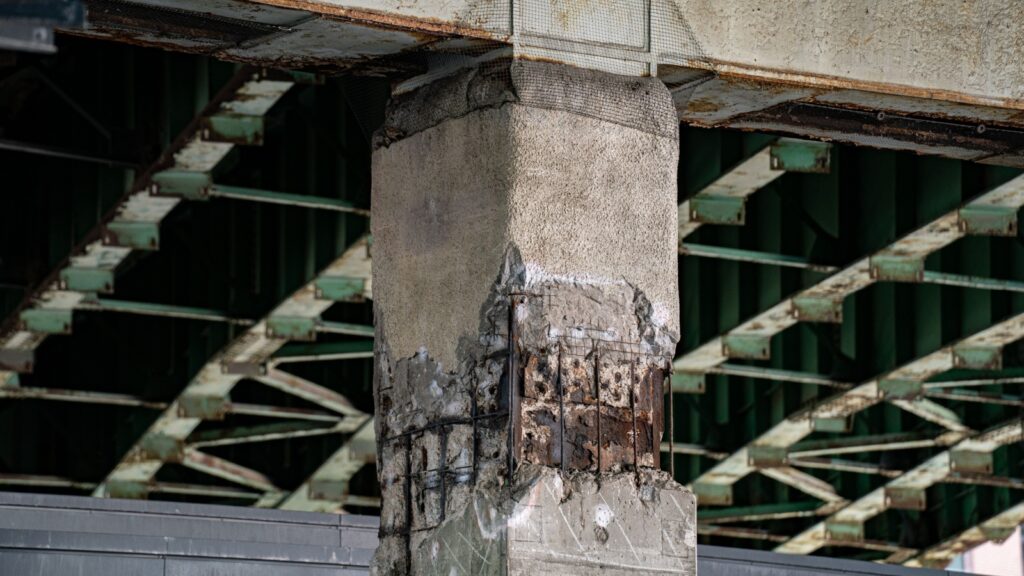
Once corrosion begins, it causes rebar to expand, placing pressure on the concrete cover and eventually causing it to crack and break apart, exposing the rebar to additional corrosives that exacerbate the problem. As more concrete is lost over time, the structure can eventually lose its strength and integrity, requiring repairs to extend the structure’s service life.
Prime Locations for Concrete Corrosion
Geography plays a significant role in how fast corrosion is likely to occur and work its damage. Bridges and structures in seaside environments battered by high chloride sea spray or directly in contact with ocean water will face some of the highest risks for corrosion. The addition of high temperatures speeds up the corrosion process. Locations with high groundwater tables or chloride-rich soil also put foundational structures at greater risk for corrosion. Cool winter climates away from the sea have their own problems, with de-icing salts wreaking havoc on roads, sidewalks, parking ramps and bridges.
Prime Times to Plan Corrosion Protection
The best time to prepare for corrosion is in the design stage, before the structure is ever built. Building protective measures directly into the structural design is a key factor in helping it reach the client’s desired service life—typically the number of years that are expected before a repair needs to be made. These strategies include using a low water-to-cement ratio, a thick concrete cover or epoxy coated rebar. The problem is that these methods can be difficult to work with or add significant costs to construction. In the case of thick concrete cover, cracking will undermine the protective effect by allowing corrosives to ingress. Epoxy coated rebar is not immune either as it can get chipped or damaged during transportation, storage and installation, creating points of corrosion vulnerability.
Admixtures for New Construction
Corrosion inhibiting admixtures offer another approach that folds protection directly into the concrete mix. In this case, the choice must be made between inorganic calcium nitrite (CNI) corrosion inhibitors and organic corrosion inhibitors (i.e. MCI® Migrating Corrosion Inhibitors) that are mainly based on amine carboxylates. The challenge of the former is that CNI works by raising the chloride threshold and requires increasingly higher doses for higher expected levels of chloride, meanwhile accelerating concrete set rate and creating workability challenges.
Organic corrosion inhibitors, in contrast, are consistently applied at a much lower dose independent of expected chloride content. Furthermore, many organic corrosion inhibiting admixtures are partially derived from corn and have been certified to meet ANSI/NSF Standard 61 for use in drinking water systems, giving them an overall friendlier profile. Organic corrosion inhibitors form a protective molecular layer on the metal surface and generally extend time to corrosion initiation, also reducing corrosion rates once started. They can be added onsite or mixed at the dosing plant.
Rebar Coatings for Construction Delays
Unfortunately, construction delays are all too common, leaving reinforcing metal half embedded and half exposed to outdoor elements. Depending on how long the delay is, plenty of opportunity may exist for corrosion to form on the unprotected rebar before the rest of the concrete can be poured. Piles of rebar left onsite for construction may also deteriorate during the waiting time.
The good news is that both unused and partially installed rebar can be protected from corrosion by applying a clear waxlike water-based coating sprayed directly onto exposed metal, leaving a thin non-tacky layer that eventually hardens. By using a coating that passes bond strength requirements, construction workers can eliminate the hassle of having to remove the coating once construction restarts, simplifying protection. Such a coating can also be applied to damaged surfaces of epoxy-coated rebar where the epoxy has chipped during installation.
Water Repellents and SACIs for Ongoing Maintenance
Although it is ideal to apply corrosion inhibiting concrete admixtures from the start of the job, it is not too late to fortify existing structures once they have been built. Periodically applying water repellants to concrete surfaces is a good preventative maintenance practice to slow the ingress of water, chlorides and other corrosives. This can be coupled with the application of a surface applied corrosion inhibitor for proactive defense. SACIs are defined by the International Concrete Repair Institute as liquids that penetrate through the concrete pore structure, contain corrosion inhibitors and act directly against corrosion at the surface of embedded metal reinforcement. This is important especially on structures where carbonation has set in over time and a natural passive environment no longer exists. The application of a high concentration SACI alone or with a water repellant (dual options exist for convenience) can delay the arrival of corrosion and also slow down rates of corrosion that have already started.
Choosing Companions Wisely
By making corrosion inhibitors a constant companion—during design, construction delays and structural maintenance—engineers can boost the service life of their structures without heroic measures, simply by wisely selecting an admixture, applying a protective coating or dosing a SACI and water repellent. Just as in life, choosing the right companions makes a significant difference in the final strength and endurance of the structure.
Special thanks to Ashraf Hasania, technical sales and product manager at Cortec®Corporation, for technical review.
SEE ALSO: MATURITY MONITORING CONCRETE INCREASES ACCURACY AND KEEPS JOBS ON SCHEDULE






