Skip to content

In urban areas, building facades can sometimes be taken over by birds and other wildlife. Birds roosting on facades should be discouraged due to health risks from droppings and the staining and deterioration they can cause.
Various bird-deterrence strategies are available, each with advantages and limitations that can lead to failure. Chemical deterrents create surface irritants but may stain materials and can become very difficult to remove when they degrade over time. Mastic-type deterrent products should be avoided, as birds can become trapped in these materials.
Acoustic systems use ultrasonic or audible sound and require an electrical power source. Coverage requirements can make configuration challenging when the entire facade of a large building needs protection, and audible deterrents may also be disturbing to people.
Vertical spikes or wires interfere with birds’ ability to land on horizontal surfaces but require periodic cleaning, as accumulated debris can create inviting perches. Vertical spike systems may also provide an armature for some birds to build nests. Horizontal wire systems can be placed at façade edges, though some birds may simply step over them.
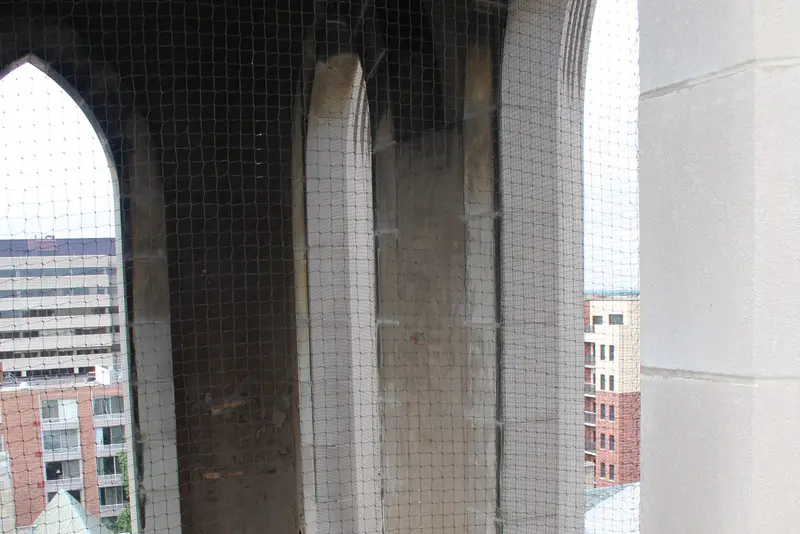
Copper or galvanized wire mesh has been used as a deterrent, either by design or as a maintenance response. While still common on mechanical louvers, it is rarely used on architectural facades. A common present-day system uses dark plastic netting, pulled taut and secured at its perimeter with stainless steel cables and hardware. Its very fine strands are visually unobtrusive (Figure 1), though effective performance depends on thoughtful installation and ongoing maintenance.
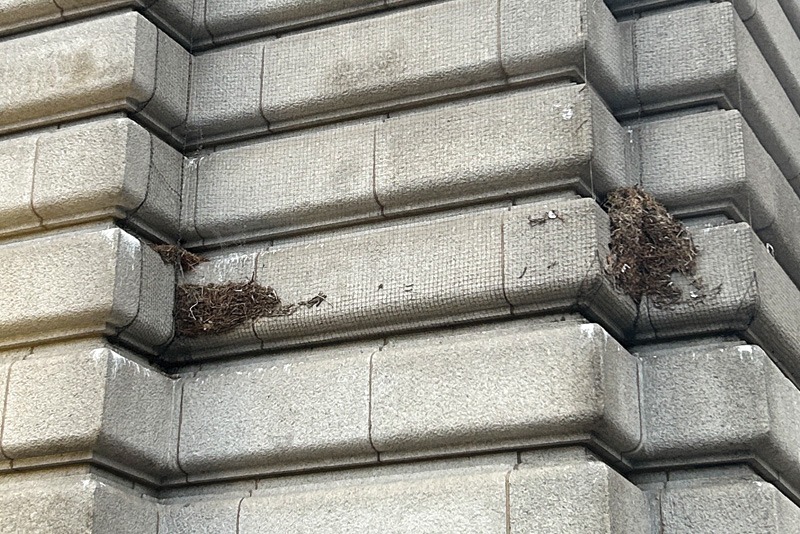
Since bird netting has a shorter service life than most facade materials, fastening hardware should be installed at joints or other easily repairable locations. It is rarely necessary to cover all horizontal ledges; blocking access to primary roosting areas is usually sufficient. On a recent project, older netting covered most of a historic masonry facade, including narrow rusticated ledges. The system was too extensive to monitor effectively, and small tears allowed wildlife access to the ledges behind the netting, creating more desirable nesting areas than would have existed without netting (Figure 2).
Selection and implementation of a bird deterrent system should consider the surface configuration, facade materials, and bird species, as perching and nesting habits vary. A mock-up of the preferred system before full implementation helps evaluate constructability and visual impact. Deterrents also become part of routine facade maintenance, including inspection for gaps or displacement, debris removal, replacement of damaged components, and modifications in response to changing wildlife behavior. Even with these requirements, maintaining a targeted deterrent typically costs less than repeated facade cleaning.
Author

Kenneth Itle, AIA, is an architect and associate principal with Wiss, Janney, Elstner Associates, Inc. (WJE) in Northbrook, Illinois, specializing in historic preservation. He can be reached at
kitle@wje.com.
The opinions expressed in Failures are based on the authors’ experiences and do not necessarily reflect that of The Construction Specifier or CSI.