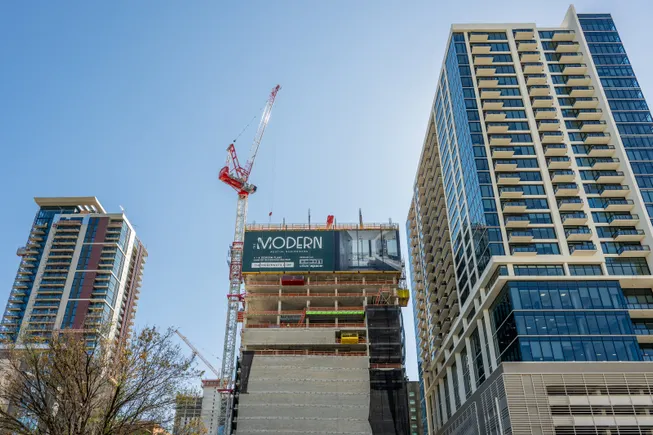

Beneath the AI buildout, some economists are finally seeing hints traditional construction is picking up once again.
Though the latest batch of economic data still shows data center and power infrastructure carried much of the industry’s momentum in March and April, shopping centers and traditional office projects have quietly gained momentum, according to construction economists.
“The year-over-year drops in construction spending for nonresidential sectors appear to be moderating,” said Juan Arias, national director of U.S. industrial analytics at CoStar, an Arlington, Virginia-based commercial real estate services firm. “Nonresidential spending is down just over 2% from a year ago. However, that is an improvement from the over 4% annual contraction seen one year ago.”
Even as activity begins to pick up on more sites, however, contractors are still wary of building costs, said Adam Raimond, program manager for cost indices at Gordian, a Greenville, South Carolina-based construction data provider. Fuel and metal prices have surged, and economists expect yet another wave of cost appreciation in the near future.
“There’s obviously the rise in gasoline and fuel costs that are having some direct cost impacts. But in addition to that, metal costs are continuing to rise further,” said Raimond. “It’s likely that in the second half of the year, the fuel crisis will take a toll on costs in other material sectors as well.”
So far, price increases have done little to impede the data center buildout. Spending on these projects jumped more than 34% year over year, said Arias. The boom has also fueled demand for surrounding substations and electrical equipment.
“The acceleration in spending on electrical infrastructure stands out, as this is tied to the data center story and will likely continue to rise as new data centers break ground,” said Arias. “Data center growth is affecting capacity utilization and industrial production for electrical component manufacturers. As demand for goods from these players tied to the grid increases, electrical construction spending will likely continue to grow.”
Other project types, such as warehouse and multifamily construction, are seeing a more sluggish recovery, said Arias. Cost appreciation on these projects may hinder progress altogether.
“It is likely that construction costs will continue to edge higher,” said Arias. “If we see more demand for contractors and suppliers from other sectors picking up, this will add further pressure on construction costs.”