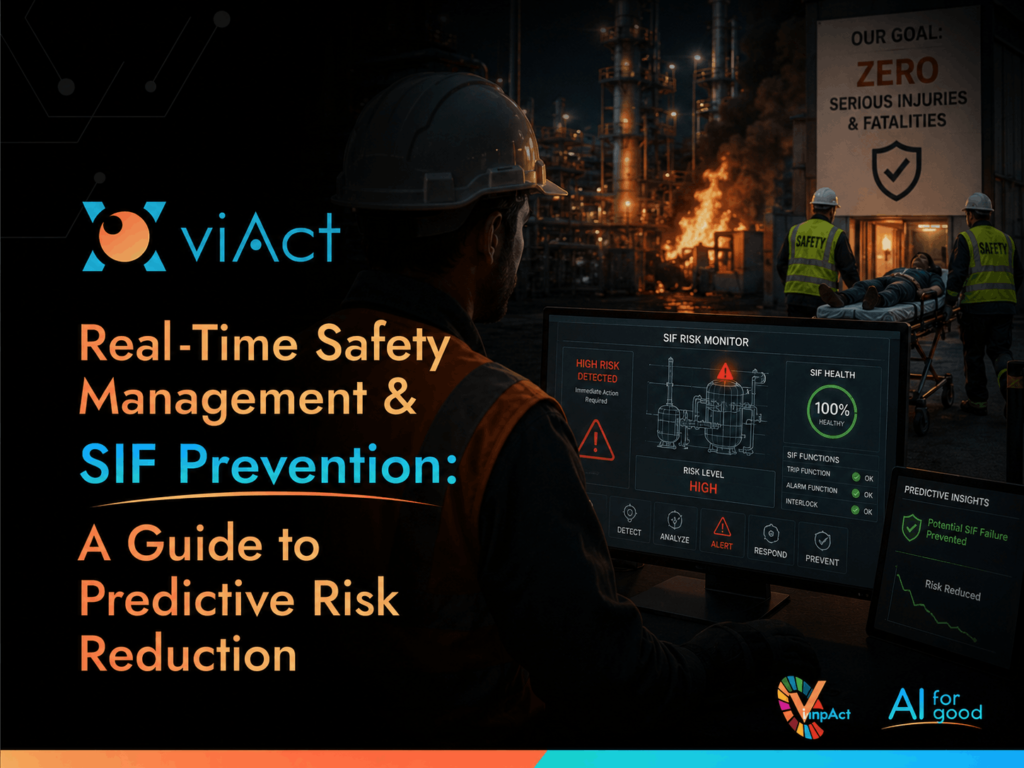

In industrial environments, hazards do not manifest abruptly. There are signs always that build long before an incident occurs. Unsafe acts, delayed corrective action, poor operational visibility, and uncontrolled risks typically occur long before a formal record of a near miss or serious injury is created. And by the time a near miss gets documented, the risk pattern behind it has often been active for weeks.
This is the core issue real-time safety management and SIF prevention strategies are devised to address. This guide aims at covering ways to identify escalating SIF risks before they become recordable incidents, operational conditions accelerating SIF exposure, and what a serious injury prevention program needs to actually intercept risk
How to Identify Escalating SIF Risk Before It Becomes a Recordable Incident
The common feature of majority of SIF events is that they were not unnoticed. They were just unmonitored. Workers closest to the work are frequently aware of which areas, tasks, and conduct expose them to the greatest danger. The challenge is that the awareness at the ground level of their operations seldom makes its way through to a safety leadership team in order to provide them the opportunity to fix issues on-time to prevent something serious from happening.
The leading indicators that signal escalating SIF risk are measurable, but only if a system is continuously monitoring for them. Some of them are mentioned below:
-
PPE non-Compliance: Recurring PPE non-compliances in the same shift across shifts, reveal a systematic control failure
-
Frequency of restricted zone entry: Repeated unauthorized access to restricted zones like crane areas, drilling floors, or other machinery exclusion zones, particularly when equipment is operating.
-
Vehicle-pedestrian proximity events per shift: Close proximity between vehicles and pedestrians that go unrecorded because no collision occurred.
-
Behavioural deviations under pressure: Workers running, taking shortcuts through exclusion zones, and bypassing barriers that increase during peak operational windows.
-
Unsupervised high-risk task execution: Confined space entries, hot work, or work at height proceeding without verified oversight during non-routine works.
Real-time safety management is founded on the premise that, the time lag between the SIF exposure builds up and the periodic assessment that captures SIF hazard exposures is where serious incidents develop.
The Operational Conditions Where pSIF Exposure Builds Fastest

SIF exposures do not increase uniformly throughout all periods of site operations. They concentrate in very specific operational conditions where visibility fragments across multiple teams faster than manual monitoring can account for. Therefore, identifying these conditions is the first step in developing any proactive EHS management plan.
The greatest concentration of SIF exposures occurs during concurrent operations. When drilling, lifting, and maintenance operations are being performed in adjacent work zones, the frequency of interactions between teams, equipment, and movement patterns increase at a rate faster than manual monitoring can capture.
Secondly, contractor-intensive periods introduce unfamiliarity into the established workflows. When new teams are brought into the operations, certain workflow/ compliances, like restricted zone boundaries, traffic routes, and PPE compliance that are routinely followed by the permanent workers, become compliance gaps for the new teams.
Thirdly, shift changeovers create consistent supervision voids. Historically, the handover window between outgoing and incoming supervisors is one of the most reliably under-monitored periods on any industrial site.
Fourthly, non-routine activities and maintenance shutdowns completely remove associated tasks from the risk controls integrated into the SOPs. Non-routine or special operations have the least established control framework around it.
Finally, the high-traffic logistics window during peak dispatch and receiving, create vehicle-pedestrian interaction patterns that may not exist during normal operations, and are often with the least dedicated safety oversight.
These are just a few conditions to name. A high-risk jobsite has plethora of such operational conditions that built potential SIFs (pSIFs) daily. However, in each of the conditions, one factor remains common: risk evolves faster than the observations systems build to detect it.
Real World Case Study
An offshore drilling rig in Abu Dhabi was managing red zone safety through manual spotters across crane decks and drill floors. Contractors regularly took shortcuts through restricted crane zones, and crowded drill floor activity made consistent monitoring impossible during simultaneous operations. Breaches were identified after the fact, triggering unplanned stoppages and investigations that delayed critical drilling schedules.
As a result, they deployed viAct AI-powered Red Zone Management solution across existing rig camera. Instant detection using viAct’s solution replaced spotter-dependent monitoring, and AI heatmaps gave supervisors live workforce density data to act before stoppages became necessary.
Results within the deployment period:
-
80%+ reduction in red zone violations
-
1,500+ operational hours recovered annually from eliminated stoppages
-
Multi-contractor shift coordination moved to a centralized real-time dashboard in viHUB
What to Look for in an Effective Real-time Safety Management and SIF Prevention System?
Not every real-time safety management system delivers the same outcomes. The criteria used in evaluating the effectiveness of a real-time safety management as part of a more comprehensive program for preventing serious injuries, extend beyond detection accuracy.
Below are a few features to look for in a serious injury prevention program built on real-time detection:
-
Scenario specificity over generic detection: Most monitoring system detect general movements and flood supervisors with alerts that require manual sorting before anyone can take action. Often by the time an appropriate alert has been found there is no longer an exposure window. viAct’s Scenario-Based Vision Intelligence identifies 200+ industry specific detection scenarios, and triggers only when a defined risk threshold is crossed in a specific operational context. Therefore, any alert that reaches a supervisor is already actionable.
-
Safety trends, not just violations: An effective system needs to provide an ongoing understanding of where SIF risks are developing, not just provide a record of individual occurrences, such as heatmap outputs by location, incidents by shift, and risk escalation patterns, so that EHS leaders have data not just to assess current conditions, but also forecast pSIF occurrences.
-
Multi-site operational oversight: Centralized control of multiple operations, contractors, and locations is critical for organisations that manage several sites. If a safety management system works well at only one site but cannot connect insights from other sites, EHS teams and the organisation cannot have an enterprise-wide system for managing safety.
-
Integration with existing workflows: Safety intelligence can only be delivered to those who can act on it when the safety management system connects with existing permit-to-work processes, shift handovers, and EHS reporting structures. A standalone safety alerting system that sits outside the usual workflows will not help to reduce the time taken to intervene.
-
Edge deployment for remote and offshore environments: For offshore facilities, remote construction sites, and sites with limited bandwidth, the ability to process events or utilise AI locally is not optional. viAct’s Edge AI viMOV, provides local detections, allowing for reliable alerts regardless of system or network conditions.
Conclusion: Why Proactive EHS Management Starts with Real-Time SIF Detection
Serious injuries develop in the time between SIF exposure building and becoming visible. Real-time safety management & SIF prevention eliminates this gap by converting continuous operational monitoring into the leading indicator intelligence that proactive EHS management actually requires. Those organizations that have most effectively reduced serious injury rates have transitioned from periodic observation to real-time operational intelligence that is specific enough to direct intervention efforts and fast enough to allow meaningful intervention before escalation occurs.
-
Repeated unmeasured precursor conditions create SIF exposure rather than single isolated unsafe act.
-
Continuous monitoring provides the only means of measuring the leading indicators of escalating risk.
-
pSIF exposure accumulates fastest during simultaneous operations, contractor-intensive cycles, shift changeovers, non-routine work, and high-traffic periods.
-
Real-time safety management provides safety leadership with operational intelligence derived from a ground-level awareness of risk, within the intervention window.
-
A serious injury prevention program requires scenario-specific detection, leading indicator outputs, multi-site visibility, and workflow integration to be operationally effective
-
Even though periodic observations and audits are essential to safety performance measurement, they will be most effective when they are also supported by ongoing detection that surfaces potential precursor conditions before they escalate.
1. What is the difference between SIF rate and TRIR, and why does it matter for safety strategy?
The Total Recordable Incident Rate (TRIR) reflects all recordable injuries regardless of severity. Serious Injuries and Fatalities (SIF), on the other hand, measures the number of incidents that lead to, or have the potential of leading to a death or a permanent disability. An organization can have decreasing TRIRs while increasing SIF exposure because the conditions that cause a minor incident and ones that cause a fatality are almost never the same. This is why, SIF preventions require a separate, and dedicated monitoring strategy rather than a general incident reduction programs.
2. What is a pSIF and how is it different from a near miss?
A pSIF or potential Serious Injury or Fatality is any event or exposure that carried a realistic probability of causing a fatality or permanent disability, regardless of whether an injury actually occurred. A near miss, on the other hand, is broader, covering any unplanned event that did not result in injury or damage but could have.
The critical distinction is “severity potential”. A worker slipping on a wet floor and catching themselves is a near miss. The same worker working unsupervised at height near an unguarded edge is a pSIF, because the energy involved and the consequence of failure are categorically different. SIF prevention programs specifically target pSIF precursor conditions because the controls required to prevent fatalities are fundamentally different from those that prevent minor injuries.
3. How does real-time monitoring reduce SIF rates?
SIF events are almost always preceded by repeated precursor conditions that go undetected because no injury resulted. Real-time monitoring reduces SIF rates by surfacing these precursors continuously, turning them into measurable leading indicators before they escalate into recordable events. The reduction happens not through faster incident response but through earlier intervention, closing the exposure window before accumulation reaches the threshold where serious injury becomes probable.
4. How long does it typically take to deploy viAct’s real-time safety management system for SIF prevention on an active industrial site?
Deployment timelines depend on site infrastructure, but viAct real-time safety management system for SIF prevention integrates with existing CCTV systems without requiring hardware changes. Deployments can be operational in days rather than months. For example, the Abu Dhabi offshore rig was fully deployed across active drilling operations in 7 days.
5. How do viAct’s AI agents support real-time SIF prevention across industrial operations?
viGent, viAct’s Generative AI co-pilot, extend real-time safety management beyond detection and alerting into active operational intelligence. Safety leaders can query live and historical operational data in natural language, generate incident summaries, identify which zones and shifts are accumulating the highest precursor frequency, and receive AI-assisted recommendations on where intervention effort should be prioritized. For large multi-site operations, this means SIF prevention decisions are no longer dependent on manual data analysis but on continuously updated intelligence that surfaces the highest-risk areas automatically across the entire operation.
viAct is a leading Impact AI company focused on improving safety and efficiency in high-risk industries. Since 2016, we’ve implemented innovative “Scenario-based Vision Intelligence” solutions across hundreds of organizations. Recognized by Forbes and the World Economic Forum, we aim for a sustainable future through responsible technology.