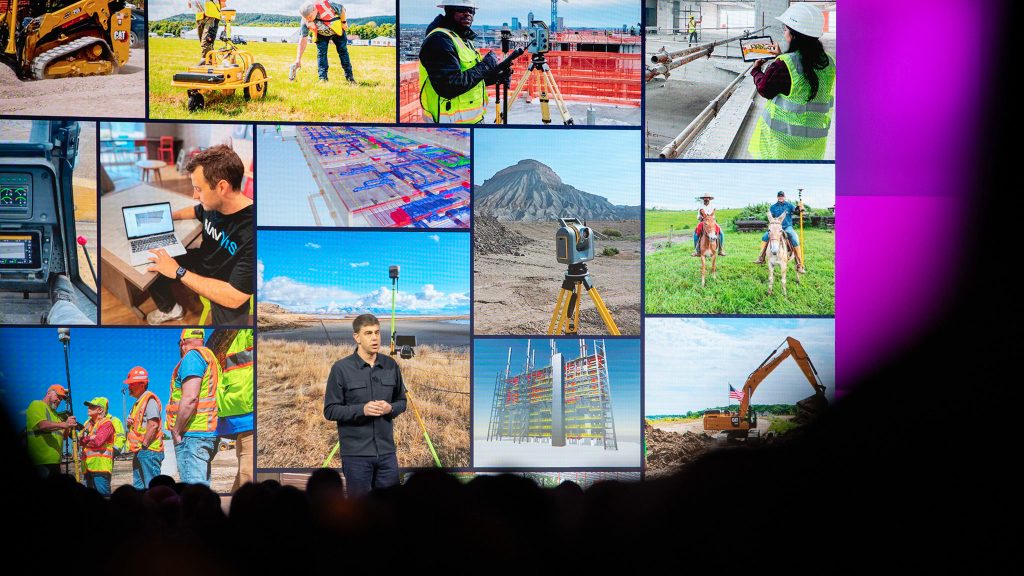

Every year, Trimble Dimensions hosts thousands of attendees. This year, the company is picking the brains of the contractors walking the exhibit hall.
Each year, experts in construction technology convene at Trimble Dimensions for hands-on, in-the-dirt demonstrations of the latest technology and machinery innovations. In 2025, Trimble thought it would take advantage of so much tech-based talent in one place at one time and conduct the first ever Trimble Dimensions survey.
From technology’s ever-increasing enmeshment with the construction workforce to persistent data-siloing issues and more, Jon Fingland, vice president and category general manager at Trimble, sat down with Construction Executive to reveal the findings of this first-ever study.
The throughline of this survey seems to be the enmeshment of construction technology and the workforce. How have you seen construction technology and the workforce become more intertwined as technology develops and the workforce shortage worsens?
I lived through the move to the cloud, the transition to mobile devices. Now we’re living through the age of AI. If I rewind to getting paper cuts from blueprints—that’s how old I am—then fast forward to today’s ability to have the latest drawing set available at the touch of a device in the field, that seems profound. That was one of the first big problems we had to solve in the industry: making sure people are working off current data.
I think what’s interesting about this moment in time is that you need some outside factors to really get people serious and honest about making the change of how they deliver the project and how they process internally. If you look at what’s happening in our market right now, it’s all coming to a head of supply-chain pressures and tariffs and workforce shortages.
We need a half million more workers this year. And 40% of the workforce is going to retire in the next five years. Combine the complexity of the work with the pressures on the supply chain and you start to see signals of shifts even in how people contract work.
They just don’t have enough workers. It’s a real problem—they must figure out how to do more with less and how to collaborate and create more predictable construction. That’s where this survey really comes into play and serves as validation that our customers are truly feeling it; that it’s not something they can continue to absorb. It’s forcing them to look at different techniques.
Would you say that, while your contractors seem pretty optimistic, they are still behind the eight ball when it comes to certain action items?
If we rewind again to 10 years ago, I don’t think the environment felt so different, but I think that now the industry is in a place where with labor and supply-chain constraints, contractors are needing to make changes. So, I look at that as a glass half full. If over 80% of contractors have an optimistic outlook about AI, but only 40% are implementing it, that 40% is still probably higher than it was 5-10 years ago. That’s a material amount of the market; I’ll take it.
Why is survey and positioning tech some of the most sought after pieces of technology that you found in this survey?
A lot of it comes from what our customers are asking us for, and it’s triangulated based on market research. There’s also an influx of outside investments from the VC and PE community investing in this space which is good for our industry. Every day it’s changing and it’s interesting to see it at the top of the survey list this year.
When it comes to companies either not adopting contech at all, not adopting enough of it, or the right kind, how can the industry as a whole continue to encourage or ramp up the buy-in of this technology?
We need to change behavior, which is hard to do. You still hear, “It’s just the way we’ve operated. This is how we schedule, how the spec is written…” There is a lot that must change. So, we have to encourage people to continue to do more, to commit to the journey.
On the vendor side, to really change behavior, you’ve got to build trust. There’s no doubt that AI can get involved in helping with decision making and automation. But when we do those things with AI, we’ve got to be able to show the vendors how we decided so that they can trust that and see where that recommendation came from.
When it comes to data siloing, one silo of sorts is the 40% of the workforce that’s set to retire. How can the industry ensure that that knowledge isn’t gone when that set of people retire?
If we take a lesson learned in the industry from 15 years ago: They started to build VDC departments, but they kept their normal estimating, scheduling and project management departments, creating an us-versus-them mentality. What we need is the experience from all domains that all these folks leaving have, plus these new folks coming in. The next generation is coming in more accepting of AI, more accepting of 3D and VDC workflows, et cetera. But you’ve got to bring those teams together. If you’re trying to change culture and behavior, you need to merge those folks in. You must use that experience and adopt a new process.

In an earlier conversation, the word ‘democratized’ was used regarding the advancements of scanning and positioning technology. Elaborate on what that means.
The way the industry has historically worked with data is in starts and stops. You design it, you hand it over and then you start to construct it, but often when you hand it over, you lose knowledge. It’s that stair step or see-saw. Every functional area and every stakeholder have their own data and data model. We’ve got to find a way to liberate that data so that it can be used throughout the process. We want the data to be available to everyone across the lifecycle. With new technology, what was once only accessible to bigger, more advanced companies is now also accessible to smaller contractors.
The construction industry’s attitude around AI has already gotten so much better. Would you say the industry is on a cusp when it comes to AI adoption and implementation?
Exactly. That’s why I get so excited when talking about the 40% who are already implementing. That’s very close to 50%. That’s what I need. I don’t need 100% right now. We need 40-50% to make certain moves. And I’ll bet, once the other half sees those moves, they won’t be able to unsee them and they’ll want to make them themselves.
SEE ALSO: THE BENEFITS OF INCORPORATING AI INTO THE CONSTRUCTION LIFECYCLE