ABC Minnesota/North Dakota creates first-of-its-kind program for telecommunications installer safety training.
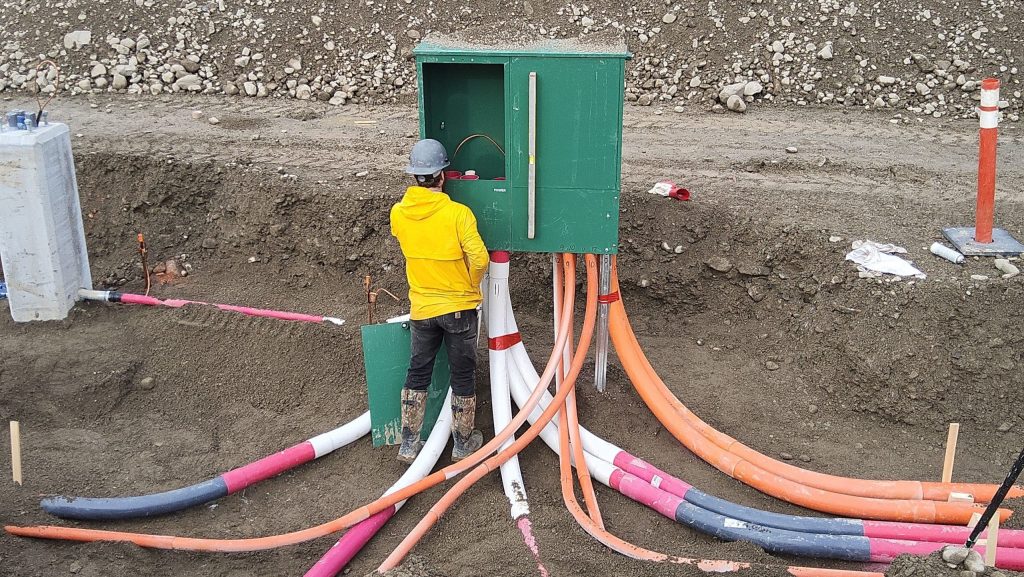
On the first day of the year, a Minnesota law requiring installers of underground telecommunication infrastructure broadband, fiber or phone lines (when projects utilize directional drilling, and/or work is being conducted within 10 feet of existing utilities) to undergo a 40-hour certification went into effect.
Originally passed in mid-2024 and proposed to go into effect in July 2025, the law’s requirements were postponed until January 2026, giving ABC Minnesota/North Dakota—in partnership with NCCER and the Minnesota Cable Communications Association—time to roll out their Safety Qualified Underground Telecommunications Installer training program, which would ensure the workforce of their contractor members were certified.
When ABC MN/ND first caught wind of this law, it quickly set to work on designing this program from scratch. It would need to encapsulate enough classes to satisfy the 40-hour requirement, with both hands-on (in the field) and hands-off (digital classroom) training portions. It would need to include a training addendum for those looking to become program instructors. It would need to be flexible enough to accommodate the demands of sometimes unpredictable and often odd construction hours. It would need to be offered in both English and Spanish. And it would need to be designed in one year.
This law being the first of its kind in the country, there was no precedent for similar programs which the chapter could reference. So, it did not shock the chapter when it was approached by Minnesota Cable in late 2024 once this legislation had passed. With a relatively small staff, Minnesota Cable was conscious of the cap on its abilities to build out a bulky safety program like the one this law would require—but just as with ABC, their members needed it. “Minnesota Cable asked if ABC was interested in partnering,” says Adam Hanson, president of ABC MN/ND. “So, we went through a few meetings and agreed to take it on.”
But each association still took pause with just where and how to begin designing the program. So, NCCER was not shocked either when it received a call to action.
Robert Jones, digital director of learning at NCCER, says, “It just made perfect sense for us to be able to support ABC. To make sure that this chapter is a leader in the state in training people how to work safely, and not just in broadband.”
Jones says they also saw the bigger picture—a national one—which influenced the type of program that they would build. “We built the program modularly,” he says. Of the seven courses, the first focuses specifically on Minnesota regulations; the other six focus on digging-safety and equipment skills. “We designed it so that if another ABC chapter came to us under similar circumstances, we are able to readily respond.”
Having worked closely with NCCER over the past several years, Hanson was confident in this next venture. “I knew that there was great opportunity there,” he says. He was also confident about the national influence a program like this could have on construction safety. “We were not only building this for Minnesota contractors.”
Perhaps the SQUTI program was built for something bigger than Minnesota, but—as it originated there—what did the contractors in Minnesota think of this program?
Director of Government Affairs for ABC MN/ND Joel Hanson says, “A lot of the feedback I got from contractors included ensuring that we weren’t just covering the bare minimum. If they’re going to have to put people through 40 hours of training, it should be worthwhile.” Hanson collected information on preexisting training that contractors were already applying, as well as supplemental activities to include. “We wanted to make this a good value for the contractors.”
Having been enacted for almost half a year now, the program is already increasing overall telecommunications safety awareness and implementation, and the more contractors who enroll and pass, the more feel and see the safety benefits. “ABC MN/ND is proud to help lead the rollout out of SQUTI”, says Janet Artmann, ABC MN/ND’s safety programs manager, “SQUTI strengthens our industry by elevating training expectations and reinforcing a culture of safety on every jobsite.”
At the time of this publication, there were 214 participants and 51 instructors enrolled; 171 of whom have already earned their orange cards—which will need to be renewed every three years.
This SQUTI certification program is already proving successful—and historical. Artmann says, “We’re always advocates for the safest, best way to do anything. Being the first program of this kind out there and already having nearly 200 orange cards, if we can keep that consistency going and keep in the forefront of people’s minds, I feel like its success will be organic and lasting.”
SEE ALSO: INFRASTRUCTURE: GOING AFTER IIJA-FUNDED WORK TWO YEARS LATER