Skip to content
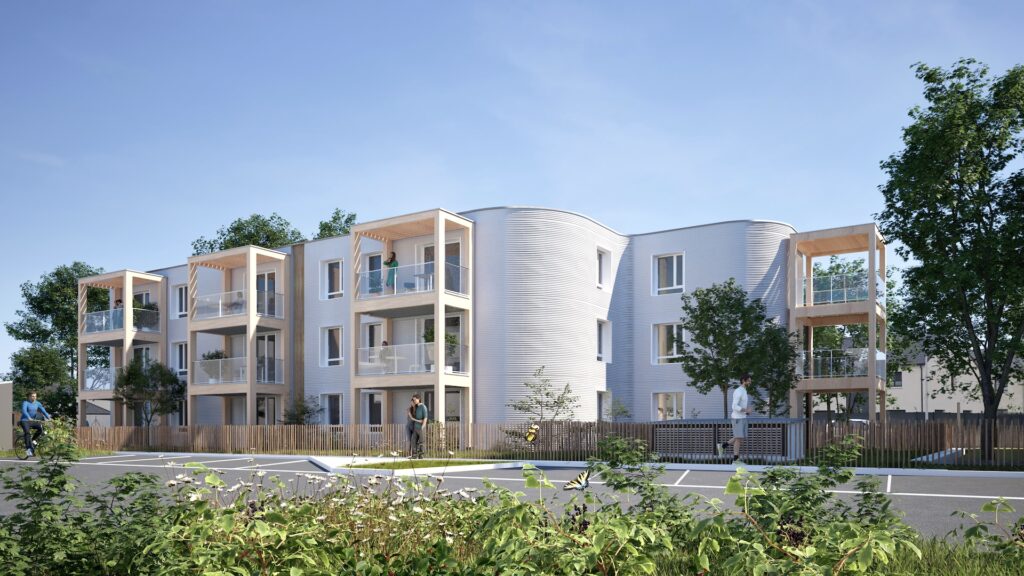

In April, PERI 3D Construction completed ViliaSprint², a construction project for a three-story residential building with 12 social housing units in Bezannes, France. According to the company, this was the first on-site-printed multifamily residential building in the country and the largest in Europe.
The Bezannes project is one in a series that demonstrates the current capabilities and measurable benefits of on-site 3D printing. The technology is finally producing results worth taking seriously, and the cost picture is becoming clearer, if not yet complete.
From an initial idea into a business model
PERI Group is a German construction technology company, founded in 1969 in Weißenhorn, best known for its formwork and scaffolding systems. Eleven years ago, they decided to take on 3D printing.
In 2018, the company became a minority shareholder of the Danish manufacturer COBOD, and two years later, completed the first 3D-printed residential building in Germany. In 2022, PERI 3D Construction was established as a subsidiary of the PERI Group.
PERI has carried out 3D-printed residential projects in Germany and a few other European countries, as well as in the U.S.
ViliaSprint²’s technical solutions
ViliaSprint² is a joint development with Plurial Novilia, a subsidiary of the French Action Logement Group, and is designed by HOBO Architecture. The building has three stories, each floor offering 350 m² of usable space.
PERI 3D used a large-format COBOD BOD2 3D gantry printer, 12 meters wide and 11 meters high. Each wall consists of an 8 cm-thick outer layer and a 16 cm-thick double inner layer. The 20 cm gap between them is filled with permanent insulation material. Fiberglass connectors link the layers and stiffen the structure, and all the printed walls are load-bearing.
In Finland, a similar building would most likely have been built with precast concrete walls and slabs. In this case, just the horizontal structures were prefabricated.
Enhanced sustainability
Sustainability has been a guiding principle in the project. Swiss Holcim developed a high-performance printable concrete for this project, using locally sourced sand and aggregates. The concrete has 30% lower CO₂ emissions than conventional concrete.
Beyond concrete, ViliaSprint² also relies on bio- and geo-based materials such as perlite and wood for the load-bearing structure of the balconies, features a central heat pump that provides hot water and heating, and uses photovoltaics.
Construction is notorious for creating a lot of material waste. This site generated 50% less waste than usual, and the curved geometry reduced the amount of concrete needed by 10%.


Efficient delivery
The original plan was to spend 50 days printing. Eventually, that was reduced to just 24 active printing days. Furthermore, only three employees were needed to erect the walls, rather than six, a fact that Plurial Novilia sees as a significant advantage during skilled-labor shortages.
Interestingly, an identical building was constructed on the same plot using traditional methods. This allows an apples-to-apples comparison across the life cycle of the buildings that is rarely seen in innovative projects that rely on estimates and guesswork. This kind of information is crucial if developers are to adopt the new method.
PERI 3D stated that the 3D-printed building’s schedule was approximately 50% faster than that of a similar conventionally built house. On cost, PERI has reported approximately 10% savings in its Heidelberg project, but no full audited cost comparison has been released across its portfolio. The business case is plausible, not yet proven at scale.
Nevertheless, Plurial Novilia is convinced enough to follow up with a project of 40 residential units and two printers running simultaneously.
From pilots to scale
3D printing is becoming a viable construction method for specific use cases in Europe, especially housing. Another strong use case is the bespoke infrastructure components that, for example, Finnish Hyperion Robotics provides.
The major constraints remain certification, standardization, and scaling beyond showcase projects. Even supportive industry coverage notes that regulation remains a limiting factor, and EU construction product rules are only now adapting more explicitly to innovative methods such as 3D printing.
3D printing has moved past the proof-of-concept stage. Still, I find it hard to see traditional construction firms wholeheartedly adopting it in the near future. In practice, the sector is advancing fastest where there is a clear client need, a repeatable building type, and a partner ecosystem that can absorb the technical risk.