
Dewalt unveils a first-of-its-kind robot that may soon be working overtime.
With the data center construction boom well underway, and the skilled-labor shortage holding steady, a people problem is rearing its head—as in there are not enough people to keep pace with the data center demand for labor.
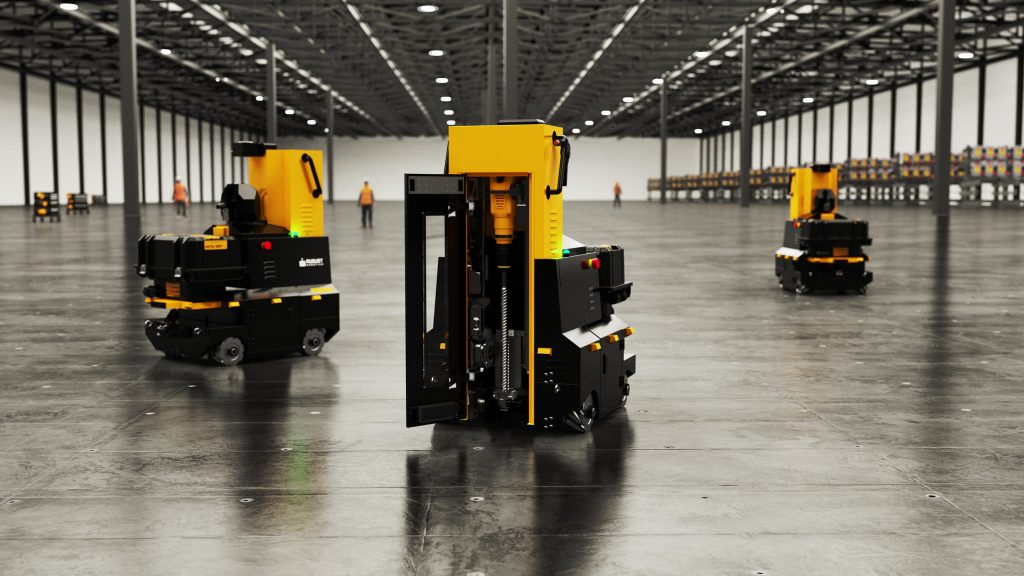
One recent innovation is hoping to address at least one facet of the problem, though. At World of Concrete in January, Stanley Black & Decker unveiled an automated DEWALT drilling robot with drilling accuracy throughout its pilot program at 99.97% for 100,000 holes. One robot has been proven to locate and drill one hole every 80 seconds—for smaller holes 3/4-inch in diameter by 2-inches deep—and one hole every 180 seconds for larger holes one-and-one-eighth-inch in diameter by 8-inches deep.
Bill Beck, president of tools and outdoors at Stanley Black & Decker, sat down with Construction Executive to discuss the design, prototype and implementation process of this invention, and how it is already positively impacting the contech sphere.
“What we’re doing within the data centers,” says Beck, “is trying to make things easier for our end users.”
This product is labeled as the world’s first. What was the impetus for this design?
Right now it’s a race to get as many data centers up as fast as possible. We said, ‘How can we change a process that’s been historically manual-labor intensive?’ There are thousands and thousands of holes that go into these data centers, anywhere between a thousand to 10,000 holes. And they’re used to anchor the racks upon racks of servers. So those holes have to be perfectly drilled and perfectly in line. Using a manual process, that can take up to almost two months. So we partnered with August Robotics and said, ‘You guys are good at robots. We’re good at drilling. Can we put the two together and create a solution that’s going to take time off the project?’ And so we delivered the first downward drilling robot. Now a project that may have taken seven weeks to be done manually can be done in seven days.
We asked how do we save time. But we also asked how do we make it safer for the employees or the end users? Because you can imagine bending over and having to drill 10,000 holes can be a lot. You can also think about it from a dust perspective. Workers shouldn’t be breathing in that drill dust, and so the robots have a vacuum attachment.
Ultimately there’s a cost savings, too. So in terms of opportunity, it’s a trifecta. The problem started with go faster. Then we said we can not only go faster, but we can be safer and deliver it at a much better value as well.
This tool was designed specifically with data centers in mind, but will it remain that way long term? Can it be used for other project types?
Whether it’s a data center, a distribution center or even big buildings that are going up in a city, they all start typically with a concrete slab. And the ability to drill holes at the right place in a timely, cost efficient way is critical. So you can see this easily expands beyond data centers. We’ve got plenty of opportunities today within data centers, but as distribution centers go up and any other building that has historically taken a human being to drill, we can do it now with our robots.
Obviously, so this isn’t about taking jobs away from anyone. This now enables people to go do jobs that require more technical skill while the robots go to what they need to do within these data centers or distribution centers or other builds.
How long has this robot officially been on the market?
Right now we’re testing with a hyperscaler. We have a fleet of 12 robots that have drilled 100,000 holes already across 10 different construction sites for the past year. We plan to fully launch mid-2026.
Is the drill-bit size scalable per project need?
With the data centers, there are really two holes that they need: A small hole about three quarters of an inch in diameter and two inches deep; a larger hole, about an inch and one-eighth in diameter and eight inches deep. It all depends on what will be held up. Of course, Dewalt makes lots of drills and lots of drill bits, so we can absolutely work to make sure that this tool can adhere to anything that the construction needs in the future.
What has feedback been like?
Feedback’s been really strong, particularly regarding two aspects. One, within the testing that we’ve had with the 12 robots that are deployed with our hyperscaler. The accuracy rate for these holes is 99.97%. So when you get that type of accuracy, how can you not be happy? You’re not having to go back and re-drill the holes. You know that the racks will fit. We’ve gotten the cost down from $65 per hole to somewhere around $20 per hole. And then of course the speed aspect of it. The robots are delivering on what we committed and our hyperscaler is continuing to ask us if we can deliver more robots.
Another place we received some really strong feedback is at the World of Concrete where we showcased. People saw the use case; they saw the problem and then the solution. The end user as well as our distributors were able to see the product in action.
Elaborate on the safety benefits.
The safety benefits are mainly three-fold: Eliminating that repetitive motion. If a few people are drilling 10,000 holes, you can imagine what that’s like to bend over that many times and the strain that can have on your back. So the robot completely eliminates that strain.
The other part, which I think we all see but sometimes don’t realize is the dust. The robot has a vacuum that brings the dust into a bag so it’s not going into the atmosphere at all. And so you don’t have to worry about if folks are there working on other parts while the robots are working.
The final part is hearing protection, which people wear of course, but if you’re letting the robot do it, that decreases that strain as well.
Dewalt tools also have a safety feature called Perform and Protect, which enables a power tool to not be used in the wrong way. It can sense if a person’s holding it wrong or if it locks up, then it’ll shut down the tool to avoid injury. So, the combination of the robot plus our Perform and Protect tools really enables us to deliver on safety.
How will this influence the development of this type of technology, whether other companies are able to build off of this idea or whether Dewalt further develops it?
When talking about robotics and AI, we look at the tenets of safety, productivity and quality. Just as with the original problem—we need to go faster—that we looked at and tried to answer, we’re doing the same thing as we look at different opportunities within other buildings. What’s the next thing that could be put on the robot that would hit across those three tenets from a new angle or perspective or need? Whether it’s hanging different things, whether it’s fabrication or different aspects of construction, you can absolutely see places where robotics and AI will play a role. So, this is a great place, especially in an industry that has a worker shortage, to innovate and hopefully help move our industry forward.
SEE ALSO: NEW WALL-SCALING ROBOTS ARE SAVING CONSTRUCTION COMPANIES TIMES, PRODUCT AND PERSONNEL