 Skip to content
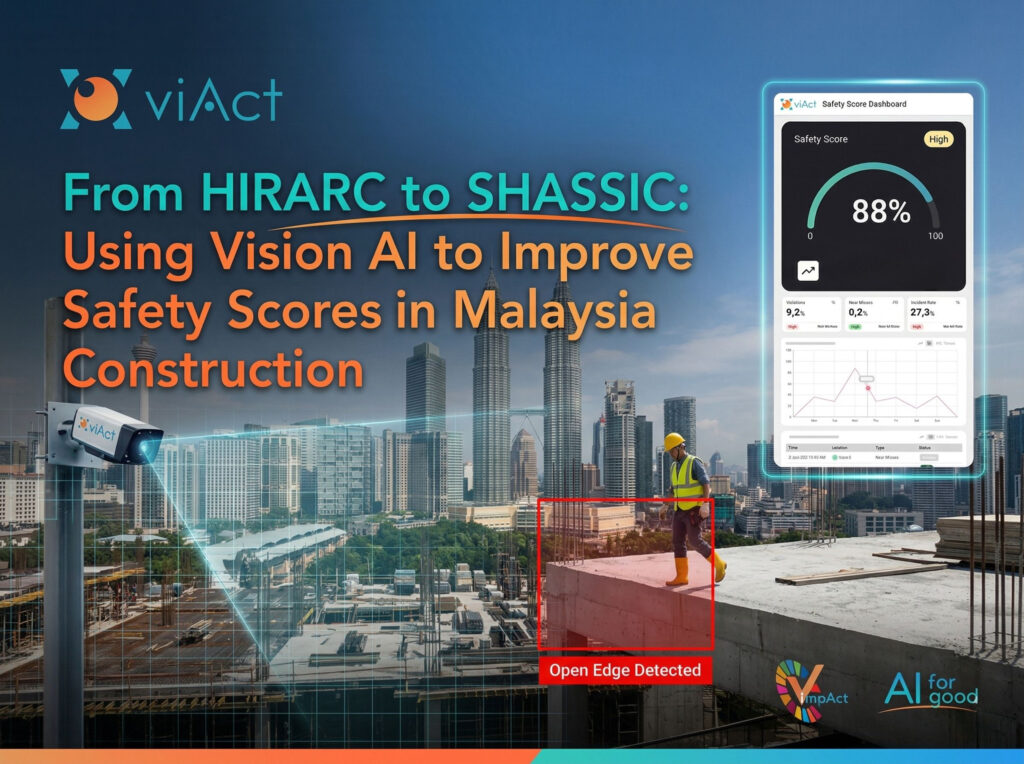

Walk onto any large construction site in Malaysia, and you’ll see structured safety practices in action—toolbox talks, hazard assessments, inspection checklists, and compliance boards. These are not just routine activities; they are part of a well-defined ecosystem built on HIRARC and SHASSIC safety frameworks.
This is where Vision AI begins to reshape the landscape. According to CIDB, Malaysian construction firms currently utilize an average of 6.9% digital technologies on-site, while allocating nearly 23% of their budgets toward adopting new technologies.
This evolution in technology adoption is paving the way for smarter approaches in workplace safety in Malaysian construction industry that can bridge the gap between safety processes and real-time site performance.
Let’s explore in detail.
HIRARC and SHASSIC Safety Compliance: A Strong Foundation for Malaysia
At the core of construction safety compliance in Malaysia are two essential systems:
1. HIRARC: Structuring Risk Management
HIRARC (Hazard Identification, Risk Assessment and Risk Control) is a fundamental framework promoted by Malaysia’s Department of Occupational Safety and Health (DOSH) under the Occupational Safety and Health Act. It was introduced as part of a broader effort to standardize how organizations identify and manage workplace risks across industries, including construction.
HIRARC ensures that every site follows a disciplined process:
It brings methodology and accountability to safety planning and daily operations.
2. SHASSIC: Measuring Safety Performance
SHASSIC (Safety and Health Assessment System in Construction) was developed by the Construction Industry Development Board (CIDB) Malaysia to provide a standardized method for evaluating safety performance across construction projects. It was introduced to bring greater transparency and benchmarking into how safety is assessed, particularly as the industry scaled and projects became more complex.
SHASSIC provides a structured way to evaluate safety through:
-
Documentation review
-
Site inspection
-
Employee interviews
It translates on-ground practices into quantifiable safety scores, which are critical for benchmarking and project credibility.
Bridging Gaps in HIRARC and SHASSIC Safety Compliance in Malaysia with Vision AI

While HIRARC and SHASSIC provide a strong foundation for construction safety compliance in Malaysia, the dynamic nature of construction sites creates a need for greater continuity in how safety is observed and measured.
Both frameworks rely, to a certain extent, on periodic assessments—whether through inspections, documentation reviews, or interviews. In fast-moving site environments, this can naturally lead to gaps in visibility, especially when conditions change between observation intervals.
As a result, three key challenges often emerge:
-
Safety data is incomplete and time-bound
-
Scoring can be subjective across auditors
-
There is no real-time linkage between risk and performance
These are not limitations of the frameworks themselves, but reflections of how complex on-site execution can be.
This is where Vision AI adds value as an enhancement layer. By enabling continuous monitoring through AI-powered video analytics, it extends visibility beyond scheduled inspections and captures safety data as it happens. Hazardous activities, unsafe behaviors, and environmental conditions can be observed in real time, creating a more consistent and structured flow of information.
Over time, this allows safety teams to move from isolated observations to a more comprehensive understanding of site performance, where risks are not only identified, but also tracked, analyzed, and linked directly to measurable outcomes.
Mapping HIRARC to Real-Time Monitoring with Vision AI in Malaysian Construction
On most construction sites, HIRARC is well-documented but its effectiveness depends on how consistently it is executed on the ground. This is where Vision AI introduces a powerful shift.
1. Hazard Identification Becomes Continuous, Not Occasional
Traditionally, hazard identification depends on site walks and safety inspections. While effective, these are limited to specific time windows.
Vision AI removes this limitation by monitoring the site 24/7. It can automatically detect unsafe conditions such as missing PPE, unsafe worker positioning near heavy equipment, or violations in work-at-height protocols.
For instance, on a high-rise project in Kuala Lumpur, a worker accessing a scaffolding platform without a safety harness is immediately detected by an AI CCTV near him. Instead of waiting for the next inspection, the system flags the incident in real time, ensuring no critical risk goes unnoticed.
This significantly improves the coverage and accuracy of hazard identification, which directly impacts the quality of HIRARC inputs.
2. Risk Assessment Shifts from Static to Data-Driven
In conventional HIRARC processes, risk assessments are often based on predefined assumptions and past experience. However, construction sites are dynamic, and risks evolve daily.
But vision AI for construction safety in Malaysia brings real-world data into this process by tracking:
-
Frequency of safety violations
-
High-risk zones across the site
-
Time-based trends (e.g., increased incidents during night shifts or peak hours)
If repeated PPE violations are observed in a specific excavation zone, the system identifies it as a high-risk area. Over time, it may reveal that most violations occur during subcontractor shifts, helping safety teams pinpoint the root cause.
Here’s how the AI Observations translate into Safety Scores on Site:
| Total Activities Monitored | |||
| High-Risk Violations (e.g., Work-at-height, equipment proximity) | |||
| Frequent non-compliance across excavation zone | Targeted training + stricter supervision | Strong compliance culture established | |
| High-risk patterns across shifts and zones | Reduced violations, but still inconsistent | Consistent safe behavior across site | |
What’s Happening Behind the Scenes:
-
In Week 1, high PPE and critical violations indicate unsafe conditions → lower safety score
-
In Week 2, corrective actions reduce violations → score improves significantly
-
In Week 3, consistent compliance and fewer high-risk events → strong safety score
2. Risk Control Becomes Immediate and Measurable
One of the biggest gaps in traditional safety management is the delay between identifying a risk and taking corrective action.
With Vision AI, once a violation is detected:
-
Instant alerts are sent to supervisors, EHS teams and stored in centralised dashboard like viHUB
-
Visual evidence (images/video clips) is attached
-
Incidents are logged automatically for tracking and reporting
When a worker enters a restricted lifting zone during crane operations, the system triggers an alert within seconds (both audio and visual). The supervisor can intervene immediately, preventing a potential accident rather than reacting after the fact.
Over time, this creates a clear record of how quickly risks are addressed, making risk control measurable and auditable.
Improving SHASSIC Safety Scores Through Data-Driven Parameters with Vision AI
SHASSIC evaluates safety performance through three key elements.
Vision AI for construction safety compliance in Malaysia enhances each of these by introducing quantifiable risk signals, continuous data capture, and normalized performance metrics, ensuring that safety scores are computed based on actual operational conditions rather than static or subjective inputs.
1. Documentation review
In a conventional setup, documentation is manually curated and often lacks consistency in granularity and traceability. AI-powered systems replace this with an automated data pipeline where safety events are continuously captured, classified, and logged.
Each detected event is converted into a structured risk signal with attributes such as:
-
Timestamp and duration of exposure
-
Risk category (PPE, proximity, working at height, etc.)
-
Severity band (low, medium, high based on context)
-
Response latency (time taken to initiate corrective action)
-
Closure status and verification evidence
These signals are aggregated over time to generate frequency distributions and response efficiency metrics.
For instance, if a site records 120 PPE violations in a week but achieves an average response time of <10 minutes with 95% closure compliance, the normalized risk exposure is reduced. This results in a relatively stable or improved safety score despite high activity levels.
2. Site inspection
Traditional inspections act as discrete sampling events, which may not represent the true variability of site conditions. Vision AI enables continuous spatiotemporal monitoring, converting video feeds into structured datasets.
-
Compliance ratios (e.g., PPE compliance %)
-
Violation frequency per unit activity (normalized by workforce density or task volume)
-
Zone-wise risk intensity mapping (based on repeated signals in specific areas)
-
Temporal risk patterns (shift-wise or time-of-day analysis)
These inputs are normalized to ensure comparability across zones, time periods, and project scales.
-
High violation rates in specific categories reduce score
-
Persistent high-risk zones increase weighted risk contribution
-
Reduction in violation frequency over time improves score trajectory
If an excavation zone shows a danger zone entry rate of 0.18 (18 violations per 100 worker entries) in Week 1 and reduces to 0.05 in Week 3, the normalized risk signal decreases significantly, leading to a measurable upward shift in the safety score.
3. Employee interviews
Employee interviews are inherently qualitative and may not accurately represent operational behavior. But vision-based AI systems introduce behavioral quantification of unsafe acts by mapping observed actions to measurable compliance indicators.
-
Worker-level compliance indices (based on repeated observations)
-
Crew-level violation clustering (identifying high-risk teams or subcontractors)
-
Behavioral consistency metrics (variance in compliance over time)
-
Post-intervention improvement rates (before vs after training or corrective actions)
These behavioral datasets act as a proxy for safety culture, replacing subjective evaluation with measurable trends.
-
Repeated non-compliance increases behavioral risk weighting
-
Consistent compliance across teams stabilizes and improves score
-
Demonstrated improvement post-intervention contributes positively to score normalization
If a subcontractor team initially exhibits a compliance index of 0.72 (72% adherence) and improves to 0.93 after targeted training, the behavioral risk component reduces, resulting in a positive adjustment in the overall safety score.
What Vision AI in HIRARC and SHASSIC Safety Compliance Brings for Construction Leaders in Malaysia
For construction and EHS leaders, vision ai for workplace safety in Malaysian constriction industry introduces a fundamental shift from observation-based safety management to data-driven decision making.
At its core, the computer vision enabled system acts as an intelligent monitoring layer across the project lifecycle—continuously capturing, structuring, and analyzing site activities. This reduces dependency on manual inspections alone and ensures that safety performance is evaluated with consistency, traceability, and real-time context.
From a leadership perspective, this unlocks three critical advantages:
-
Operational clarity: Leaders gain access to normalized safety metrics across zones, contractors, and time periods, making it easier to identify high-risk areas and prioritize interventions.
-
Audit readiness: With automated documentation and time-stamped visual evidence, HIRARAC and SHASSIC safety compliance evaluations become more streamlined, transparent, and defensible.
-
Performance accountability: AI Construction Safety Score in Malaysia are now directly linked to actual site behavior, enabling clearer benchmarking across projects and teams.
Importantly, Vision AI does not replace existing safety frameworks, it augments them. When integrated with tools like BIM, it adds spatial and phase-level context to risks, allowing leaders to understand not just what is happening, but where and under what conditions.
Conclusion: Key Takeaways
-
Safety scores evolve into dynamic performance indicators, capturing risk exposure, response efficiency, and behavioral trends—rather than relying on isolated audit outcomes
-
Documentation becomes a byproduct of operations, where every risk, action, and resolution is automatically recorded, verified, and audit-ready—eliminating reporting gaps and inconsistencies
-
·Site inspections shift from periodic verification to continuous spatiotemporal analysis, allowing risks to be identified based on where, when, and how frequently they occur
-
Safety performance becomes a standardized and comparable metric, allowing stakeholders to benchmark projects, contractors, and teams based on real operational data—not perception
Vision AI transforms HIRARC and SHASSIC assessments from a periodic compliance framework into a continuously validated, data-driven safety system that reflects real on-site performance.
1. What is viAct AI Construction Safety Score and what it includes?
viAct Construction Safety Score is a data-driven index (0–100) that reflects real-time safety performance on-site, based on AI-detected risk signals, behavioral patterns, and response effectiveness.
2. How does Vision AI work on a construction site?
Vision AI uses CCTV cameras, drones, or edge devices to monitor activities in real time. It detects unsafe acts (like missing PPE or unsafe proximity) using specific safety modules and converts them into structured safety data.
3. Apart from construction, which other industries in Malaysia can use Vision AI?
Vision AI for workplace safety can be utilised by the following industries: Construction & infrastructure projects
The flexibility of the AI systems allow them to adapt to different site environments.
4. Will the Vision AI system for Malaysian construction sites difficult for teams to use?
No, modern AI platforms like viAct is designed with user-friendly dashboards and alerts, making it easy for supervisors and EHS teams to understand risks and take action without technical complexity.
5. Is viAct currently available in Malaysia?
Yes, viAct is available in Malaysia and is designed to align with local construction practices following both HIRARC and SHASSIC frameworks, making it highly relevant for ongoing and upcoming projects.
– viAct is the leading Impact AI company enhancing safety in high-risk industries for a sustainable future.







