Skip to content
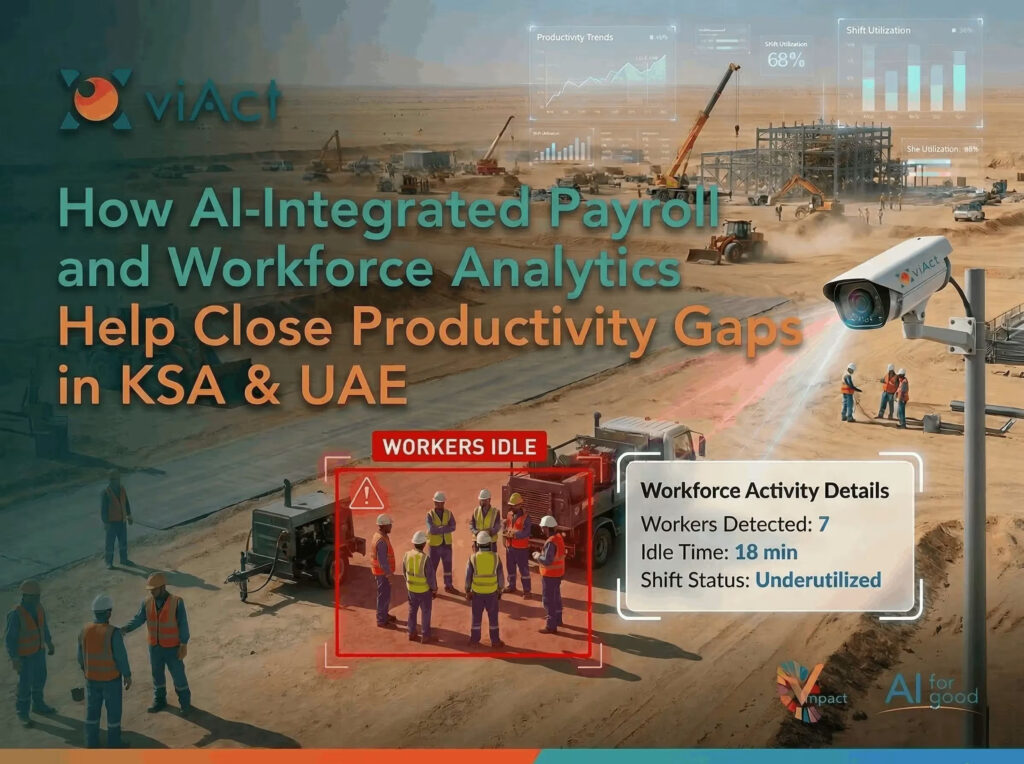

Saudi Arabia and the UAE are experiencing fast industrial expansion, due to their large infrastructure programs, manufacturing investments, and logistics corridors being driven by initiatives like Saudi Vision 2030 and UAE Industry 4.0 strategies. Further, according to the World Bank’s 2025 Gulf Economic Update, the economic growth of all member countries of the Gulf Cooperation Council (GCC) is projected to increase to 4.50% in 2026, as non-oil and industrial diversity develop.
As the industry expands, so does its workforce need. In order to meet demand of the construction projects, manufacturing plants, energy generation, and logistics operations across the region; large numbers of contract labourers operate across multiple work zones: a challenge that extends across sectors, from improving workforce productivity in Saudi Arabia’s construction projects to energy and logistics operations.
In both UAE and Saudi Arabia, industrial sectors depend heavily on expatriate and migrant workers. The continuous expansion of large infrastructure and industrial programs means that managing a workforce attendance, contractor deployment, and payroll accuracy across multiple workforces has become a major operational focus for the majority of organisations operating within this region.
As the expansion of industrial projects continues and organizations bring additional contractors or temporary workers into their businesses, there is an increasing divide between the way they ‘manage their workforce’ and how they ‘pay their employees’. This gap could potentially impact productivity, payroll accuracy, and overall operations. Consequently, companies are looking into using AI-based workforce analytics to connect employee usage with attendance data, payroll processing, and workforce performance data to create an integrated approach to managing their workforce.
Why Workforce Productivity Monitoring Is Difficult in KSA & UAE Industrial Sites
In large industrial facilities throughout Saudi Arabia and the UAE, workforce monitoring becomes complex due the following reasons:
-
Multi-Contractor Workforces Across Large Industrial Sites: In the gulf region, a number of sub-contractors work on multiple areas of a site, simultaneously. Each contractor handles their own labour records and attendance reporting leading to fragmented workforce data. As a result, the operations team may not have a complete and unified view of the presence and productivity of each labourer on site.
-
Remote Industrial Locations and Desert Operations: Many industrial sites across Saudi Arabia and UAE are located in remote locations, especially in energy, infrastructure and logistics sectors. In such cases, supervisors are required to supervise the workforce over vast area, where there may not be on-site HR or administrative supervision available at the location. Such industrial environments create challenges to monitor employee presence and track their movement across varying locations.
-
Shift-Based Operations and Extended Working Hours: Rotating shifts are the standard way most industrial operations including manufacturing plants, logistic hubs, and energy facilities adopt to ensure continuous operation. Employees frequently rotate through day and night shifts, and overtime schedules based upon operational needs. When attendance tracking is managed manually, it becomes difficult to track accurate employee records across various shifts.
The Payroll, Attendance, and Workforce Data Disconnect in Gulf Industrial Sites
Even when organizations have on-site monitoring of their workforce, the basic statistics associated with their workforce remain typically scattered across different databases. For example, payroll systems, attendance records and workforce reporting operate on different platforms. This makes it difficult for organizations to have a complete view of how labour is being utilised and how correctly payroll is being calculated.
-
Disconnected Payroll and Attendance Systems: Many companies use separate systems to handle payroll processing and attendance tracking. In order to complete the payroll process, the HR team often has to manually approve all attendance logs, contractor records, and payroll input records. The process of manually reconciling all of these records often delay the payroll verification process and cause delays in finding discrepancies in employee records.
-
Overtime Tracking and Payroll Justification Challenges: Multi-shift industrial operations have employees that rotate between shifts and work overtime. Managing overtime records becomes very complicated as attendance systems, payroll systems and accounts received from contractors are not fully integrated. In addition, countries like Saudi Arabia and UAE are required to follow Wage Protection Systems (WPS) requirements, that makes accurate workforce records essential for payroll verification.
The fragmented nature of workforce data presents challenges to industrial organizations when maintaining clear visibility over their labour costs and weighted factors of productivity. Consequently, many regional businesses are looking for new technologies to tie together consistent performance of worksite monitoring through payroll and operational data.
How AI Supports Workforce Monitoring in Industrial Sites
With industrial sites growing larger, it becomes more difficult to keep track of activities within the site through manual observation alone. AI is now being used in industrial environments across the Gulf to strengthen how workforce presence and movement are captured across large sites.
-
Visual Workforce Presence Verification: Through analysis of camera feeds, computer vision can monitor worker entries into certain work locations or zones. This enables organizations to verify worker attendance without relying completely on traditional methods of counting (e.g., headcounts, attendance cards). The visual verification tool, supported by automated people counting video analytics, can also help reduce counting inaccuracies in contractor-heavy worksite.
-
Contactless Attendance and Identity Verification: Facial recognition or computer vision-based identity verification for contactless attendance has begun to be used by various industrial sites as an alternative method of maintaining workforce attendance. These methods help eliminate issues like buddy punching (where one employee punches in for another) and card sharing. This allows more reliable recording and use of workforce data for payroll processing.
-
Workforce Distribution Monitoring Across Work Zones: Most large industrial projects involve multiple works operating parallelly. AI CCTVs, in such environments, help operations staff monitor worker distribution across different work areas. Supervisors can use such visibility to identify if the workforce is appropriately centred in the right location and task.
-
Night Shift and Remote Site Coverage: Sites operating at night or in remote locations often have reduced on-site supervision. AI camera systems can maintain continuous monitoring across these environments, ensuring workforce presence is recorded even when direct human oversight is limited.
AI-Based Workforce Analytics for Productivity and Labor Cost Visibility
The next step after collecting workforce presence data is using it to develop operational intelligence. By combining verified attendance, activity and payroll information, along with project reporting; the AI-integrated payroll and workforce analytics solution provide organisations with a way to move beyond raw attendance logs towards a clearer understanding of how effectively labour has been employed and the associated costs incurred for that effectiveness.

Some of the operational areas where AI-based workforce analytics can provide useful insights include:
-
Contractor Productivity Benchmarking: In the Gulf region, industrial facilities often depend on multiple subcontractors to complete a single project. AI-based workforce analytics enable operations team to track the utilization and completion of tasks of various subcontractors over time so that they can readily distinguish which teams are consistently performing and which teams may need to change their work processes.
-
Overtime Validation and Payroll Justification: Overtime is a significant and recurring cost in shift-heavy industrial operations. By utilizing verified workforce activity data linked to employee’s time card, as well as their attendance history, the workforce analytics platforms give the payroll teams a clear, factual basis to review an employee’s request for overtime prior to processing it. This reduces the likelihood of payroll errors, and also assists in complying with the WPS compliance in Saudi Arabia and the UAE.
-
Shift Discipline and Break Pattern Analysis: Analysing data from shift activity, helps highlight patterns like excessive break time, late handoff of shifts and low worker density in certain departments. Recognizing these trends allows supervisors to deal with workflow problems sooner, instead of waiting until the end of a shift or a pay period to find out about them.
-
Workforce Deployment Insights Across Operational Areas: Workers on large industrial sites frequently move between zones as project requirements change. Using AI-enabled workforce analytics software, operations managers can identify where labor resources are concentrated at different points during the day, supporting more informed decisions when reallocating workers across tasks or adjusting deployment ahead of the next shift.
Integrating Payroll Systems with AI Workforce Analytics
AI-based workforce analytics helps integrate workforce activity data with attendance and payroll records. This leads to better verification of payroll, fewer discrepancies in shift records, and a greater degree of clarity when reviewing contractor personnel submissions. Instead of simply relying on manual reports within payroll systems, payroll staff can cross-reference workforce records against operational data.
Additionally, AI-driven analytics can provide better insight into labor costs across a multi-million-dollar industrial operation. Through the integration of workforce historical activity patterns and the information from payroll records, companies are able to see exactly how much their labor resources are being used for each job/project/contractor and/or operational zone. These insights allow operations teams to determine how to allocate personnel for maximum efficiency, while the payroll teams receive a clearer set of records for processing compensation and financial reporting.
When a company has multiple facilities with large workforces, integrating payroll systems with AI-based Workforce Analytics systems reduces administrative complexity and improves the accuracy of workforce data. Over the time, this integration helps firms move from a reactive to a structured, data-driven workforce management approach.
The shift toward AI-integrated workforce and payroll management by industrial companies across Saudi Arabia and the UAE is less about using new technologies just for their own sake, but rather as a means of addressing the long-standing visibility gap between ‘how labour is employed’ and ‘how employees are paid for that employment’. As the size of the projects continue to increase and the complexity of contractor workforces continues to evolve, organizations that invest on integrating their labour monitoring, attendance and payroll data will be in a better position to properly manage labour costs, achieve compliance with the WPS regulations, and make faster and more informed operational decisions. The foundation being built today through AI-enabled monitoring and analytics, will set the stage for separating reactive labour force management from making truly data-driven labour force decisions in the years to come.
The broader significance of this shift extends beyond administrative efficiency. When workforce data is accurate, consistent, and connected to operational reporting, it changes the quality of decisions that operations managers, HR teams, and project leads are able to make. For example, contract labourers can be assessed based on their verified performance rather than by the self-reported figures. The actual shift activity of an employee can be compared to his/her overtime costs before payroll is paid. Employees may be reassigned between work zones based on their actual deployment patterns rather than by the summary provided at the end of their shifts. These changes are not marginal. In large industries, labour represents one of the largest cost variables, and having consistent and accurate workforce data at all times can have an enormous impact over time when looking at the cumulative impact of improved workforce data over hundreds of shifts and dozens of contractors.
Due to the ongoing effects of Saudi Vision 2030 and UAE Industry 4.0 strategies driving industrial growth throughout the region, the need for structured and transparent workforce management will only increase. By integrating AI-based workforce analytics into existing payroll and HR systems, organizations can now develop an operational capability that grows as projects’ scales rather than being overwhelmed by them. The goal is not simply to automate what was previously done manually; it is to gain a level of workforce visibility that was never previously possible, and to use that visibility to improve operational efficiency, compliance, and competitiveness of industrial operations in the Gulf.
Conclusion: Key Takeaways
Closing the productivity gap is a major challenge for all industrial enterprises operating in KSA and UAE. And it cannot be addressed by merely introducing digital tools. In fact, the key lies in integrating and correlating huge volumes of hitherto unrelated data. AI-based payroll and workforce analytics solutions can transform unrelated and disparate attendance records, contractor information and payroll inputs into a unified, integrated, structured and auditable operations picture.
Here are the key takeaways for organizations in the KSA & the UAE industrial sector:
-
Fragmented workforce data is a cost problem, not just an admin problem Payroll, rostering and contractor data is often fragmented across numerous applications, leading to a range of payroll and industrial relations issues including payroll errors, overtime disputes and compliance gaps. The potential impact of these issues is significant, particularly when spread across multiple shifts, sites and teams of contractors.
-
Workforce monitoring by means of manual observation cannot scale with the pace of industrial growth in the Gulf. Under the pressure of Vision 2030 and UAE Industry 4.0, capital developments are increasing dramatically in size and more contractors are being deployed. While on-site foremen can only physically monitor a relatively small section of work during the day, the occurrence of untoward events on other parts of the site remain undetected until it is too late. The worksite can be covered continuously by means of AI CCTV cameras.
-
WPS requires verified data, not reported data. Most countries including Saudi Arabia and UAE are insisting on payroll accuracy through Wage Protection System (WPS). Attendance can be camera verified and man-hours for on-site work can be AI verified and also manually, giving auditable records that manual reported data often cannot deliver.
-
Contractor benchmarking is only relevant if all your contractors are measured in the same way. viAct AI CCTV platform applies the same metrics to all your sub-contractors on site. These metrics hold everyone to account for their shift behaviour, attendance, idling and productivity per man hour. Unlike traditional reporting methods where one contractor’s words are as good as another’s, viAct’s platform ensures accountability is uniform and consistent for all.
-
Payroll integration is where operational data becomes financial intelligence. Connecting work done to payroll processes cuts down time spent on reconciliation, prevents labour disputes by identifying and correcting issues prior to payroll, and brings operational and financial teams onto the same page.
-
From a reactive to a data-driven approach starts with visibility. With workforce analytics incorporating AI today, companies are not only solving payroll challenges for today but are also building foundations to manage the more complex industrial workforce in the GCC region in the future.
1. How does viAct AI-enabled Workforce Productivity Monitoring Solution address the payroll data disconnect common in Gulf industrial operations?
With viAct Workforce Productivity Monitoring Solution powered by AI, all the information necessary for creating accurate payrolls is synchronized automatically; attendance and shift details captured via camera verification are directly linked to man-hour records and contractor submissions, eliminating the need for manual reconciliation of these data at month-end. As a result, the payroll teams receive detailed and auditable evidence related to every shift (including overtime and contractor man-hours) without having to send out and obtain reports from various places or reconcile between disparate systems.
2. We manage several industrial facilities across KSA and UAE with large contractor workforces. Can viAct give us a single view across all sites?
Yes. viAct’s platform consolidates workforce activity, attendance, and productivity data across multiple sites into one centralized view, allowing Operations & HR teams to track contractor efficiency as well as payroll records at all of the various locations simultaneously, without needing to receive separate reports from multiple sites or contractors.
3. How does viAct benchmark productivity across multiple contractors on the same industrial site?
viAct gathers similar workforce data for each of the contractors from the same AI-CCTV camera systems, keeping all the contractors on the same evaluative basis. This includes metrics such as:
-
Shift discipline
-
Attendance accuracy
-
Total idle time
-
Man-hours output
This removes reliance on self-reported figures and gives operations teams a factual, comparable view of contractor performance without any manual effort.
4. How quickly can viAct identify a productivity problem during a shift?
viAct flags productivity issues during the course of a shift, rather than at the end of a shift. It identifies idle times, length of breaks taken over scheduled times, late start times, queues forming, and low overall workforce density in real-time. This allows supervisors to take corrective action during the shift instead of finding out lost man-hours in an end-of-day report. This live visibility distinguishes viAct from traditional payroll systems or attendance systems.
5. Our industrial site is in a remote and desert location with limited connectivity. Will viAct still work reliably?
Certainly, viAct’s solution is designed to function even in environments where there is little access to the internet, such as in remote or desert regions. viAct’s ability to record and track workforce attendance, daily activities during each shift, and provide reporting for these records is accomplished on-site so that monitoring is performed continuously regardless of whether there is a reliable internet connection to the cloud. viAct’s solution fits particularly well within the construction, oil & gas, infrastructure, energy, manufacturing, and logistics industries that are abundant throughout both Saudi Arabia and the UAE.
– viAct is the leading Impact AI company enhancing safety in high-risk industries for a sustainable future.