Skip to content
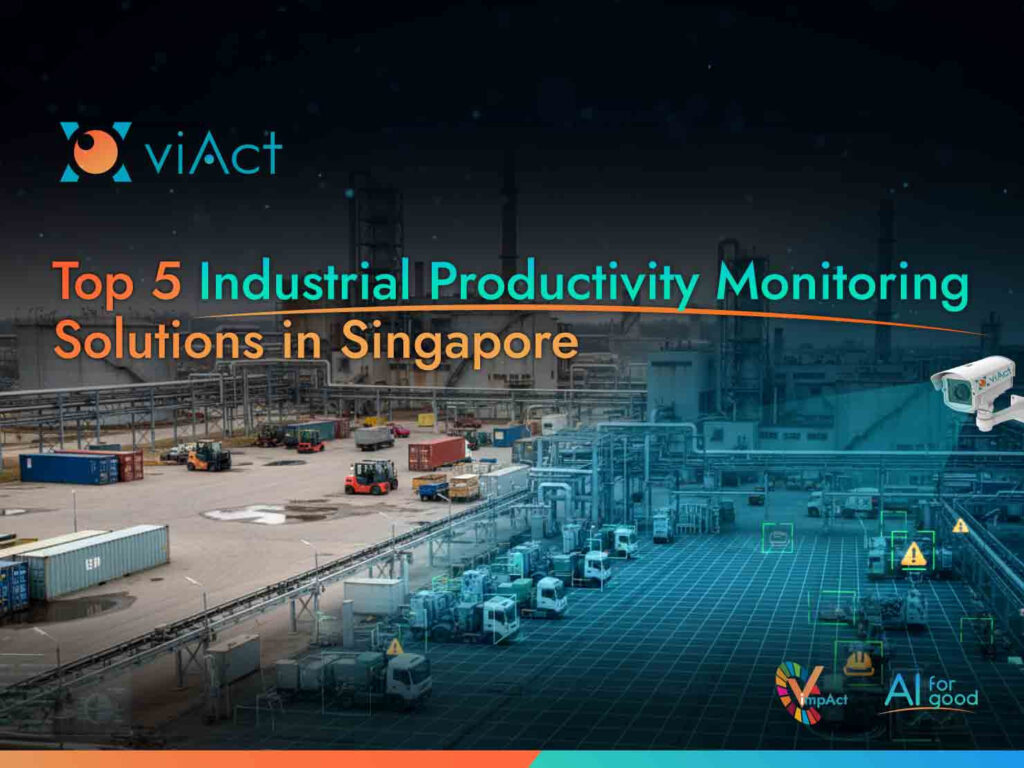

Over the past decade, Singapore has positioned itself as one of the world’s most advanced Industry 4.0 hubs. Across construction, logistics, infrastructure, facilities, and advanced manufacturing, organizations are rapidly adopting digital technologies to improve efficiency, reduce operational losses, and stay globally competitive.
This shift has fueled growing demand for industrial productivity monitoring solutions in Singapore. These platforms go far beyond traditional dashboards by combining computer vision, predictive analytics, robotics, and workflow automation to help companies optimize people, processes, and equipment in real time.
In this blog, we discuss 5 leading industrial automation software operating in Singapore that are helping heavy industrial sites transform operations.

Among Singapore’s AI innovators, viAct has built its reputation around helping industrial organizations understand how work actually happens on the ground and where productivity is being lost. Instead of relying on manual reporting, supervisor observations, or delayed performance metrics, the platform turns existing camera infrastructure into a continuous operational intelligence layer.
A key differentiator is its deep focus on real-world industrial workflows. Sites such as construction projects, large manufacturing plants, logistics hubs, and energy facilities are highly dynamic environments where productivity is influenced by movement, coordination, equipment availability, and worker behavior.
viAct’s AI modules are trained specifically on these environments, allowing operations teams to gain visibility into day-to-day site performance that was previously difficult to quantify.
Technologies powering productivity monitoring
viAct combines multiple AI capabilities into a single ecosystem:
-
AI video analytics for real-time activity monitoring
-
Computer vision trained on industrial workflows
-
Predictive analytics for equipment and operations
-
Edge AI deployment for low-latency processing
-
Generative AI copilots supporting operational teams.
How viAct drives industrial productivity
Industrial productivity is often lost in small inefficiencies that accumulate throughout the day. viAct focuses on uncovering these hidden inefficiencies and turning them into measurable improvements.
For example, smart factory monitoring system can identify machines that remain idle during scheduled production windows, detect workflow bottlenecks that slow material movement, and analyze vehicle movement patterns to improve logistics planning.
In large construction projects, route optimization reduces congestion and waiting time for heavy equipment, helping projects stay on schedule.
The platform also provides visibility into workforce deployment and time-on-task, allowing managers to understand whether teams are spending time on productive activities or waiting for resources and instructions. These insights help organizations improve planning, scheduling, and coordination across shifts and locations.
Real impact in industrial environments
By converting visual data into actionable insights, viAct helps organizations:
-
Improve workforce deployment efficiency
-
Increase equipment utilization
-
Reduce operational delays and disruptions
-
Strengthen safety and productivity simultaneously
This combination of safety and productivity monitoring makes viAct one of the most comprehensive industrial AI platforms in Singapore.
2. Cryotos
Cryotos is a Singapore-based AI CMMS platform focused on improving asset reliability and maintenance productivity. The company helps industrial organizations digitize maintenance workflows and shift toward predictive asset management.
Technology approach
Cryotos combines predictive analytics and workflow automation to build a connected maintenance ecosystem. Instead of waiting for equipment failures, the platform continuously monitors asset performance and automatically schedules preventive and predictive maintenance tasks.
With real-time data access, it makes the user experience better and enhances visibility by facilitating precise inventory control, optimal stock levels, automated reorder triggers and minimising wastage.
Productivity impact
Unplanned downtime remains one of the biggest productivity losses in industrial operations. Cryotos improves uptime and reliability by helping teams anticipate failures and streamline maintenance planning.
-
Reduced equipment breakdowns and emergency repairs
-
Automated work orders and maintenance scheduling
-
Optimized spare-parts inventory and asset tracking
-
Manufacturing plants and production facilities
-
Asset-intensive industries and utilities
-
Facilities with large equipment fleets
3. Curium
Curium focuses on AI-powered operations intelligence designed to help industrial organizations like logistics, healthcare, public spaces and mobility-based operations optimize workflows, planning, and resource allocation using advanced analytics.
Technology approach
The platform aggregates operational data from multiple systems, deploying sensors like LiDAR, RADAR and sensors to apply machine learning to uncover inefficiencies and workflow bottlenecks. It connects real-time performance data with planning tools, enabling leaders to make faster and more informed operational decisions.
Productivity impact
Limited visibility into processes often results in scheduling delays and inefficient resource use. Curium helps organizations transform raw operational data into actionable insights that improve coordination and planning.
-
Improved workforce and resource allocation
-
Better operational planning and scheduling
-
Faster decision-making through real-time insights
4. SixSense
SixSense is one of the industrial productivity monitoring solutions in Singapore known for applying deep learning and computer vision to precision manufacturing, particularly within semiconductor production.
Technology approach
Its AI vision systems monitor production lines in real time, detecting defects, anomalies, and process deviations early in the production cycle. Automated inspection reduces reliance on manual quality checks and increases detection accuracy.
Productivity impact
In precision manufacturing, minor defects can cause significant production losses. SixSense helps manufacturers improve throughput and reduce waste by strengthening quality control.
Key productivity gains include:
-
Earlier defect detection and reduced rework
-
Higher production yield and throughput
-
Lower reliance on manual inspection processes
-
Semiconductor and electronics manufacturing
-
High-precision production environments
-
Quality-driven industrial processes
5. Hivebotics Pte Ltd
Hivebotics develops autonomous robots and technology powered by AI and computer vision to automate facility monitoring and maintenance operations.
Technology approach
The company deploys robots and AI modules equipped with sensors and vision systems that can navigate facilities independently and perform routine inspection and cleaning tasks. This brings AI-driven productivity monitoring into the physical workspace. With facilities for optimum fleet management, access control, and incident detection, it creates a collaborative environment between humans and AI for better outcomes.
Productivity impact
Routine facility tasks often consume valuable manpower and time. Hivebotics improves efficiency by automating repetitive processes and ensuring continuous operational coverage.
-
Reduced reliance on manual labour
-
Continuous facility monitoring and maintenance
-
More consistent operational performance
-
Industrial and commercial facilities
-
Warehouses and logistics hubs
-
Large infrastructure environments
Let’s evaluate the strength and impact of these 5 solutions in a comprehensive summary.
| Primary Productivity Impact | |||
| End-to-end AI video analytics transforming CCTV into real-time operational intelligence | Reduces unplanned downtime, improves workforce utilisation, optimises vehicle routes and logistics, detects workflow bottlenecks, lowers LTIs/DART rates, enables real-time cross-site performance benchmarking | Construction, manufacturing, oil & gas, mining, logistics | |
| AI-driven maintenance and asset productivity through smart CMMS | Minimises equipment failures, automates maintenance workflows, improves spare-parts planning, increases asset lifespan and production uptime | Manufacturing, utilities, facilities, heavy industry | |
| Data-driven workflow optimisation and operational intelligence | Identifies bottlenecks, improves scheduling and resource allocation, enhances operational visibility, supports faster decision-making | Manufacturing, logistics, healthcare | |
| Precision manufacturing productivity through AI inspection | Detects defects early, reduces rework and scrap, improves yield and production throughput | Semiconductor and advanced manufacturing | |
| Robotics-powered facility productivity and automation | Automates routine inspections and cleaning, improves facility uptime, reduces labour dependency, and ensures consistent operations | Facilities management, manufacturing, commercial & industrial spaces |
Each of these companies approaches industrial productivity from a distinct angle. viAct focuses on turning existing CCTV infrastructure into real-time operational intelligence, combining safety, workforce efficiency, and equipment monitoring into one platform. Cryotos takes a maintenance-first approach, using AI and IoT to predict failures and keep assets running reliably. Curium concentrates on analysing operational data to uncover workflow inefficiencies and improve decision-making across processes. SixSense specialises in precision manufacturing, using computer vision to detect defects early and maximise production yield. Meanwhile, Hivebotics Pte Ltd expands productivity monitoring into robotics, automating routine facility tasks and inspections to maintain continuous operations.
Together, they illustrate how productivity transformation can start from safety, maintenance, analytics, quality, or robotics—depending on organisational priorities.
Conclusion: Key Takeaways
-
Singapore is rapidly emerging as a global hub for AI-driven operational excellence, with productivity technology expanding across industries.
-
Industrial automation software is no longer limited to dashboards, as it now includes computer vision, robotics, predictive maintenance, and AI copilots.
-
Visual intelligence platforms show how safety, productivity, and operational efficiency are becoming deeply interconnected.
-
Predictive maintenance solutions highlight the massive productivity gains from reducing unplanned downtime.
-
Operations intelligence platforms enable data-driven planning and resource optimisation.
-
Precision AI inspection proves how quality and productivity improvements go hand-in-hand.
-
Robotics solutions demonstrate the growing role of automation in facility and workforce productivity.
Industrial productivity in Singapore is entering a new era where AI continuously monitors, predicts, and optimizes operations. Organizations that adopt these technologies early will gain a major advantage in efficiency, resilience, and long-term competitiveness.
1. How is AI-powered productivity monitoring different from traditional methods?
Traditional dashboards rely on manually entered data and lagging indicators. Modern AI platforms like viAct automatically capture real-time operational data, enabling predictive insights and faster decision-making.
2. We already track KPIs manually. Why should we switch to AI monitoring?
Manual tracking gives delayed insights. AI monitoring provides real-time visibility, helping leaders react immediately instead of waiting for weekly or monthly reports.
3. What is the ideal number of cameras to start with industrial productivity monitoring?
A pilot often begins with 5–20 cameras covering high-risk or high-activity zones such as hazardous zones, high-traffic areas, loading areas, production lines, and storage zones.
4. What types of productivity metrics can AI track automatically?
5. What should organizations evaluate before choosing an AI solution?
Key factors include scalability, integration capabilities, deployment flexibility, privacy features, and how well the solution aligns with operational goals
– viAct is the leading Impact AI company enhancing safety in high-risk industries for a sustainable future.