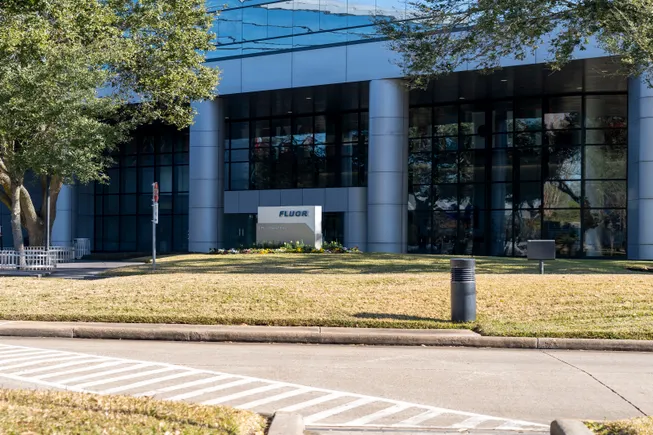

After a year marked largely by uncertainty, more large-scale projects are now moving closer to execution in 2026, according to Fluor.
On the company’s second quarter earnings call last year, CEO Jim Breuer said clients were taking a “wait-and-see approach due to a variety of reasons,” such as trade policy discussions and overall cost escalation. That ultimately led to project cancellations or extended deferments in a few cases during that period.
But now, Fluor CEO Jim Breuer said “the uncertainty and hesitation that we saw last year is abating,” in a positive sign for construction activity.
“As we stand in early 2026, we’re seeing improved confidence across our client base,” said Breuer during Fluor’s fourth quarter earnings call on Tuesday. “This confidence is a result of high levels of new front-end work, as well as detailed negotiations on projects that we see converting to backlog in the next several quarters, weighted towards the second half of 2026.”
For that reason, Irving, Texas-based Fluor expects new awards this year to be “significantly higher than in 2025,” said Breuer. He highlighted energy construction as a specific area for that rebound.

Jim Breuer
Courtesy of Fluor
“Prospects for 2026 include our entrance back into the gas-fired power market,” said Breuer during the call. “We currently have a limited notice to proceed with a confidential U.S. utility for a large-scale project with a potential to add two additional facilities for the same client.”
These projects will start on a reimbursable basis and then convert to a negotiated fixed price once the execution plan and estimate are completed in late 2026 or early 2027, said Breuer.
He also said the firm’s legacy fixed-price exposure is shrinking. Backlog tied to older infrastructure projects has declined to $250 million from $700 million a year ago, as those jobs move toward completion.
Increase in nuclear projects
Breuer pointed to nuclear project prospects during the call. The company recently advanced a Romanian small modular reactor project and is pursuing additional conventional and SMR opportunities with multiple technology providers, he said.
It also sold 71 million shares of NuScale Power, a small modular nuclear reactor company, for $1.35 billion, according to a separate Tuesday release. Fluor plans to monetize its remaining 40 million shares in the second quarter of 2026, according to the release.
In the U.S., Fluor secured an early engineering award tied to expansion of a uranium enrichment plant in Ohio. The project forms part of federal efforts to rebuild domestic nuclear fuel supply chains.
“In the nuclear power market, we’re pleased with our progress to advance current projects,” said Breuer. “We continue to expand and diversify our nuclear power portfolio, which we believe will provide significant growth potential in the mid to long term.”
Breuer also emphasized Fluor’s use of artificial intelligence across project planning.
“AI will enhance our ability to plan, design, procure and build, improving decision timeliness and quality, accelerating execution and sharpening our competitive edge,” said Breuer. “As of today, we’ve deployed AI across the project lifecycle, from predicted analytics on capital projects to intelligent pricing insights across the supply chain. We have also implemented AI applications across individual functional roles, including HR, finance, legal and procurement.”
Q4 by the numbers
Fluor reported a loss of $1.57 billion in the fourth quarter of 2025, a reversal from $1.86 billion in profit during Q4 a year ago, according to the report. Its revenue reached $4.18 billion for the fourth quarter, about a 2% drop from $4.26 billion in the same period a year earlier.
For the full year, Fluor posted a $51 million loss in 2025, down from a $2.15 billion gain in 2024. Its revenue for the full year also dropped about 5% from $16.32 billion in 2024 to $15.5 billion in 2025, according to the report.
Backlog fell about 10% from $28.48 billion a year ago to $25.54 billion, according to the report. New awards in the fourth quarter also tumbled compared to a year ago, falling to $1.13 billion from $2.31 billion in the same period during 2024.
The earnings report did not generate enthusiasm from Andrew Wittman, senior research analyst at Baird, a Milwaukee-based financial services company.
“Fluor’s 4Q25 print contained the usual mix of awards, charges, material movements of cash flows, etc., but unlikely change the story much,” wrote Wittman in the research note. “We focus on awards, weak at $1.13 billion.”