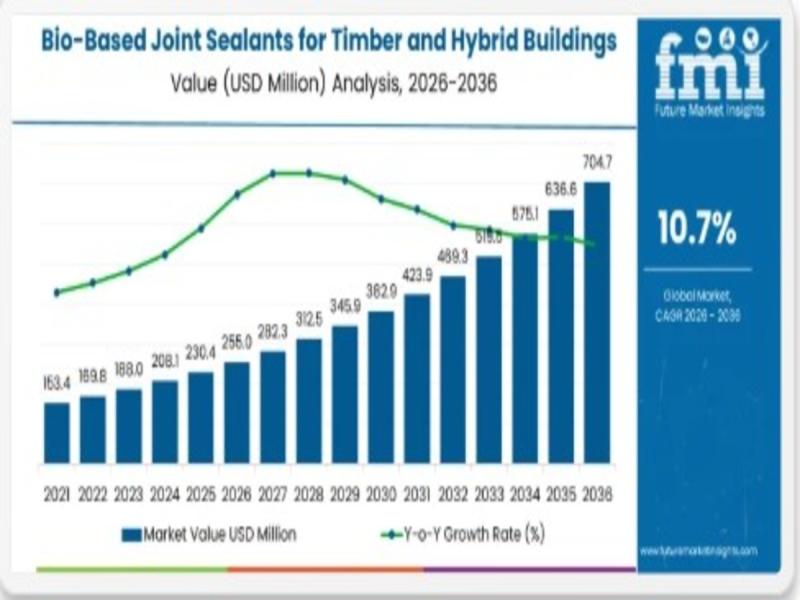
The global Bio-Based Joint Sealants for Timber and Hybrid Buildings Market is on a compelling growth trajectory, with the industry valued at USD 255 million in 2026 and projected to reach USD 704.7 million by 2036, driven by rising adoption of sustainable construction and high-performance material demand. The market’s robust 10.7 % compound annual growth rate (CAGR) through 2036 highlights strong momentum in eco-friendly sealant solutions tailored to engineered timber and hybrid building systems, reflecting shifting builder priorities toward low-emission, high-durability construction materials.
Key Market Insights at a Glance
The bio-based joint sealants market is evolving beyond niche sustainable projects into mainstream construction applications due to increasing environmental standards and performance expectations. Sealants that offer exceptional movement accommodation, moisture resistance, and adhesion to wood, engineered timber (like cross-laminated timber and glulam), and hybrid interfaces are gaining specification traction. Growth is underpinned by bio-derived formulation improvements that enhance elasticity and durability, while aligning with green building codes and low-VOC criteria.
Segment Overview
By building type, mass timber residential projects lead demand, accounting for roughly one-third of the market as developers adopt bio-based solutions to meet embodied carbon targets and repeatable prefabricated builds benefit from standardized sealant detailing. Secondary adoption is expanding in mass timber non-residential and hybrid timber-concrete or timber-steel structures, where complex joint interfaces require tailored sealant performance.
In terms of application, expansion joints represent the largest share due to frequent material movement in timber structures. These joints demand sealants with high elasticity and adhesion to prevent air leakage and maintain structural integrity. Other notable applications include floor slab, perimeter window/door joints, roof and balcony junctures, and interior partitions, each selected based on movement profiles and durability requirements.
Request for Sample Report | Customize Report |purchase Full Report – https://www.futuremarketinsights.com/reports/sample/rep-gb-30462
Regional Overview
Regionally, Europe and North America are major markets, supported by stringent environmental regulations, green building initiatives, and strong adoption of timber construction methods. Asia Pacific is a critical growth engine, driven by accelerating sustainable urban development and hybrid structural projects. Countries such as Germany, Sweden, Norway, the United States, and China are posting substantial CAGR figures through 2036, reflecting localized incentives and strategic construction practices that prioritize sustainability and performance in joint sealing solutions.
Competitive Landscape
The competitive landscape is defined by companies investing in bio-based or partially bio-derived sealants optimized for wood and hybrid applications. Leaders such as Henkel AG & Co. KGaA, Sika AG, Bostik (Arkema Group), Soudal Group, and Mapei S.p.A. are shaping market direction by integrating formulation innovations with timber engineering standards and moisture-resistant performance criteria. These firms emphasize predictable curing and movement tolerance across diverse climates and substrates, securing specification wins in both residential and commercial projects.
Market Outlook: Powering the Next Decade
Over the next decade, the bio-based joint sealants market is anticipated to shift from early adoption to broader mainstreaming, closely tied to the surge in sustainable construction practices. Between 2026 and 2031, the market will strengthen as engineered timber systems become more common in mid-rise and modular construction, expanding from USD 255 million to an estimated USD 379 million. Between 2031 and 2036, wider integration of timber and hybrid designs into commercial and institutional builds will accelerate growth even further, opening significant value opportunities that push the market toward USD 704.7 million by 2036.
Key Players of Sustainable Label Industry
Innovation in bio-based sealants is increasingly driven by manufacturers who balance sustainability credentials with mechanical performance. Market frontrunners are setting benchmarks through product portfolios that blend renewable feedstocks with proven elasticity and longevity, enhancing joint performance across diverse environmental conditions. Their strategic initiatives include collaborations with timber fabricators, integration into green building specifications, and expansion of geographic footprints to capture demand across Europe, North America, and Asia Pacific.
Recent Strategic Developments
Recent industry developments include formulation advancements that improve adhesion to timber and composite interfaces, strategic partnerships to promote sustainable construction adoption, and expanded testing protocols that tie sealant performance to lifecycle assessments. These moves underscore a transition from conventional petrochemical sealants toward solutions that meet both performance and environmental benchmarks sought by architects, builders, and regulatory bodies globally.
As the construction industry evolves to embrace sustainability frameworks and reduce carbon footprints, bio-based joint sealants are poised to play a critical role in the next generation of timber and hybrid building innovations. The market’s expansion reflects a convergence of environmental stewardship with the practical demands of modern construction, signaling a transformative decade ahead for sustainable sealant technologies.
Purchase Full Report for Detailed Insights: https://www.futuremarketinsights.com/reports/bio-based-joint-sealants-for-timber-and-hybrid-buildings-market
Why Choose FMI: https://www.futuremarketinsights.com/why-fmi
Explore More Related Studies Published by FMI Research:
Functional Printing Market https://www.futuremarketinsights.com/reports/functional-printing-market
Neopentyl Polyhydric Alcohol Market https://www.futuremarketinsights.com/reports/neopentyl-polyhydric-alcohol-market
Acetic Ether Market https://www.futuremarketinsights.com/reports/acetic-ether-market
Contact Us:
Future Market Insights Inc.
Christiana Corporate, 200 Continental Drive,
Suite 401, Newark, Delaware – 19713, USA
T: +1-347-918-3531
For Sales Enquiries: sales@futuremarketinsights.com
Website: https://www.futuremarketinsights.com
About Future Market Insights (FMI)
Future Market Insights, Inc. (FMI) is an ESOMAR-certified, ISO 9001:2015 market research and consulting organization, trusted by Fortune 500 clients and global enterprises. With operations in the U.S., UK, India, and Dubai, FMI provides data-backed insights and strategic intelligence across 30+ industries and 1200 markets worldwide.
This release was published on openPR.