 Skip to content
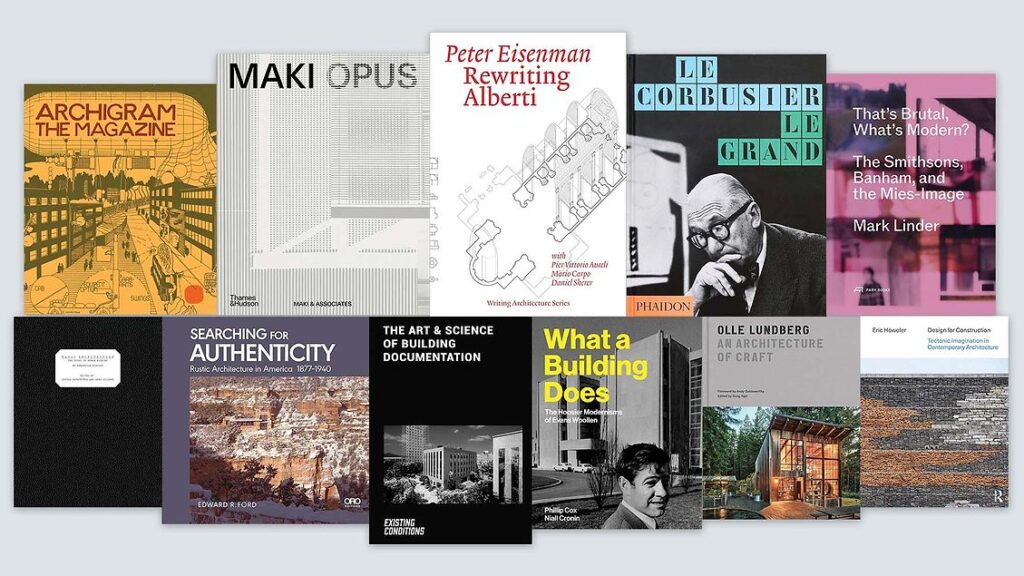

Ideal for gifting (or keeping) this holiday season, our selections include the back-in-print classic ‘Le Corbusier: Le Grand’ and the psychedelic fever dream of ‘Archigram,’ the magazine.
All images courtesy the publishers.
Archigram the Magazine: The Authorized Facsimile Edition of all 9½ Original Issues,
edited by Peter Cook, Thomas Evans, and Steve Kroeter. DAP and Designers & Books, 288 pages, $195.
Most readers probably know the work of the British architecture collective Archigram by reputation or through recent scholarship, not from handling the limited-edition printed matter that the group published between 1961 and 1974. Following a Kickstarter campaign, a team assembled by Thomas Evans has faithfully reproduced Archigram, the magazine, down to the last detail and stapled insert, from its comic book–inspired graphics and pop-up cutouts to the actual electronic resistor that accompanied one issue. These impressive facsimiles arrive in a “groovy” clamshell box alongside a new reader’s guide, featuring writings by Peter Cook, David Grahame Shane, and a host of contemporary architects that contextualize the small-but-mighty zines. This is one psychedelic fever dream that’s worth adding to your library, or gifting to another. Leopoldo Villardi
Maki Opus,
by Fumihiko Maki. Thames & Hudson, 400 pages, $90.

Documenting nearly 60 projects, this comprehensive collection showcases the work of Fumihiko Maki, the much-lauded Japanese architect who died in 2024 at age 95. Organized into chapters with such titles as “Making Collective Form” and “Nature and the Rural Environment”—rather than chronologically—the book highlights recurring themes throughout Maki’s long and consequential career. Placed among the well-illustrated project profiles are essays by Maki, as well as by academics, critics, and other architects, providing insight not only into his individual buildings but also the philosophy behind them. Joann Gonchar, FAIA
Rewriting Alberti,
by Peter Eisenman with Pier Vittorio Aureli, Mario Carpo, and Daniel Sherer. MIT Press, 224 pages, $35.
Every architect thinks they know about Leon Battista Alberti—it doesn’t get any more old-school than the first architect since Vitruvius to develop a comprehensive treatise on proportion and part-to-whole harmony. But, for centuries, Alberti’s 10-book De re aedificatoria has overshadowed his five buildings. In Rewriting Alberti, Peter Eisenman analyzes Alberti’s written and built works to reveal the disjunction between them. In contributed essays, Pier Vittorio Aureli traces the idea of the “project” to Alberti; Mario Carpo explores how he changed the profession’s relationship to drawing; and Daniel Sherer reconsiders Manfredo Tafuri’s view of the Renaissance architect. Patrick Templeton
Le Corbusier: Le Grand,
by Jean-Louis Cohen and Tim Benton. Phaidon, 848 pages, $60.
First published in 2008, Le Corbusier: Le Grand is back in print and available to be appreciated by readers who like to peruse and linger. This dérive through the life and work of Charles-Édouard Jeanneret is a largely self-guided one—of its 848 pages, only about two dozen feature writings by the eminent historians Jean-Louis Cohen and Tim Benton. But what the tome lacks in textual structure it makes up for in a curated assortment of photographs (of buildings and of the man himself), archival drawings, ephemera, sketches, pattern books, and more. LV
That’s Brutal, What’s Modern? The Smithsons, Banham, and the Mies-Image,
by Mark Linder. Park Books, 304 pages, $45.
Brutalism is having a heyday, but it’s a slippery term. In this new book, Mark Linder—whose prior Nothing Less than Literal is the most incisive analysis of Minimalist art’s influence on architecture—parses the varied and contradictory understandings of the New Brutalism movement by investigating the publications and exhibitions of architects Alison and Peter Smithson, their fascination with imaging, and the legacy of Mies van der Rohe. Linder argues that the Smithsons pursued a “Mies-image,” what he calls a “thumbprint of modernity.” In doing so, Linder offers a new theory to understand Brutalism’s salience today, when architecture is so concerned with image-making. PT
Magic Architecture: The Story of Human Housing,
by Frederick Kiesler. Edited by Spyros Papapetros and Gerd Zillner. MIT Press, 400 pages, $75.
Frederick Kiesler (1890–1965) submitted this 10-part manuscript shortly after World War II. It was his most ambitious book: a genre-bending, holistic alternate history of architecture spanning from prehistoric caves to the atomic bomb. The publishers, who were less interested in Kiesler’s diagrams and novel ideas and more in popular encyclopedias, rejected it. Over the last decade, the editors have painstakingly reassembled this book from the archives, supplementing it with introductory essays, notes, and interpretations. PT
Searching for Authenticity: Rustic Architecture in America 1877–1940,
by Edward Ford. Oro Editions, 500 pages, $60.
On the heels of the newly built transcontinental railroad, amid rapid industrialization and urban growth, a uniquely American rustic style emerged. In his most recent book, Ed Ford surveys 40 rustic structures, considering how they were shaped by the railroads and tourism. Many of these buildings contributed to the destruction of the very environments and cultures that they sought to emulate, but others, Ford argues, are misunderstood masterpieces, exemplary of a truly original architecture worthy of our attention. Grace Kuth
The Art & Science of Building Documentation,
by Existing Conditions. Oscar Riera Ojeda Publishers, 208 pages, $65.
Building-documentation is the unsung hero of adaptive reuse and historic preservation; Existing Conditions, a 3D-laser-scanning company founded in 1997, is at the forefront of the field. This book surveys the firm’s work in documenting buildings of varied scales and typologies, many of them landmarks—such as Harvard GSD’s Gund Hall and the Woolworth Building in New York—with a multitude of scans, plans, and models. The case studies are supplemented by essays and interviews with Existing Conditions’ founder Kurt Yeghian and former president Jared Curtis. Matthew Marani
What a Building Does: The Hoosier Modernisms of Evans Woollen,
by Phillip Cox and Niall Cronin. Indiana University Press, 246 pages, $40.
When considering Modernist architecture in Indiana, most think of Columbus—midcentury stomping ground of Eero Saarinen, I.M. Pei, Robert Venturi, et al.—without acknowledging the local talent who shaped the Hoosier State’s built environment during the postwar years. What a Building Does presents a comprehensive history of Indianapolis native Evans Woollen (1927–2016), whose built work in Columbus is nil but who is credited with bringing Brutalism to his hometown with projects like Clowes Memorial Hall. A Yale grad, Woollen’s diverse output also included airy glass-and-steel residences such as the Thomas V. Parke House, a 1957 Record House that was Woollen’s first completed commission back in Indianapolis following an apprenticeship with Philip Johnson. Matt Hickman
Design for Construction: Tectonic Imagination in Contemporary Architecture,
by Eric Höweler. Routledge, 368 pages, $44.
Good design doesn’t always translate into well-conceived construction. This 368-page tome by architect Eric Höweler dives into projects, techniques, workflows, and more, that bridge these two, sometimes at odds, necessarily complementary fields. The many case studies, ranging from Renzo Piano Building Workshop’s The New York Times Headquarters (2007) to OMA’s CCTV Headquarters (2004), are well researched and clearly written, each supported by images, detailed diagrams and drawings. MM
Olle Lundberg: An Architecture of Craft,
by Olle Lundberg. Edited by Dung Ngo. Foreword by Andy Goldsworthy. Princeton Architecture Press, 256 pages, $50.
Olle Lundberg’s monograph was published shortly before he died unexpectedly at the age of 71 this past October. In the book, he describes his design journey—including the founding of his San Francisco–based practice, Lundberg Design, in 1987—his intimate relationship with building materials, and five of his major projects, including his Sonoma cabin, which he shared with his wife Mary. His unrelenting commitment to fabrication and craft, his unmitigated awe for the natural world, and his expansive creativity are evident in the monograph’s pages. GK
For other notable books, peruse our book reviews.







