Skip to content
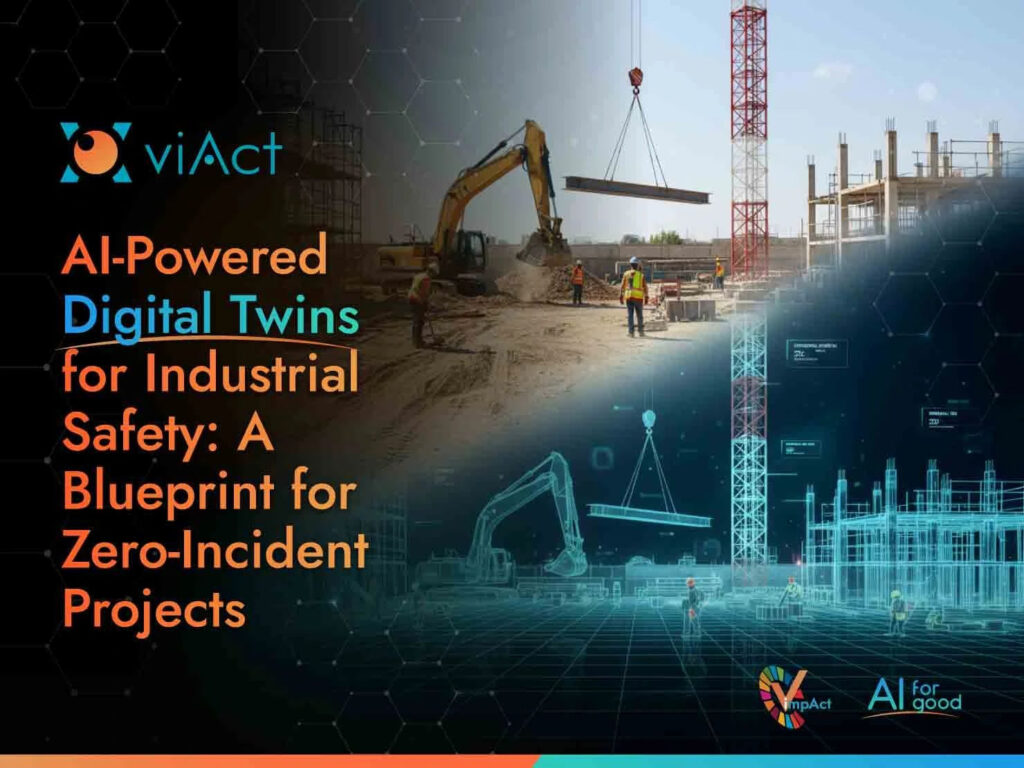

Industrial safety has always relied on anticipation—recognising potential hazards before they escalate into incidents. Yet today’s industrial environments are more complex than ever. Construction sites change daily, manufacturing floors operate at high speeds, mines extend deeper into unpredictable geology, and oil & gas facilities manage volatile processes under strict constraints.
In such dynamic settings, traditional safety methods often struggle to keep pace with the speed at which risk evolves.
This is where AI-powered digital twins are beginning to redefine how safety is understood and managed. By creating a living, data-driven replica of industrial environments, digital twins enable safety teams to visualise risk, predict unsafe conditions, and intervene earlier—moving closer to the long-standing goal of zero-incident operations.
Let’s dive into the details.
What is an AI-Powered Digital Twin?
A digital twin is a virtual representation of a physical asset, site, or operation that continuously updates using real-world data. In industrial safety, this may represent an entire construction site, a manufacturing line, an underground mine, or a processing facility.
What makes a digital twin “AI-powered” is its ability to interpret data intelligently rather than simply display it. These systems ingest information from multiple sources and apply AI models to detect patterns, anomalies, and emerging risks.
A report by Strategic Market Research mentions how 75% of companies are already utilising Digital Twins in some form or the other. Even McKinsey predicts the global market for digital twin technology to reach $73.5 billion by 2027. Companies like Siemens are already utilising digital twins to overcome the biggest manufacturing challenges.
Unlike static models, AI-powered digital twins evolve as conditions change. When combined with Building Information Modelling (BIM), the digital twins extend beyond design visualization to become living safety systems—continuously updating site conditions, equipment movements, and risk zones to support zero-incident project execution.
How Digital Twins Work in Industrial Safety

At a practical level, digital twins powered by AI operate through four interconnected layers.
The first layer is data capture.
Sensors, AI cameras, edge AI devices, smart wearables, drones and machine logs continuously collect information about people, equipment, and the environment. This may include worker movement, PPE usage, temperature readings, gas concentrations, equipment vibration, or vehicle trajectories.
The second layer is real-time integration.
Data streams are synchronised and mapped onto a virtual 3D representation of the site. This creates spatial awareness—showing where workers, assets, and hazards exist relative to one another.
The third layer is AI interpretation.
Machine learning and computer vision models analyse the incoming data to identify unsafe behaviours, abnormal conditions, and early warning signals. Over time, these models learn site-specific risk patterns, such as recurring near-miss zones or fatigue trends during certain shifts.
The final layer is decision support.
Insights from the digital twin are translated into alerts, simulations, or recommendations that support faster and more informed safety decisions by EHS leaders and operational managers.
Together, these layers transform raw data into actionable safety intelligence.
Where Digital Twin Safety Create the Greatest Industrial Impact
While digital twins can support many operational goals, their impact on industrial safety is particularly significant in several key areas.
1. Visualising Risk Through Real-Time 3D Context
One of the most powerful contributions of digital twins is their ability to make risk visible and spatially understandable. Traditional site plans and risk assessments are static, often relying on lagging safety indicators, while real sites are constantly changing.
For example, in a construction site, a digital twin can reflect the daily changes, such as scaffold modifications, crane positioning, or new access routes. Safety managers can instantly see where fall hazards intersect with high worker density or where lifting zones overlap with pedestrian paths.
Similarly, in mining, digital twins help visualise underground tunnels, ventilation paths, and vehicle routes—critical for identifying collision risks or areas with insufficient airflow.
These evolving risk conditions are interpreted by the central monitoring station through quantifiable safety KPIs, including dynamic safety scores, near-miss frequency trends, and site-level scorecards. By translating spatial risk interactions into measurable indicators, the teams can prioritise interventions based on severity and exposure rather than isolated observations.
2. Layout Optimisation and Built-In Hazard Reduction
Many safety incidents are influenced by poor layout design rather than unsafe behaviour alone. Congested pathways, blind spots, and inefficient material placement all increase risk.
Digital twins allow organisations to test layout changes virtually before implementing them on site. AI simulations can evaluate how frontline workers and machines move under different configurations, highlighting designs that reduce conflict points.
For example, in warehouses, digital twins can simulate forklift routes, pedestrian walkways, and storage layouts. Adjustments can then be made to reduce crossing points, improve visibility, and shorten emergency evacuation paths—eliminating hazards at the design stage rather than relying solely on rules or training.
3. PPE Compliance with Environmental Awareness
PPE compliance is often inconsistent across large industrial sites. Workers may remove equipment in areas they perceive as low-risk or during long shifts. Also, the changing PPE requirements based on activities, lay down the potential for breach between task changes.
Digital twins enhance PPE monitoring by adding a layer of contextual intelligence. Instead of treating PPE as a blanket requirement, the system understands where specific protections are most critical.
In manufacturing, respiratory protection can be monitored more closely near chemical processes. In construction, fall protection becomes a priority in elevated zones. In mining, visibility gear can be enforced in vehicle interaction areas.
By linking PPE detection to specific zones within the digital twin, safety interventions become more targeted and effective.
4. Predictive Risk Detection and Early Intervention
One of the most transformative aspects of AI-based digital twins is their ability to support predictive safety.
By analysing historical data alongside real-time inputs, AI models can identify patterns that frequently precede incidents. These may include repeated near-misses in a specific location, fatigue indicators during extended shifts, or environmental thresholds being gradually exceeded.
Consider a critical low-visibility mining environment. Digital twins integrate data from vehicle telematics, proximity sensors, CCTV feeds, and worker location systems to model how haul trucks, loaders, and personnel interact across shifts.
When machine learning detects recurring near-misses at specific intersections during the time window of shift-change, the digital twin flags these zones as escalating risk areas. This shift from hindsight to foresight enables safety teams to intervene earlier, reducing reliance on luck and manual vigilance.
5. Emergency Preparedness and Response Simulation
Traditional emergency response plans in industrial sites were often designed using assumptions that may not reflect real-world complexity. Digital twins allow organisations to simulate emergencies within a realistic virtual environment.
For instance, on large construction sites, emergencies rarely occur in controlled conditions. Multiple subcontractors, evolving layouts, temporary structures, and heavy equipment make response coordination particularly challenging.
AI-powered digital twins allow construction firms to simulate these complex realities in advance—before an actual crisis unfolds.
Consider a high-rise construction project where a simulated fire breaks out on an upper floor during active work hours. Within the digital twin, the fire scenario is modelled against the current site configuration, including scaffold positions, temporary staircases, hoist availability, and material storage areas. As smoke spreads, the system evaluates how evacuation routes are affected, identifying floors where access paths become blocked by ongoing works or stored materials.
It also assesses how long it would take workers across different trades to reach safe zones, accounting for crowding at stairwells and limited lift access.
The simulation reveals communication gaps—such as areas where alarm audibility is reduced due to machinery noise or structural barriers—and highlights zones where workers unfamiliar with recent layout changes may hesitate or choose unsafe exit routes.
6. Training and Skill Development in Safer Virtual Environments
Effective safety training depends on realism. Digital twins enable immersive, site-specific training where workers can experience hazards without exposure to real danger.
New employees can familiarise themselves with layouts, restricted zones, and emergency routes. Experienced safety teams can rehearse rare but high-impact scenarios, improving situational awareness and decision-making.
This approach complements traditional training methods and supports long-term safety culture development.
The Role of Digital Twins in Zero-Incident Projects
Zero-Incident strategies are effective only when safety is treated as a continuously engineered system rather than a static set of rules. Digital twin safety provides the foundation for this approach by enabling organisations to design, test, and refine safety decisions within a live operational context.
Key steps to formulating a Zero-Incident strategy using digital twins include:
-
Establish a real-time risk baseline: Use the digital twin to map current site conditions, workflows, workforce distribution, equipment movement, and environmental factors. This creates a continuously updated baseline against which safety performance can be measured as operations evolve.
-
Embed safety controls into operational design: Physical safeguards, access restrictions, traffic routes, and procedural controls should be represented directly within the digital twin. This ensures that safety is assessed as part of how work is executed, not reviewed after the fact.
-
Translate operational data into leading safety signals: AI models analyse behavioural patterns, environmental changes, and system interactions to detect early deviations from safe operating conditions. These signals provide a warning before risks escalate into incidents.
-
Evaluate operational changes before deployment: Production increases, layout modifications, shift restructuring, or contractor onboarding can be simulated within the digital twin to understand their impact on congestion, workload distribution, and emergency readiness.
-
Prioritise interventions based on potential impact: Digital twins enable organisations to focus attention where operational failure would have the greatest consequences, supporting smarter allocation of supervisory effort and safety resources.
-
Continuously validate safety performance: Safety strategies should be reviewed against live conditions, not assumptions. Digital twins verify whether controls remain effective as sites change, highlighting gaps that emerge over time.
-
Capture and reuse organisational learning: Insights from simulations, near-miss analysis, and corrective action management can be retained within the digital twin framework, allowing safety intelligence to transfer across projects and locations.
By formulating Zero-Incident project strategies around advanced digital twins, organisations move from reactive compliance toward anticipatory, evidence-based safety management, where risks are understood, tested, and addressed as part of everyday operations rather than after incidents occur.
Looking Ahead at Zero-Incident Projects: Designing Safety into the Future
As industrial environments grow more complex, safety must evolve from a reactive function into a design principle. AI-powered digital twins enable this transition by integrating safety intelligence into how sites are planned, operated, and improved.
For EHS professionals navigating high-risk industries, digital twins represent more than a technological advancement. They offer a new way of understanding risk—one that is continuous, contextual, and predictive. And in the pursuit of zero-incident projects, this deeper understanding may prove indispensable.
1. How is a digital twin powered by AI different from BIM or 3D models?
While BIM and 3D models provide static representations of assets and layouts, AI-powered digital twins continuously update with live data from the site. They add predictive analytics, risk detection, and scenario simulation, enabling safety teams to anticipate hazards, optimise workflows, and visualise the impact of changes in real time.
2. Can digital twins run on active worksites?
Yes. Digital twins like the ones provided by viAct are designed to operate alongside ongoing operations without interrupting work. They ingest live feeds from cameras, wearables, or IoT sensors, updating the virtual model continuously. This allows managers to monitor changing conditions, identify risks, and intervene instantly even as construction, manufacturing, or mining activities proceed.
3. Do digital twins based on AI need new hardware?
Not necessarily. Many digital twin deployments leverage existing CCTV, IoT devices, and machinery sensors. Additional sensors or wearables are added only where data gaps exist or more precise monitoring is required. This approach reduces cost and accelerates deployment while ensuring the twin remains fully informed.
4. Can the digital twins operated through AI handle frequent layout changes?
Absolutely. One of the key strengths of digital twins like viAct is their adaptability. Sites with changing scaffolds, machinery, access routes, or storage layouts can update the digital twin daily. Safety managers can instantly visualise how these changes affect worker exposure, hazard zones, or emergency egress routes, enabling proactive mitigation.
5. Do digital twins work in low-connectivity areas?
Many systems support edge computing, which allows core analytics and alerts to function on-site even with intermittent or no internet connectivity. This is particularly important for remote mining operations, underground facilities, or offshore installations, where maintaining continuous monitoring is critical for safety.
Ready to dive into the world of AI-Powered Digital Twins in Industrial Safety?