
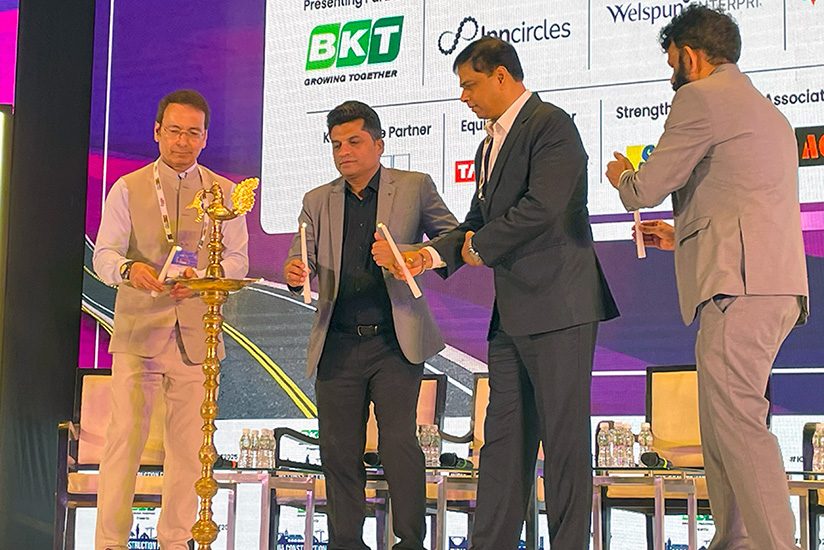

The 15th annual Roads & Highways Sustainable Technologies & Advancement Expo opened in Mumbai, India, earlier this month, with organizers noting that they are more than concrete and asphalt—and framing the stakes for India’s own massive build-out with a quote attributed to President John F. Kennedy: “American roads are not good because America is rich, but America is rich because American roads are good.”
The conference and exhibit, which drew about 10,000 financiers, contractors, government officials and others, was produced by Pratap Padode, founder of the FIRST Construction Council and editor-in-chief of India-based trade publication Construction World.
The council has emerged as a key industry think tank, convening leaders to debate policy, technology and sustainability as India accelerates toward an estimated $1.4 trillion in infrastructure investment by 2040, a figure first noted by the Ministry of Finance in its 2019 National Infrastructure Pipeline report.
Financing the Buildout
Much of the two-day conference centered on how to fund India’s growth while mitigating investor risk. “The money is available, but risk mitigation remains a stumbling block,” said Phani Prasad Mandalaparthy, associate director for transport, mobility, and logistics at Crisil Intelligence. While ESG-linked funds and green bonds are drawing interest, deal closings continue to lag, he noted.
Ajay Saxena, sector head for infrastructure development at the Maharashtra Institution for Transformation, outlined approaches to draw in more capital with higher risk tolerance, including joint ventures with American and Japanese partners. He added that “clearing the red tape” and regulatory reform under Prime Minister Narendra Modi’s government could itself be seen as a risk-mitigating factor.
Other participants pointed to the need for predictable deal structures, realistic bidding practices and clearly drafted exit and arbitration provisions. Corporate governance must improve within Indian contracting and supplier firms as well as in government, Vishal Biraia, fund manager at Bandhan Infrastructure Fund, cautioned. “All stakeholders need protection; otherwise, it is a constraint on capital flow,” he said.
Abhishek Chhajer, chief financial officer of Highways Infrastructure Trust, emphasized the importance of channeling 90% of capital into projects themselves, while also cutting the current 8- to 10-month average lag time for government approvals.
He cited global infrastructure capital outlets, including KKR, Blackstone and sovereign wealth funds, as ready participants in India’s growth if such benchmarks are met.
Participants in the 15th annual RAHSTA Expo in Mumbai explored displays from global equipment makers and toured dozens of pavilions showcasing materials, technology and services for India’s expanding road and highway sector. Images: Bryan Gottlieb/ENR
The potential payoff, speakers noted, can be substantial. A World Bank review of India’s Golden Quadrilateral highway network found nearby manufacturing firms saw real income growth of more than 2.7%, with the initial investment recouped in under two years. KPMG’s “AI-powered Road Infrastructure Transformation – Roads 2047” report further estimates that predictive maintenance enabled by artificial intelligence could reduce lifecycle costs of roads by up to 30%, a potential game-changer for investors seeking reliable returns.
Such evidence has heightened foreign investor interest in road and logistics projects, even as they remain wary of execution risks.
Digital Tools and Smart Technologies
India’s PM Gati Shakti National Master Plan, launched in 2021, is already moving in that direction. The platform consolidates more than 550 GIS-based data layers, bringing together 16 central ministries and 36 states and union territories to coordinate infrastructure planning and implementation.
These layers include economic, geographic, environmental and logistics nodes, which help optimize highway alignments and Detailed Project Report (DPR) preparation by identifying “Go/No-Go” zones and reducing clearance delays, according to government documents.
By integrating decision-support tools such as proximity analyses and environmental overlays, the master plan is designed to streamline project approvals and cut costly rework.
Building on these findings, Aris Mukherjee, co-founder of RTDT Laboratories AG, demonstrated how autonomous vehicles can already be deployed to assess pavement conditions in real time.
Panelists said that using drones, LiDAR and digital mapping to generate 3D as-builts is becoming standard practice, especially as contractors are required to link their data with the master plan for multimodal logistics planning.
Greener Highways and EV-Ready Corridors
Discussing greening and future-proofing of India’s roads session, Brig. Gen. Gurjeet Singh Kambo, head of special initiatives for Larsen & Toubro’s transportation infrastructure unit and a veteran of major tunneling and road projects in India’s Himalayan region, outlined how recycled materials, green certifications and EV-ready corridors are being integrated into next-generation highway design. The firm ranks at No. 17 in ENR’s Top 250 Global Contractors list for 2025.
Sessions examined the integration of plastic, fly ash and other recycled materials in pavements, climate-resilient design practices and certification programs such as GRIHA and CII-GreenPro.
Speakers also looked ahead to EV-ready corridors, with planning for charging infrastructure and grid integration already underway.
Case studies presented at the conference showed how circular economy principles, emissions-cutting smart construction practices and real-time monitoring can shorten timelines and reduce environmental impact.
Road Ahead: Why It Matters
The conference occurred just days after the U.S. imposed new tariffs on Indian steel, aluminum and manufactured goods, raising concerns over higher input costs for road and bridge projects. In response, Indian leaders pointed to the country’s widening outreach to alternative trade blocs and capital sources.
At the September BRICS summit in Kazan, Russia, Modi met with Chinese President Xi Jinping and other leaders to emphasize infrastructure finance, green energy and logistics corridors as areas of cooperation.
India has also accelerated bilateral talks with Japan and Gulf sovereign wealth funds, while development banks such as the Asian Infrastructure Investment Bank and the New Development Bank are expanding their lending to Indian transport projects.
The moves signal India’s intent to hedge against tariff-driven volatility by securing foreign capital and technology through diversified channels.
For contractors, suppliers and financiers both domestic and foreign, the message was clear: India’s infrastructure buildout is accelerating, backed by the National Infrastructure Pipeline’s $1.4 trillion commitments and World Bank estimates of $2.4 trillion needed in climate-resilient urban infrastructure by 2050.
KPMG tied these trends directly to technology adoption, arguing that intelligent planning, material optimization and predictive maintenance will be critical to keeping the spending sustainable and aligned with India’s net-zero by 2070 target announced at COP26 in Glasgow in 2021.
With highways, data centers, energy facilities, fiber and warehouses identified as near-term growth areas—followed by airports and ports—the conference stressed that those delivering predictable returns, deploying digital tech and meeting sustainability expectations will best capitalize on opportunities in one of the world’s fastest-growing construction markets.






